(916) 308-3856



📌Key Takeaways
Cheap, quick oil changes prevent expensive pump failures and protect your profit margins.
-
Oil Is Your Pump's Lifeline: Clean oil controls heat and friction—skip changes, and seals fail, pressure drops, and callbacks follow.
-
Follow a Run-Hours Schedule: Change oil after 50 hours on new pumps, then every 300 hours—calendars lie, but run-hours don't.
-
Watch for Warning Signs: Dark, milky, or shimmery oil means trouble—stop and investigate before small problems become big repairs.
-
Balance Your System: Using too few or too many nozzles forces pumps to overwork, creating heat that shortens equipment life.
-
Track Everything Simply: A basic log—paper or spreadsheet—prevents surprises and keeps your warranty valid.
A $40 oil change beats a $400+ pump replacement every time.
Misting system contractors and technicians will find actionable maintenance schedules here, preparing them for the detailed service intervals that follow.
~ ~ ~ ~ ~ ~ ~ ~ ~ ~ ~ ~ ~ ~ ~ ~ ~ ~ ~ ~ ~ ~ ~ ~ ~ ~ ~ ~ ~ ~ ~ ~ ~ ~ ~ ~ ~ ~ ~ ~ ~ ~ ~ ~ ~ ~ ~ ~ ~ ~ ~ ~ ~ ~
The "Change Oil" lamp is blinking. The pump is running louder than it should. And your crew is already on the way to a job site that was supposed to be a clean install—not a callback.
You know this feeling. You installed a system months ago, the client was thrilled, and now you're facing an unplanned service visit because the pump seized up. No one tracked the run-hours. No one changed the oil. And now you're eating the labor cost and explaining why a system that should have lasted years failed in its first season.
A 1000 PSI misting pump is not a passive appliance—it's an engine. Just like your work truck, it has pistons, bearings, and seals that depend on clean oil to manage friction and heat. Skip the oil changes, and you get the same result: predictable failure, preventable callbacks, and margin you'll never recover.
Pump Longevity Starts With the Oil (Not Luck)
Pump longevity means fewer swaps, fewer emergencies, and predictable performance across multiple seasons. You install it, you maintain it on schedule, and it keeps running. That's the goal.
The three-piston pump design inside most 1000 PSI units generates significant heat and friction under normal operation. Clean oil protects the internal components—the bearings, the seals, the piston assembly—by reducing metal-to-metal contact and dissipating heat. When that oil breaks down or becomes contaminated, the protection disappears.
The oil in your pump performs three margin-critical jobs. It lubricates moving surfaces so friction doesn't spike temperatures. It transfers heat away from load-bearing components. And it keeps abrasive particles and moisture from accelerating wear. When any of these functions degrades, failure follows.
You wouldn't run your service truck 300 hours without an oil change. The pump deserves the same respect.
The Failure Chain: Dirty Oil → Heat → Seal Wear → Pressure Problems → Callback
Here's what actually happens when oil changes get skipped:
Stage 1: Contamination accumulates. Moisture, particulates, and oxidation byproducts build up in the crankcase. Every run-hour adds thermal stress, and every unsealed bottle or humid environment increases contamination risk. Industry resources from Machinery Lubrication and OilSafe consistently emphasize that particle and moisture contamination accelerate wear and shorten equipment life across all industrial applications.
Stage 2: Heat rises. Dirty oil loses its ability to transfer heat away from moving parts. The pump starts running hotter than designed. You might hear it—louder operation is often the first audible warning.
Stage 3: Seals degrade. Excess heat accelerates seal wear. Oil seals and water seals begin to fail ahead of schedule. Leaks appear. Pressure drops.
Stage 4: Pressure problems surface. The system can no longer maintain consistent 1000 PSI output. Nozzles underperform. Mist quality suffers.
Stage 5: The callback. Your phone rings. The client is unhappy. You're dispatching a crew for work you won't bill.
This sequence is entirely preventable. The intervention point is the oil change.
When troubleshooting, do not mask the problem by simply cranking up the unloader valve. Correct performance depends on nozzle size, nozzle quantity, and proper pump sizing—not pressure tweaking. If you're balancing output across a zone, start with nozzle fundamentals: balancing your pump and nozzles and choosing the proper nozzle size.
A Simple Oil-Change Schedule for 1000 PSI Misting Pumps (Run-Hours Based)
Read the owner's manual for specific adding-oil procedures and safety precautions before servicing your pump. Different pumps and duty cycles can have different requirements—use the manual as your source of truth. The following intervals are based on manufacturer guidelines:

Break-In Oil Change (New Pump): After approximately 50 run-hours (though some specific compact models suggest as early as 20), change the pump oil. This removes any metal particles from the initial break-in period and establishes a clean baseline.
Recurring Maintenance Interval:Change pump oil every 300 run-hours. Many pumps include a built-in oil change reminder lamp that illuminates at this interval—reset it after each service. Treat 300 hours as a category-level benchmark, but verify your specific pump's interval in the manual.
Longer-Term Service Checkpoints:
-
At 1,500 run-hours: Change the water filter, check the pressure valve, inspect electrical terminals, verify bolt tightness, and replace the water seal and O-ring.
-
At 2,000 run-hours: Change the oil seal and inspect the bearings for wear. Replace bearings if necessary.
Quick Inspection Checklist (at each oil change):
-
Check oil level before draining
-
Note oil color and consistency (dark or milky oil indicates contamination)
-
Look for leaks around seals and fittings
-
Record run-hours in your maintenance log
-
Verify pump is operating at the correct baseline pressure (typically 70 bar for a 1000 PSI system)
What to Look for Before You Change Pump Oil
Before you drain and refill, take 60 seconds to inspect:

Oil Level: If it's low between changes, you may have a slow leak. Find it before it becomes a fast one.
Oil Color: Clean oil is typically clear or light amber. Dark oil indicates oxidation and heat stress. Milky or cloudy oil signals moisture contamination—a serious problem that demands immediate attention. As Micro-Lube notes, moisture in lubricants accelerates corrosion and wear mechanisms. If you see metallic shimmer in the oil, stop and escalate to a diagnostic workflow—that's a red flag indicating internal component wear.
Visible Leaks: Check around the oil drain plug, fill port, and seals. Any wetness or residue is worth documenting.
Unusual Noise or Vibration: If the pump sounds different—louder, rougher, or inconsistent—note it in your log. These are early warning signs.
Record what you see. A maintenance log that tracks observations over time helps you spot trends before they become failures.
The Oil Change Calendar + Pump-Life ROI Calculator
Use this table to track your maintenance and calculate the ROI of prevention:
|
Field |
Your Entry |
|---|---|
|
Pump Model |
_______________ |
|
Install Date |
_______________ |
|
Current Run-Hours |
_______________ |
|
Next Oil Change Due (Run-Hours) |
_______________ |
|
Last Oil Change Date |
_______________ |
|
Oil Change Completed By |
_______________ |
|
Parts Cost (Oil + Seals) |
$_______________ |
|
Labor Time (Minutes) |
_______________ |
|
Estimated Cost if Pump Fails |
$_______________ |
|
Estimated Callback Labor Cost |
$_______________ |
|
Maintenance ROI Note |
_______________ |
Sample ROI calculation: If an oil change costs $15 in materials and 20 minutes of labor (roughly $25 at typical crew rates), your total preventive cost is about $40. A pump replacement runs $400 or more, plus installation time. A callback visit—even if you don't replace anything—can easily cost $150–$200 in unbilled labor and travel.
The math is simple: $40 in prevention versus $400+ in failure. Oil changes are the cheapest form of pump-life insurance you can buy.
Print this table or keep it in a shared spreadsheet. Assign one crew member to update it weekly.
ROI: Why a 20-Minute Oil Change Beats Replacing a Pump
Scheduled oil changes cost predictable labor and consumables. Failures cost urgent troubleshooting, travel time, reschedules, replacement parts, and client dissatisfaction—which you'll pay for later in lost referrals.
Beyond the direct cost savings, consider the indirect value:
Reputation protection. Clients remember callbacks. They remember systems that failed. They also remember contractors who delivered reliable performance. Your maintenance discipline directly affects referrals and repeat business.
Warranty compliance. Smart Mist USA's warranty assumes oil changes are performed per the manual guidelines. Seals must also be replaced on the recommended timeline. Neglecting these intervals can void your coverage. See the full warranty maintenance requirements for details.
Predictable scheduling. When you track run-hours, you know when service is due. No surprises, no emergency parts orders, no scrambling.
If you're evaluating whether higher-quality equipment is worth the investment, frame the decision around total lifecycle cost—planned maintenance plus risk of failures—rather than purchase price alone. Review your options in high pressure misting pumps and explore high-pressure mist pump fundamentals and durability evaluation beyond price for deeper contractor-focused context.
Build the Habit: The Maintenance Log That Prevents Surprises
You don't need sophisticated software. You need a system your crew will actually use.
Option 1: Paper log at the job site. Leave a laminated maintenance card with each pump installation. Instruct the client (or your service tech) to record run-hours weekly.
Option 2:Shared spreadsheet. Maintain a master list of all installed pumps with columns for model, install date, last service, and next service due. Review it monthly.
Option 3: Delegate with accountability. Assign one team member to own the maintenance schedule. Their job is to flag pumps approaching service intervals before problems occur.
The specific method matters less than the consistency. Pick one and stick with it. Your goal is converting maintenance into a routine, not a hero moment.
Protect Your Warranty—Protect Your Pump
Your maintenance routine directly impacts warranty coverage. Keep these points in mind:
Covered: Manufacturer defects when maintenance has been performed per manual guidelines.
Not Covered:
-
Neglect, including failure to change oil and/or water/oil seals at recommended intervals
-
Hard freeze damage
-
Using the pump for anything other than pumping water (insecticide, chemicals)
-
Hard water or poor water quality damage—install a phosphate filter for hard water areas
-
Leaving the pump in direct sun or rain
-
Damage from failing to bring the pump inside at end of season
For calcium buildup issues in your maintenance workflow, a prolonged soak in a 1:1 solution of white vinegar and water is widely considered the safest, industry-standard approach to protect delicate O-rings, though commercial cleaners like CLR can be used cautiously for severe scale if thoroughly flushed.
Enclosures and covers can help protect pumps from sun and rain exposure during the season. See available pump enclosures and covers for additional protection.
Beyond Oil: System Balance Extends Pump Life
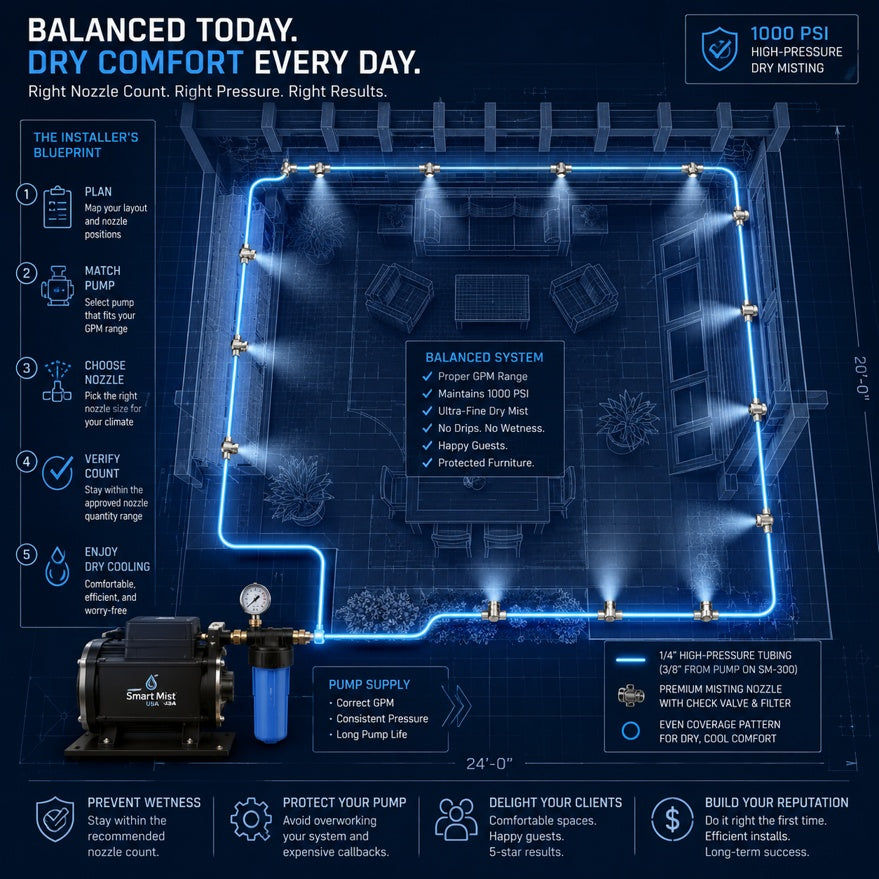
Oil changes address lubrication, but pump longevity also depends on proper system balance. When balancing your pump and nozzles, you reduce heat buildup and premature wear.
Using too few nozzles forces the pump to work harder, generating excess heat and noise. Using too many nozzles exceeds pump capacity and drops system pressure. Either scenario accelerates wear.
Consult the Nozzle Size & Quantity Chart before modifying any installation. Stay within the recommended range for your pump model. This isn't about "optimizing"—it's about keeping the pump happy so it keeps you profitable.
Common Maintenance Diagnostics
How often should you change oil in a misting pump?
Use your pump's owner's manual as the source of truth. Most schedules call for an initial break-in change after approximately 50 hours on a new pump (though some models suggest 20), followed by every 300 run-hours during ongoing operation. Run-hours are the most reliable trigger because calendars lie—duty cycles vary.
What happens if you don't change pump oil?
Contaminated oil loses its protective properties. Friction and heat increase, seals wear prematurely, and the pump fails earlier than it should—often leading to mid-season callbacks, unplanned downtime, and the reputation cost that follows.
What are signs pump oil needs to be changed?
Dark or discolored oil, milky or cloudy appearance (moisture contamination), low oil level between changes, abnormal heat, or louder-than-normal pump operation. If you see metallic shimmer, stop and escalate diagnostics immediately.
How do I track run-hours for maintenance?
Many pumps include a built-in run-hour counter and oil change reminder lamp. If yours doesn't, track usage manually by recording estimated daily operation hours and tallying weekly. The key is a consistent routine your crew will follow, not a complex system nobody updates.
When to Escalate: Oil, Seals, or Something Else?
Not every problem is solved by an oil change. Escalate to a repair workflow when you encounter:
-
Recurring low pressure that persists after oil changes and filter cleaning
-
Persistent leaks that return after seal replacement
-
Repeated shutdowns or electrical faults
-
Unusual bearing noise that doesn't resolve with oil service
-
Contamination indicators that return quickly (especially milky oil)
These symptoms may indicate internal component failure requiring professional diagnosis. Request a repair through the support workflow rather than guessing at parts replacements.
For complex cases or sizing questions, contact support directly.
From Reactive to Predictable
The difference between contractors who deal with callbacks and contractors who don't often comes down to one thing: a maintenance routine. Oil changes are the foundation of that routine—cheap, fast, and effective.
Track run-hours. Change the oil. Log the service. Do it consistently, and your pumps will run reliably season after season. Your clients will remember that reliability. Your margin will reflect it.
Print the calendar. Assign the responsibility. Start tracking today.
For more guidance on system design and maintenance, explore our Installation Guides or browse the full Knowledge Center.
Disclaimer: Maintenance intervals provided here are general guidelines based on typical manufacturer recommendations. Always consult your specific pump's owner's manual for exact service intervals and procedures. Performance may vary based on operating conditions, water quality, and usage patterns.
Our Editorial Process:
Our expert team uses AI tools to help organize and structure our initial drafts. Every piece is then extensively rewritten, fact-checked, and enriched with first-hand insights and experiences by expert humans on our Insights Team to ensure accuracy and clarity.
About the Smart Mist USA Insights Team:
The Smart Mist USA Insights Team turns real-world installation and maintenance questions into practical, technician-friendly guidance. We collaborate with support and product documentation to help you prevent failures, reduce callbacks, and keep systems operating reliably season after season.