(916) 308-3856


📌Key Takeaways
-
Nozzle size is not one-size-fits-all — the right choice depends on your climate, temperature, and patio height.
-
Four standard sizes cover every climate: 0.10mm (very humid), 0.15mm (moderate), 0.20mm (dry), 0.30mm (extremely dry).
-
Pressure Makes It Work: 1000+ PSI is the threshold for proper atomization across all nozzle sizes — without it, even the right nozzle will drip.
-
Match the Whole System: Nozzle size and quantity must stay within your pump's operating range to maintain pressure.
-
Hard Water Clogs Precision Nozzles: Dissolved minerals build up over time — phosphate filters protect nozzles and pump components before scale forms.
-
Four Variables Cause Wet Installs: High humidity, low mounting height, oversized nozzles, or pump-nozzle mismatch — fix the setup, not the symptoms.
Get the selection right up front, and you'll enjoy cool, dry outdoor comfort all summer.
~ ~ ~ ~ ~ ~ ~ ~ ~ ~ ~ ~ ~ ~ ~ ~ ~ ~
You invested in a high-pressure misting system to cool your outdoor space — not to soak your furniture. But if you've ever watched a misting system drip onto the patio below or felt that clammy dampness in the air instead of refreshing cool, the culprit is almost always the same: the wrong nozzle size for the conditions.
Here's the good news: nozzle selection isn't complicated once you understand the three variables that drive the decision — humidity, temperature, and patio height. Get those right, match the nozzle to your pump, and your system will deliver exactly what it promises: cool, dry air without dripping.
Think of a misting system like a camera. The pump is the light source, the tubing is the lens barrel, and the nozzle orifice is the aperture. A poorly chosen aperture produces a blurry image. A poorly matched nozzle produces wet furniture and wastes money. The orifice size — and how it interacts with pressure, humidity, and mounting height — determines whether water atomizes into a cooling mist or falls as unwanted drizzle.
This guide walks through all four standard nozzle sizes, the conditions each one is designed for, and the system-level variables that determine whether your setup delivers dry comfort or a wet mess.
What the Orifice Size Actually Does
The orifice is the tiny opening at the tip of each nozzle where pressurized water exits the system. Its diameter — measured in fractions of a millimeter — directly controls how small the water droplets become when they leave the nozzle.
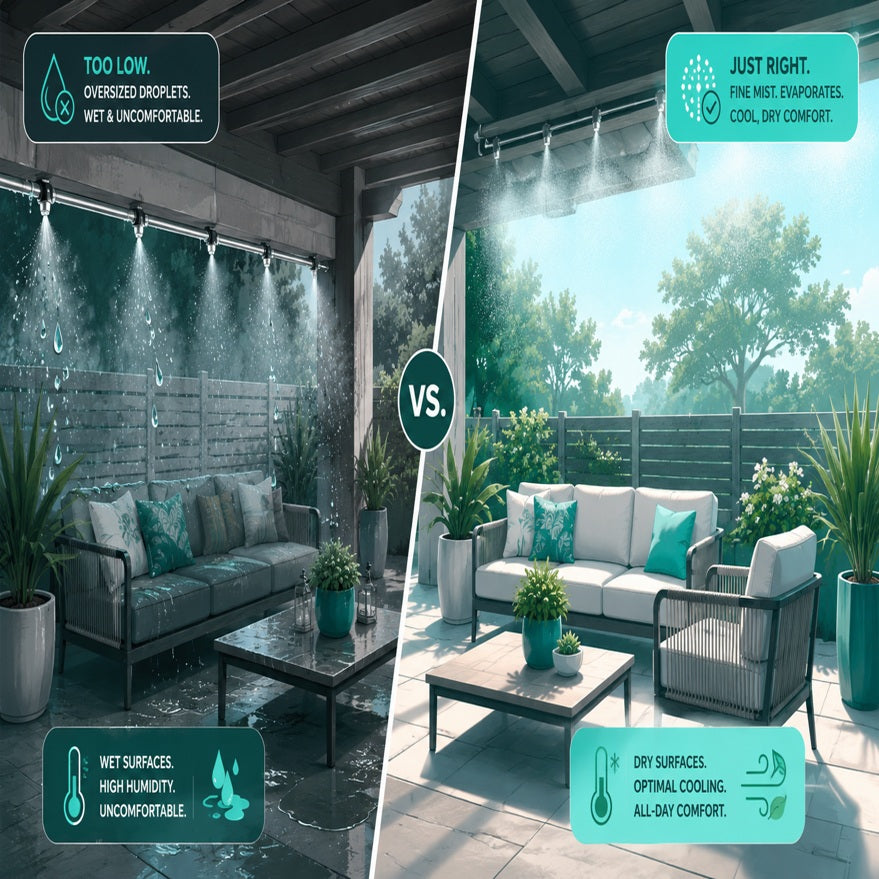
Smaller droplets have more surface area relative to their volume. More surface area means faster heat absorption from the surrounding air — and faster evaporation. This is the evaporative cooling effect: the mist doesn't cool by wetting surfaces. It cools by disappearing into the air and taking heat energy with it.
The orifice size acts as the control valve for this process. Too large an opening produces bigger droplets that fall before evaporating. Too small, and you sacrifice output volume. The right size depends on your specific conditions — which is why Smart Mist USA offers four options rather than one.
Why 1000 PSI Is the Threshold — For Every Nozzle Size
Pressure is what forces water through the nozzle orifice fast enough to shatter into micro-droplets. Without adequate pressure, even the best-matched nozzle produces droplets too large for efficient evaporation.
Low-pressure systems produce larger droplets that will cause wetting rather than cooling. Mid-pressure systems (200–300 PSI) offer better evaporative cooling than low-pressure systems but still may cause wetting. Neither does the flash evaporation that high-pressure systems achieve.
High-pressure systems operating at 1000+ PSI atomize water into particles measured in microns — small enough to evaporate in seconds under most outdoor conditions. Smart Mist USA's SM-100 through SM-300 pump line operates at 70 bar (1000 PSI). At this pressure, the droplets produced by any of the four nozzle sizes evaporate effectively when the nozzle is properly matched to the climate.
A high-pressure system can cool surrounding areas by up to 25 degrees depending on temperature and humidity conditions. Drier climates experience more evaporation and therefore more cooling, though high-pressure systems deliver noticeable results across a range of conditions.

The Four Nozzle Sizes and When to Use Each
Choosing the right nozzle comes down to three factors: temperature, humidity, and patio height. The following guide covers each size and the conditions it was designed for.
0.10mm (.004") — High Humidity Climates
The 0.10mm nozzle creates the finest mist available, which evaporates quickly even in humid air that is already close to saturation. This makes it the right choice for climates where the air needs a little help absorbing moisture.
Best for:Very humid climates with relative humidity over 60% and patio heights around 8 feet — for example, Florida and similar Gulf Coast conditions.
Important note:The finer orifice is more sensitive to water quality. Upgrading to a higher-grade filter is recommended for optimal performance and to prevent mineral buildup from narrowing the opening over time.
0.15mm (.006") — Moderate Climates
The .15mm nozzle works well in a moderate range of conditions — neither extremely humid nor extremely dry. It provides good atomization without the maintenance sensitivity of the smaller .10mm size.
Best for:Relatively dry climates with low patio heights around 7–8 feet and temperatures in the low 100s (such as coastal California), or moderately humid climates with temperatures in the low-to-mid 100s and patio heights of 8–9 feet (such as parts of Texas).
0.20mm (.008") — Dry Climates
In genuinely dry conditions, the air is hungry for moisture. A 0.20mm nozzle delivers more cooling output volume — the slightly larger droplets still evaporate quickly because the air can absorb them readily. This size is a popular choice in hot, arid regions.
Best for:Very dry climates with temperatures in the low-to-high 100s and patio heights around 8–9 feet (such as Arizona, Nevada, and inland California). One Arizona customer who swapped from 0.15mm to 0.20mm described the difference as dramatic — the drier air simply absorbed the larger droplets without any wetting.
Important note:Using 0.20mm in a humid climate invites trouble. The larger droplets need more time to evaporate, and if the air can't absorb them before they fall, you'll end up with a wet patio regardless of pressure.
0.30mm (0.012") — Extreme Desert Conditions
The 0.30mm nozzle is designed for the hottest, driest conditions where maximum output is needed and the bone-dry air ensures even larger droplets evaporate before landing.
Best for:Extremely dry climates with temperatures in the high 100s and patio heights around 9–10 feet — think desert Arizona in peak summer.
Important note:This is a climate-specific choice. Outside of genuinely extreme dry heat, a 0.30mm nozzle in a more moderate climate will produce a wet patio, not a cool one.
Quick Reference: Nozzle Size by Climate
-
0.10mm (.004"):Humidity over 60% | Patio ~8 ft | Temps below 90°F | Example: Florida, Gulf Coast
-
0.15mm (0.006"):Moderate humidity | Patio 7–9 ft | Temps in low 100s | Example: California, parts of Texas
-
0.20mm (0.008"):Humidity below 40% | Patio 8–9 ft | Temps in the 100s | Example: Arizona, Nevada, New Mexico
-
0.30mm (0.012"):Extremely dry | Patio 9–10 ft | Temps in high 100s | Example: Desert Arizona in peak summer
The Four Reasons a Misting System Gets Things Wet
When a misting system soaks instead of cools, the cause almost always traces back to one of four variables. Understanding these failure modes helps you avoid them in the first place.
-
Humidity too high or temperature too low for efficient evaporation.Evaporative cooling depends on the air's capacity to absorb moisture. On a cool, humid day, even fine mist may not evaporate before landing. This isn't a system failure — it's physics. The solution is matching your nozzle size to your actual climate conditions (smaller orifice for humid conditions), and using the interval spraying feature on app-controlled pumps to reduce continuous output when conditions are less favorable.
-
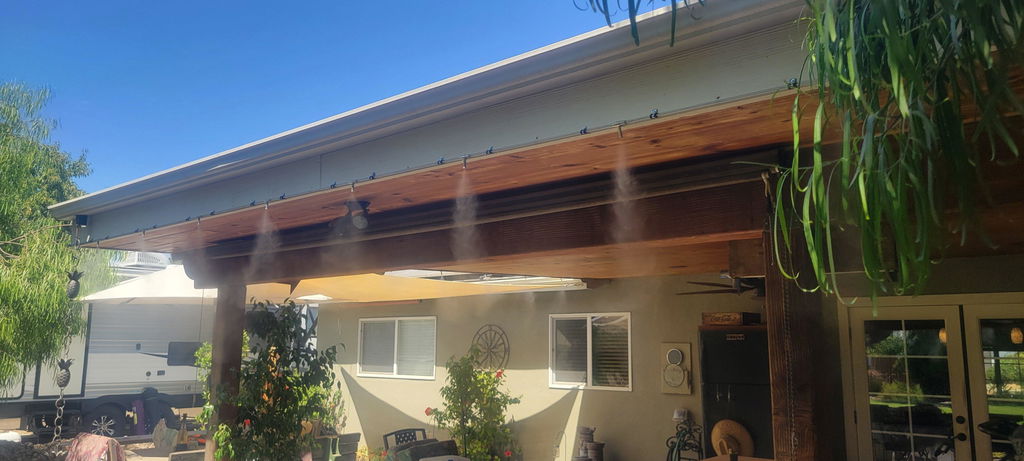
Nozzles mounted too low.Droplets need travel distance to fully evaporate. Mounting nozzles at around 10 feet gives them adequate fall distance for flash evaporation. Mount them significantly lower and even fine mist may land before disappearing. This is one of the most common setup mistakes, and it's entirely preventable with a little planning before you run the tubing.
-
Nozzle orifice too large for the conditions.A 0.20mm or 0.30mm nozzle in a humid climate produces droplets that the air can't absorb fast enough. The fix is straightforward: match the nozzle size to your local humidity and temperature using the guide above. When in doubt in a moderate or humid climate, go smaller rather than larger.
-
Too many nozzles, or nozzle size too large, for the pump — resulting in low pressure.When nozzle demand exceeds pump capacity, system pressure drops below the threshold for proper atomization. Instead of 1000 PSI mist, you get lower-pressure spray. The droplets come out larger, evaporate slower, and land on everything. The fix is consulting the nozzle chart and ensuring your pump is correctly matched to your nozzle size and quantity.

For a deeper dive into diagnosing and fixing wetness issues, explore the guide on wet patio syndrome and how to fix dripping nozzles.
Spacing, Count, and Pump Balance: The Rest of the Equation
Even the perfectly chosen nozzle size fails if the rest of the system isn't balanced. Three additional variables matter.
Spacing matters.Smart Mist USA recommends at least 18 inches between nozzles, with 24–30 inches being a common working range for most patio configurations. Any closer, and the spray patterns overlap, causing droplets to combine into larger particles that fall rather than evaporate.
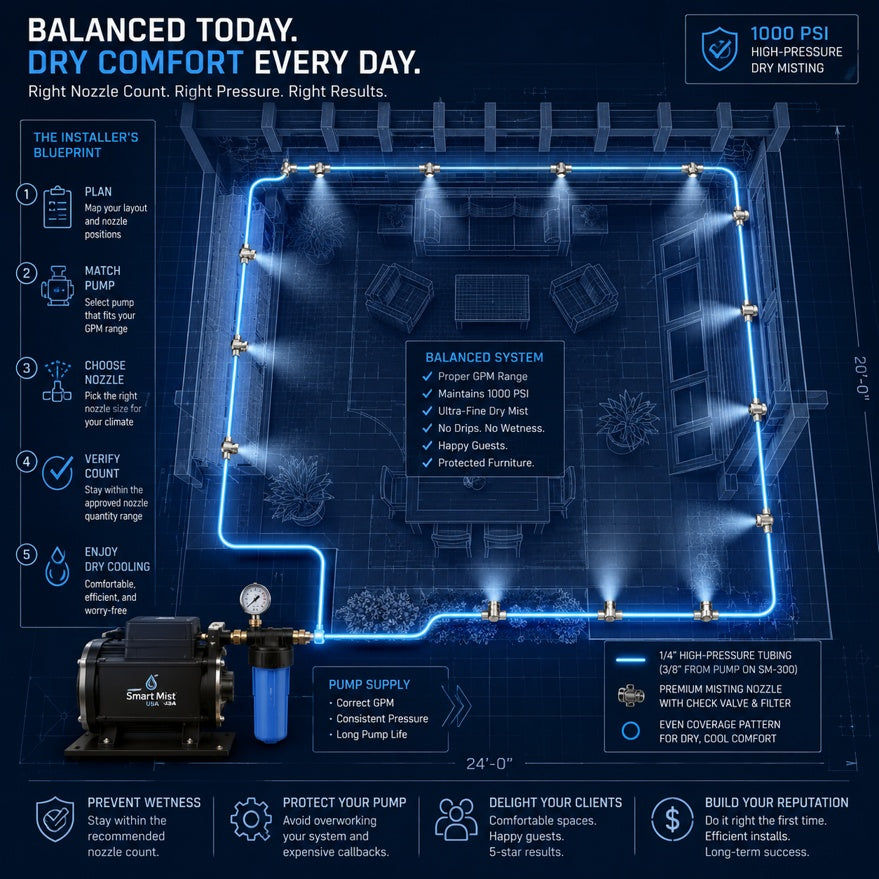
Nozzle count matters.The relationship between pump capacity and nozzle quantity is critical. Use too few nozzles and the pump works against excessive backpressure, running hot and wearing out faster. Use too many and system pressure drops below the threshold for effective atomization. For 0.15mm nozzles on 60Hz systems, the working ranges are 8–28 nozzles on the SM-100, 12–40 on the SM-150, and 22–60 on the SM-200. Consult the nozzle chart before finalizing your layout.
Pump sizing determines capacity.Flow rate is determined by nozzle size and quantity — there are no user-adjustable settings on the pumps to change flow after installation. Two parameters determine pump size: nozzle size and nozzle quantity. If you need to add more nozzles or cover a larger area, the answer is a larger pump. Similarly, two parameters guide nozzle size selection: climate (humidity) and mounting height. Get these right during initial setup and the system performs as designed.
For the next step in that conversation, explore the guide on balancing your pump and nozzles.
Hard Water Can Ruin Good Nozzle Science
You can choose exactly the right nozzle size, dial in the spacing, and match the pump perfectly — and still face performance problems if water quality undermines the system over time.
Hard water, driven by dissolved calcium and magnesium, creates scale buildup that gradually clogs nozzle orifices and damages pump valves and other components. Precision orifices — especially the smaller 0.10mm and 0.15mm sizes — don't tolerate much buildup before the spray pattern distorts and droplet size increases. Once that happens, evaporation efficiency drops and the wetting complaints follow.
Smart Mist USA includes a stainless-steel mesh sediment filter with each high-pressure system. These protect against particles like dirt and sand, but dissolved minerals like calcium flow right through.
Scalex filters treat the water to prevent scale formation in nozzles and pump components — a reliability requirement in calcium-heavy regions, not an optional upgrade.
For maintenance on existing calcium deposits, use CLR or a similar commercial calcium remover. For clogged nozzles, cleaning with CLR or replacement are both effective options.
For more on protecting your system from water quality issues, see the guide on hard water management for high-pressure misting.
Frequently Asked Questions
Is there one nozzle size that works everywhere?
No. Nozzle size is a climate-specific choice. What works perfectly in desert Arizona (0.20mm or 0.30mm) will create a wet mess in Florida. What keeps Florida dry (0.10mm) won't deliver enough cooling output in Las Vegas. The right size is always the one matched to your humidity, temperature, and patio height.
Why can a 1000 PSI system still get surfaces wet?
Because pressure alone doesn't finish the job. Wetness can still come from humidity that's too high for efficient evaporation, mounting that's too low, a nozzle that's too large for the climate, or a pump-nozzle combination that drops working pressure under demand. High pressure is necessary — it's not permission to ignore layout and nozzle selection.
Can I change nozzle size after installation without changing the pump?
Sometimes, within limits. Changing to a smaller nozzle size reduces flow demand on the pump, which can work if you're within the pump's minimum nozzle count range. Moving to a larger nozzle size increases flow demand — if this takes you outside the pump's operating range, pressure will drop and performance will suffer. Always consult the nozzle chart before swapping sizes.
Can you fix wetness by changing pump settings later?
No. The system's flow rate is mechanically fixed by the physical nozzle array installed. There are no variable pressure dials on these pumps to compensate for poor initial nozzle selection. Performance is solved through setup variables: nozzle size, nozzle quantity, climate considerations, mounting height, and pump-size selection. If the design is wrong, the fix is correcting those variables — not adjustments that don't exist. Solve the design upfront.
Getting Nozzle Selection Right the First Time
Dry cooling isn't luck — it's the result of matching the right nozzle to your climate and patio height, then supporting that choice with proper spacing, nozzle count, and a pump that can maintain pressure across your full layout.
The four-nozzle framework is the foundation of that decision: 0.10mm for humid climates, 0.15mm for moderate conditions, 0.20mm for genuinely dry heat, 0.30mm for the extremes of desert summer. Each size exists because no single orifice dimension works everywhere — and using the wrong one guarantees wet patios, not cool ones.
As one customer put it after getting the selection right: "Finally! A misting system that works like a restaurant patio! All components solid, temperature lower and NO moisture on the ground."
That outcome isn't coincidence. It's what happens when the nozzle matches the climate, the pump matches the nozzle count, and the layout gives droplets the space and height to evaporate before they land on anything.
The next step is understanding how nozzle count and pump capacity work together in detail — because even the right orifice fails in an unbalanced system. Use the nozzle chart to match your pump to your project requirements before you buy.
Our expert team uses AI tools to help organize and structure our initial drafts. Every piece is then extensively rewritten, fact-checked, and enriched with first-hand insights and experiences by expert humans on our Insights Team to ensure accuracy and clarity.
About the Smart Mist USA Insights Team
The Smart Mist USA Insights Team is our dedicated engine for synthesizing complex topics into clear, helpful guides. While our content is thoroughly reviewed for clarity and accuracy, it is for informational purposes and should not replace professional advice.