(916) 308-3856



📌Key Takeaways
Wet patios from misting systems trace back to two fixable causes—dripping after shutoff or wetting during operation—each with different solutions.
-
First, Identify the Pattern: A quick 60-second test after shutoff tells you whether water drains from the line or droplets fail to evaporate while running.
-
Anti-Drip Nozzles Stop Post-Shutoff Drips: Spring-loaded valves inside these nozzles seal automatically when the pump stops, preventing trapped water from escaping.
-
Runtime Wetting Has Four Causes: Low mounting height, oversized nozzles, too many nozzles for your pump, or high humidity all create droplets that land before evaporating.
-
Spacing and Height Matter: Nozzles need 24–30 inches apart to avoid droplets merging, and about 10 feet of height so mist evaporates before reaching guests.
-
Interval Spraying Beats Humidity: Cycling the pump on and off—like 3 seconds on, 5 seconds off—lets mist evaporate between bursts in muggy conditions.
Diagnose first, then fix—most wet patio problems take less than an afternoon to solve.
Venue managers, restaurant owners, and homeowners troubleshooting damp patios will find clear diagnostic steps here, preparing them for the detailed fixes that follow.
~ ~ ~ ~ ~ ~ ~ ~ ~ ~ ~ ~ ~ ~ ~ ~ ~ ~ ~ ~ ~ ~ ~ ~ ~ ~ ~ ~ ~ ~ ~ ~ ~ ~ ~ ~ ~ ~ ~ ~ ~ ~ ~ ~ ~ ~ ~ ~ ~ ~ ~ ~ ~ ~
A venue manager points at the puddle forming beneath the misting line and says, "This is why guests won't sit here." That moment—wet chairs, damp floors, a client who trusted you to deliver comfort—is the exact scenario this guide exists to prevent. The good news: dripping and wetting problems trace back to identifiable causes, and most fixes take less than an afternoon.
Misting nozzle problems fall into two distinct categories that require completely different solutions. Knowing which one you're dealing with is the fastest path back to dry, comfortable cooling.
The 60-Second Diagnosis: Is It Dripping After Shutoff or Wetting During Operation?
Stand near your misting line and run this quick test. Turn the system on for a few minutes, then shut it off. Watch what happens over the next sixty seconds.
Pattern 1: Drip after shutoff. The pump stops, and within a minute or two, you see drips forming at certain nozzles—usually at the end of the line or at low points. The system worked fine while running, but now water is escaping. This points to line drain, and the fix involves anti-drip components.
Pattern 2: Wetting during operation. The pump is running, the nozzles are spraying, but mist is landing on surfaces instead of evaporating. Chairs get damp. Floors develop wet spots. Guests feel sprinkled rather than cooled. This points to droplet size, pressure, spacing, or environmental conditions—and the fix depends on which factor is the culprit.
Once you identify which pattern matches your situation, the path forward becomes clear.
Why Nozzles Drip After Shutoff
When a misting pump stops, water remains trapped inside the tubing. Gravity pulls that water toward the lowest points in the system, and it has to go somewhere. The result is line drain—water slowly seeping out through nozzles positioned at the end of runs or at any downward slope in your layout.
This is normal hydraulic behavior, not a defect. But it creates puddles that look unprofessional and leave guests questioning whether the system works correctly.
The Fix: Anti-Drip Nozzles and Valves
Anti-drip nozzles contain a small spring-loaded valve inside. While the pump runs and pressure builds, the spring compresses and allows water to flow through the orifice. When the pump shuts off and pressure drops, the spring pushes the valve closed, sealing the nozzle before trapped water can escape.
This mechanism functions like a check valve that prevents reverse flow, stopping line drain at the source.
Where to start: To fully eliminate line drain, you should generally upgrade the entire line to anti-drip nozzles, or install an automated drain valve at the absolute lowest point of the system. If you only cap the end-of-line or low-point nozzles with anti-drip models, the trapped water column will simply seek the next path of least resistance, forcing standard nozzles further up the line to drip instead. A fully integrated anti-drip setup ensures uniform shutoff. Premium anti-drip nozzles with built-in filters handle both the drip problem and help protect against clogs in a single component. For a full selection of replacement options, browse the nozzles collection.
Why Patios Get Wet During Operation
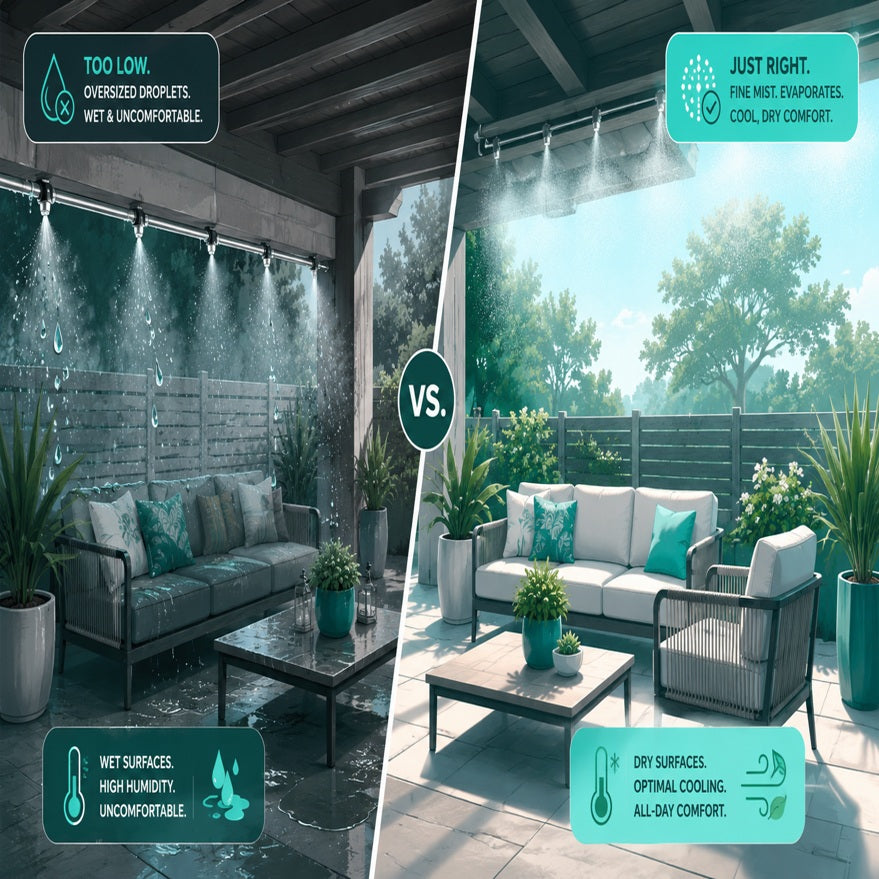
Runtime wetting—surfaces getting damp while the system runs—stems from droplets that fail to evaporate before they land. Four specific factors drive this problem:
-
Temperatures too low and/or humidity too high for efficient evaporation
-
Nozzles mounted too low
-
Nozzle size too large, producing droplets that are too big
-
Number or size of nozzles too large for the pump, resulting in low pressure
Understanding which factor applies to your situation guides you toward the right fix.

Pressure and Droplet Size: The Difference Between Mist and Spray
High-pressure misting systems operating at 1000+ PSI produce extremely fine droplets that evaporate rapidly, cooling the surrounding air without wetting surfaces below. This is evaporative cooling in action—the same principle that makes a breeze feel cool on damp skin.
Lower pressure systems create larger droplets. These bigger particles carry more mass, fall faster, and take longer to evaporate. The result looks less like cooling mist and more like a light sprinkler. Mid-pressure systems in the 200-300 PSI range often produce this effect, which is why high-pressure misting system kits engineered for 1000 PSI operation represent the standard for dry cooling in commercial applications.
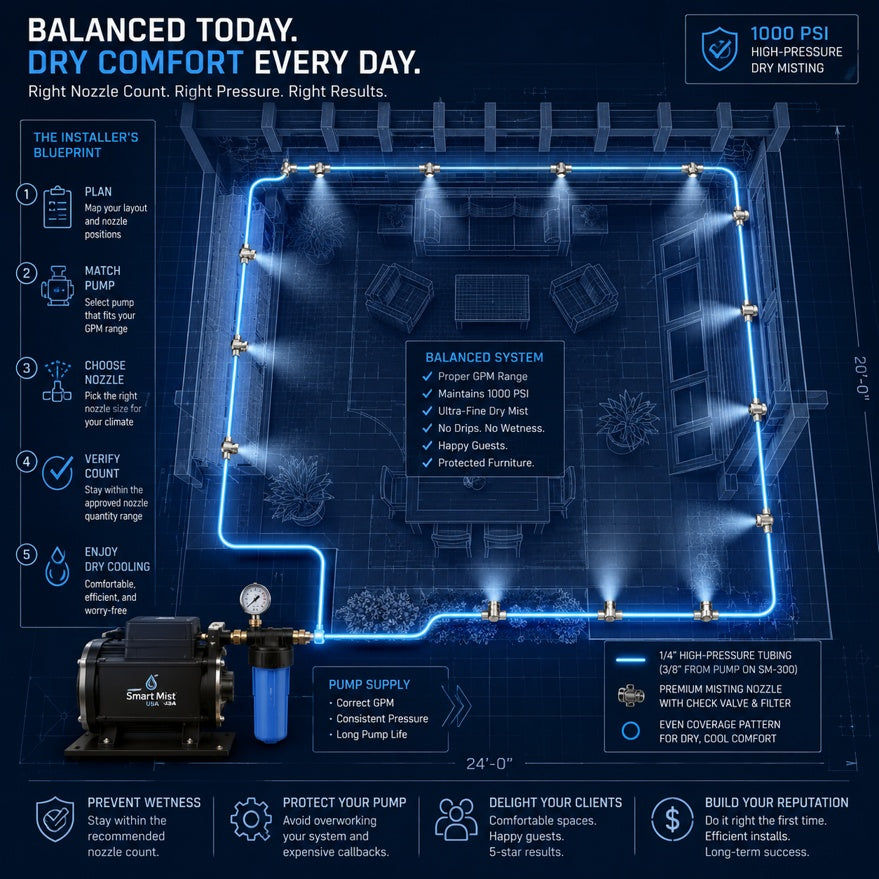
If your system was designed for high pressure but surfaces are getting wet, check whether your pump and nozzle configuration match. Too many nozzles—or nozzles with orifices too large for the pump's capacity—can drop effective operating pressure and push the system into "spray" territory. This pump-to-nozzle mismatch is a common cause of wetting problems because pressure sags when total flow demand exceeds what the pump can deliver. The nozzle size and quantity chart shows the relationship between pump flow rate and nozzle load, and the high-pressure misting pumps collection covers upgrade options if your current pump falls short.
One important note: in a properly designed system, flow rate is determined by nozzle size and quantity combined with pump capacity. There are no user-adjustable settings to "dial down" flow or pressure. Your control comes from correct initial setup and operational techniques like interval spraying—not from ad-hoc adjustments to core hydraulic flow.
Nozzle Size: When Droplets Are Simply Too Big
Even with adequate pressure, selecting nozzles with orifices that are too large for your application produces droplets that won't evaporate quickly enough. Larger orifice nozzles output more water volume per minute, which can overwhelm the evaporation capacity of the surrounding air—especially in conditions that aren't bone-dry.
For humid climates or lower mounting heights, smaller orifice nozzles reduce droplet volume and improve evaporation rates. The nozzle size and quantity chart helps match nozzle selection to your specific climate and mounting conditions.
Even with properly sized nozzles, physical placement dictates evaporation success.
Mounting Height: Giving Droplets Room to Evaporate
Nozzles mounted too low don't give droplets enough air time to evaporate before reaching surfaces. Even a well-built system can feel wet if it's installed too close to seating, floors, or tabletops.
A typical installation mounts tubing at around 10 feet, with nozzles hanging from the bottom edge of a beam and angled to direct mist outward. This height provides sufficient travel distance for droplets to flash into vapor before reaching guest level.
Common layout mistakes that cause wet spots include mounting nozzles directly above seating areas, running lines on walls where mist has nowhere to travel before reaching surfaces, and clustering nozzles at corners where spray patterns stack.
For detailed layout guidance, the installation guides walk through planning and mounting step by step.
Nozzle Spacing: Closer Is Not Better
When nozzles sit too close together, their spray patterns overlap. Droplets from adjacent nozzles collide mid-air and combine into larger droplets—a process called coalescence. These merged droplets are heavier, fall faster, and evaporate slower than the fine particles each nozzle would produce on its own.
The recommended spacing between nozzles is 24 to 30 inches. Anything closer risks coalescence and the wetting problems that follow.
Environment: Humidity and Airflow Can Defeat Evaporation
Evaporation rate depends heavily on the moisture already present in the air. The psychrometric relationship between ambient air temperature and relative humidity dictates the air’s remaining vapor capacity. Drier climates experience faster evaporation and therefore more cooling effect. In humid conditions, the air holds less capacity for additional moisture, so mist travels farther before disappearing.
When humidity climbs, mist trails extend downward and may reach seating level before fully evaporating. This is physics, not a system failure—but it does require adjustment. The good news is that high-pressure misting systems remain effective even in humid climates when properly configured with interval spraying and appropriate nozzle selection.
Interval spraying is the primary operational tool for managing humid conditions. Rather than running continuously, the system cycles on for a few seconds, pauses to let mist evaporate, then cycles again. This keeps air cool without saturating the space. App-controlled pumps let you dial in the exact on/off timing—three seconds on and five seconds off, six seconds on and three seconds off, whatever balance works for the day's conditions.
Beyond interval adjustment, aiming nozzles outward to create a perimeter curtain rather than pointing them directly at guests can improve evaporation distance.
Streaming, Uneven Spray, and Chronic Dripping: When to Replace Nozzles

A healthy nozzle produces a consistent, cone-shaped mist pattern. When that pattern distorts—streaming in a single direction, spraying unevenly, or dripping even under pressure—the orifice has likely worn or become damaged.
The tiny openings in misting nozzles experience significant wear over time. Mineral deposits, particulate matter, and simple erosion from high-pressure water flow gradually degrade the precision-machined edges that create fine mist. Once the orifice shape changes, spray quality suffers.
Nozzles are consumables. Treating them as maintenance items rather than permanent components prevents the frustration of chasing performance problems that trace back to worn parts. When spray patterns degrade, replacement restores proper function faster than attempting to clean or repair damaged orifices. Keeping spare nozzles on hand means quick swaps with minimal downtime. For expectations around consumables and upkeep, see the warranty information.
Hard Water and Filtration: The Silent Cause Behind Clogs and Strange Spray Patterns
Hard water contains dissolved minerals—primarily calcium—that create scale buildup inside pumps, tubing, and nozzle orifices. This buildup restricts flow, distorts spray patterns, and eventually causes complete blockages.
The challenge is that standard sediment filters remove particles like sand and debris but do nothing to address dissolved minerals. Calcium flows freely through mesh filters, accumulating gradually inside the system. By the time symptoms appear—weak spray, inconsistent patterns, nozzles that clog repeatedly—scale has already built up in the pump valves and throughout the line.
Preventing calcium damage requires water treatment rather than just filtration. Phosphate-based treatment systems use slow-dissolving crystals that bind with calcium and prevent it from depositing on surfaces. This is different from sediment filtration and addresses a different problem.
For systems already showing calcium buildup, soaking components in a 50/50 solution of white vinegar and warm water safely dissolves deposits from nozzles and fittings. While industrial scale removers like CLR act faster, white vinegar is overwhelmingly recommended by industry professionals; harsh chemicals can rapidly degrade the delicate rubber O-rings and internal anti-drip springs, leading to permanent nozzle failure. Regular vinegar soaking is the safest, most consistent method for this application. Replacement is equally valid when buildup is severe. The hard water management guide covers prevention and maintenance in detail.
Protecting the pump matters as much as protecting the nozzles. Calcium scale inside pump valves causes performance degradation and can lead to premature failure—damage that falls outside warranty coverage when water quality is the cause.
FAQ: Quick Answers Venue Operators Actually Need
Why do misting nozzles drip after shutoff?
Water trapped in the tubing drains to the lowest points in the system once pump pressure drops. Anti-drip nozzles contain spring-loaded valves that close when pressure falls, preventing this drainage. As established, full-line anti-drip integration or a low-point automated drain valve neutralizes post-shutoff drainage.
Do anti-drip nozzles reduce cooling performance?
No. Anti-drip nozzles function identically to standard nozzles while the system runs. The spring mechanism only activates when pressure drops below operating levels, so cooling output remains unchanged during normal operation.
How far apart should misting nozzles be spaced?
Maintain 24 to 30 inches between nozzles. Closer spacing causes droplets from adjacent nozzles to collide and merge into larger droplets that fall rather than evaporate. The pre-cut stainless steel tubing in most kits sets 24-inch spacing by default.
Why does my patio get wetter on humid days?
High humidity slows evaporation, allowing mist to travel farther before disappearing. Interval spraying—cycling the system on and off rather than running continuously—gives droplets time to evaporate between bursts. Adjusting the on/off ratio through an app-controlled pump lets you match output to conditions.
The Dry Patio Standard: Getting Back to Comfortable Cooling
Wet patios cost venues more than just cleanup time. They cost guest satisfaction, seating capacity, and reputation. If you want to understand why wet systems drive customers away, the flash evaporation explainer breaks down the physics and business impact.
The fix starts with identifying which problem you're solving—shutdown drip or runtime wetting—then working through the diagnostic path that matches.
For shutdown drip, installing a full line of anti-drip nozzles or an automated drain valve eliminates the issue. For runtime wetting, the four-cause checklist guides you: verify temperatures and humidity allow for evaporation, confirm nozzles are mounted at around 10 feet, check that nozzle size is appropriate for your conditions, and ensure pump capacity matches your nozzle count and size.
Browse premium anti-drip nozzles to address drip problems, or review the installation guides for layout and spacing reference. For systems that need humidity-responsive control, app-controlled pumps provide the interval spraying capability that keeps things dry when conditions change.
Questions about your specific system? Contact us for guidance.
Disclaimer: This content is for informational purposes and should not replace professional advice. Always follow manufacturer guidelines and safety data sheets when handling chemical descalers.
Our expert team uses AI tools to help organize and structure our initial drafts. Every piece is then extensively rewritten, fact-checked, and enriched with first-hand insights and experiences by expert humans on our Insights Team to ensure accuracy and clarity.
About the Smart Mist USA Insights Team
The Smart Mist USA Insights Team is our dedicated engine for synthesizing complex topics into clear, helpful guides. While our content is thoroughly reviewed for clarity and accuracy, it is for informational purposes and should not replace professional advice.