(916) 308-3856


📌 Key Takeaways
Matching your nozzle count to your pump's capacity is the single factor that determines whether your misting system delivers dry cooling or wet disappointment.
-
Nozzle Count Is Math, Not a Wish List: Every nozzle draws a specific amount of water—exceed your pump's flow rate and pressure drops, creating wetness instead of cooling.
-
Stay in the Mid-to-Upper Range:Running at the bottom edge wears out your pump faster; pushing the top edge leaves no room for additional nozzles and usually results in lower pressure
-
Choose Nozzle Size Before Counting: Climate, mounting height, and humidity dictate whether you need 0.10mm, 0.15mm, 0.20mm, and 0.30mm nozzles—pick the right size first, then count.
-
You Can't Fix Sizing Mistakes After Install: High-pressure pumps have fixed flow rates, so no dial or app setting compensates for too many nozzles—resize the zone or upgrade the pump.
-
Three Minutes Now Saves Hours Later: A quick pre-install check of nozzle count against pump capacity prevents callbacks, wet guests, and reputation damage.
Homeowners, misting contractors and installers will find the step-by-step sizing method below, preparing them for cleaner installs and better client outcomes.
~ ~ ~ ~ ~ ~ ~ ~ ~ ~ ~ ~ ~ ~ ~ ~ ~ ~
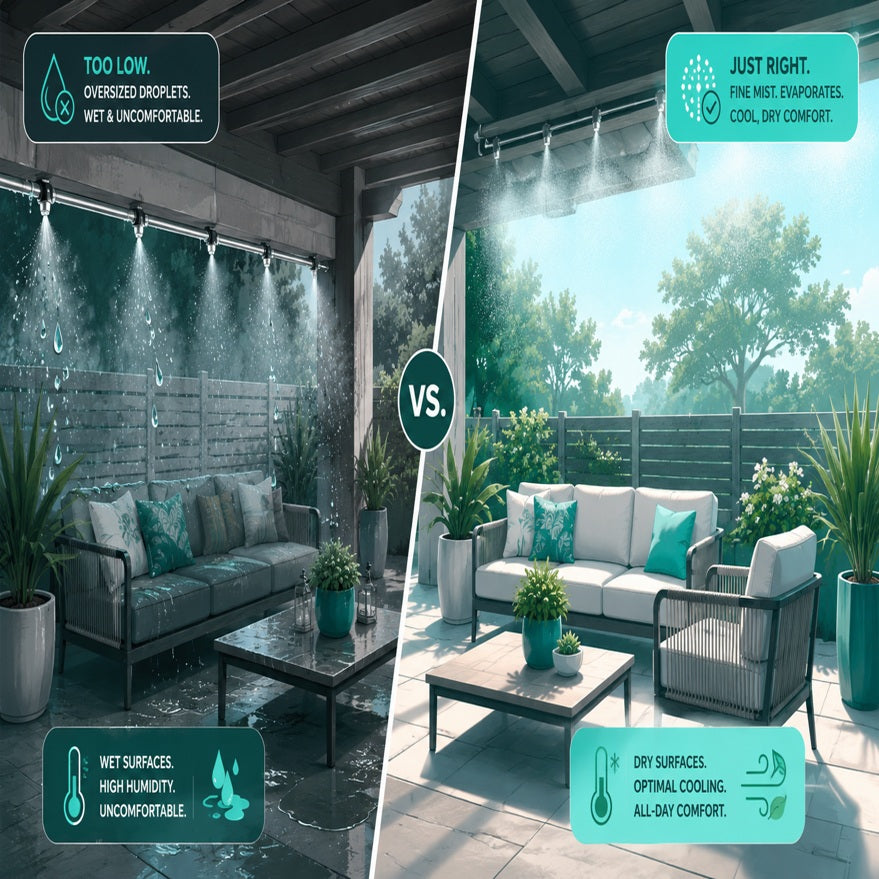
Balancing your pump to the size and quantity of your nozzles is crucial to the performance and life of your system. At 1000 PSI, a properly balanced high pressure misting pump produces droplets fine enough to evaporate before they reach people or furniture. But exceed the pump's capacity—even by a few nozzles—and pressure drops, droplets grow larger, and you get wetness instead of cooling. Mastering this simple calculation method separates a callback-free install from one that damages your reputation.
Nozzle Count Must Fit the Pump, Not the Patio Wish List
Every nozzle in a 1000 PSI misting system draws a specific amount of water measured in gallons per minute. Your pump can only supply so much flow at operating pressure. When total nozzle demand exceeds pump capacity, pressure drops. When pressure drops, droplet size increases. When droplets get bigger, they stop evaporating in the air and start landing on furniture, guests, and your professional reputation.
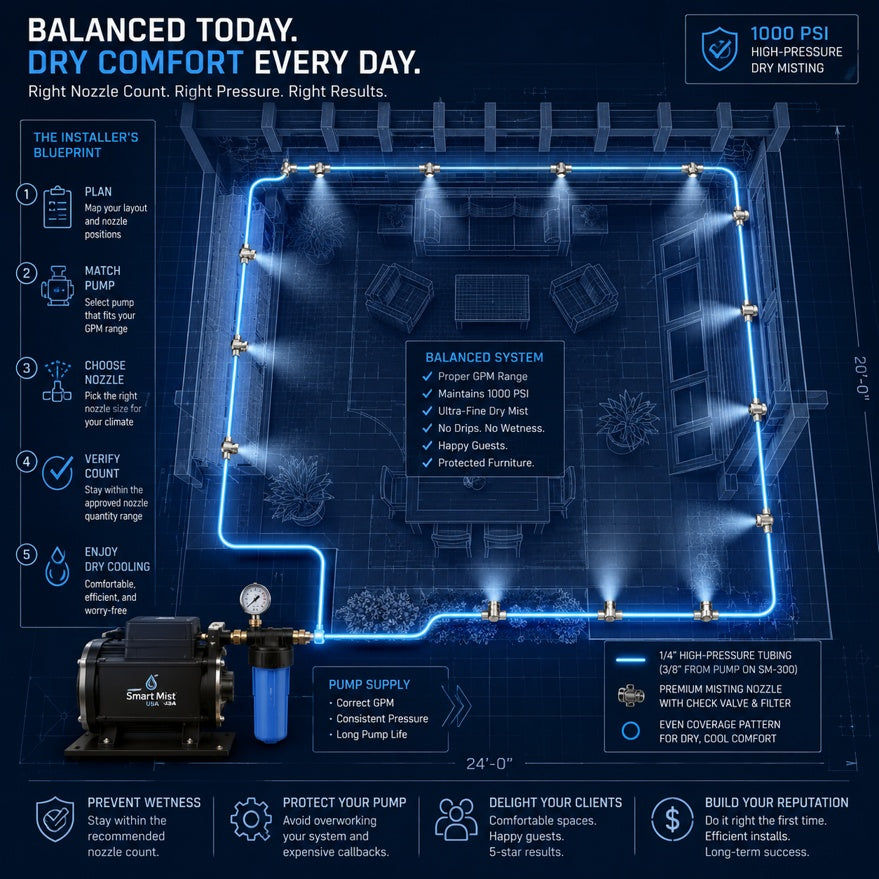
This is system balancing: matching nozzle size and quantity to pump capacity so the system maintains the pressure required for dry evaporative cooling. The goal is balanced output—not maximum nozzle count.
The principle works in reverse too. Run too few nozzles on a pump designed for higher demand, and the pump overworks itself. It runs hotter, louder, and wears out faster. Neither extreme serves you or your client.
Step 1: Choose Nozzle Size Based on Climate and Mounting Height
Before counting nozzles, you need to know which nozzle aperture fits the job. The size you choose affects how much water each nozzle draws and how quickly that water evaporates.

0.15mm (0.006") nozzles work for most installations. They fit relatively dry climates with lower mounting heights around 7–8 feet, or moderately humid climates with mounting heights of 8–9 feet. In conditions where summer temperatures hit the 90s but relative humidity stays below 60%, these nozzles produce droplets that evaporate reliably before reaching the ground. Standard nozzle spacing runs 24 inches.
0.20mm (0.008") nozzles suit very dry, hotter climates—think Arizona, Nevada, New Mexico. They work well at mounting heights around 8 feet in these conditions, or at 7-8 feet in relatively dry climates when more output is appropriate. The larger aperture delivers more water volume, which works when the air is dry enough to absorb it quickly. At lower mounting heights or in more humid conditions, these nozzles create wetness risk.
0.30mm. ( .012” ) nozzlessuit extremely hot, dry climates- think parts of Arizona, Nevada, New Mexico. Use in these climates with mounting heights of 9 –10 feet. The larger orifice allows the mist to travel further before evaporating, which is needed at these increased heights and dry humidity conditions.
0.10mm (0.004") nozzles occupy the other end of the spectrum—useful when summer temperatures rarely exceed 90°F and humidity runs above 50%. They require upgraded filtration and suit specialized applications rather than typical patio installs.
The key variables beyond climate: mounting height (higher gives droplets more time to evaporate), shade coverage (shaded areas evaporate slower), and airflow (wind accelerates evaporation but can blow mist where you don't want it). For detailed guidance on selecting the right aperture, see Choosing The Proper Nozzle Size. Smart Mist's Outdoor Misters page provides additional context for matching systems to site conditions.
Step 2: Check the Pump's Approved Nozzle-Count Range
Once you've selected nozzle size, check how many nozzles your pump can handle. The table below shows the approved working ranges for Smart Mist USA's app-controlled pump lineup at 60Hz.
|
Pump Model |
Flow Rate (L/min) |
0.10mm Nozzles |
0.15mm Nozzles |
0.20mm Nozzles |
0.30mm Nozzles |
|---|---|---|---|---|---|
|
SM-100 |
1.2 |
12–35 |
8–28 |
7–18 |
6-12 |
|
SM-150 |
1.8 |
20–50 |
12–40 |
10–27 |
8-18 |
|
SM-200 |
2.4 |
28–65 |
22–60 |
15–36 |
10-24 |
|
SM-300 |
3.0 |
38–90 |
30–75 |
18–50 |
20-36 |
These ranges represent tested operating parameters—not suggestions. Stay within them, and the system maintains pressure. Exceed the upper limit, and pressure drops. Fall below the lower limit, and the pump runs hot, loud, and has decreased life.
If your planned nozzle count falls outside the row for your chosen nozzle size, stop there. Do not force the layout. Redesign the zone or move to a larger pump.
For the most current specifications, reference the Nozzle Size and Quantity Chart on the Smart Mist USA website.
Step 3: Stay in the Mid-to-Upper Range When Possible
The table shows minimum and maximum counts, but the sweet spot sits in the middle to upper portion of each range. For best performance, use at least 50% of the maximum nozzle quantity.
A practical way to think about it: first, get inside the approved range. Second, avoid living at the bottom edge. Third, avoid pushing the top edge if site conditions already increase wetness risk.
Running at the bottom edge of the range forces the pump to work against more resistance than it needs. The result: higher operating temperature, increased noise, and accelerated wear on internal components. You’ll hear a louder unit, and you face earlier pump replacement.
Running at the very top edge leaves no margin for error. If site conditions turn slightly less favorable—humidity spikes, wind dies down, temperature climbs—you're already at the pressure threshold. One small variable shift tips you into wetness territory.
The mid-to-upper range gives you cooling capacity and operational headroom. The pump runs cooler and quieter, lasts longer, and handles minor environmental fluctuations without dropping below dry-cooling pressure.
What Happens When You Use Too Many Nozzles
Exceeding pump capacity triggers a predictable failure chain. Total water demand surpasses what the pump can deliver at 1000 PSI. Pressure drops—sometimes to 600 or 500 PSI, sometimes lower. At reduced pressure, nozzles produce larger droplets that can't evaporate before reaching surfaces.

When a misting system produces wetness instead of dry cooling, one of four causes is typically responsible: temperatures too low or humidity too high for efficient evaporation, nozzles mounted too low, nozzle aperture too large for the conditions, or nozzle count exceeding what the pump can supply at full pressure. Overloading the pump falls squarely in that fourth category.
The symptoms show up fast. Water beads on patio furniture. Guests feel dampness instead of cooling. The mist that should disappear six feet above the ground is now landing on tablecloths and dinner plates.
The physics don't negotiate. Total nozzle GPM must stay within pump capacity, or dry cooling becomes impossible. For deeper context on why pressure matters, see The Hidden Cost of 'Wet' Systems: Why 160 PSI Booster Pumps Fail Your Clients.
What Happens When You Use Too Few Nozzles
Under-loading a pump creates different problems. When nozzle count falls below the minimum range, a large volume of water gets forced back through the pump's internal bypass loop. While the pump's unloader valve prevents pressure from exceeding system limits, this continuous recirculation rapidly heats the water.Internal components cook against this thermal buildup. The pump runs hot. Operating temperature climbs, stressing seals and shortening component life. Noise increases noticeably—your client hears a laboring machine instead of quiet background operation. Over months, premature wear accumulates into early failure.
Worked Examples for Common Scenarios
Scenario 1: Moderate-humidity patio install with 0.15mm nozzles
A restaurant in Texas needs misting coverage for a 60-foot perimeter patio. Summer humidity runs 45–55%, temperatures hit mid-90s, and mounting height is 9 feet. Use 0.15mm nozzles at 24-inch spacing, giving you 30 nozzle ports.
Check the table: 30 nozzles with 0.15mm aperture falls within the SM-150 range (12–40) and sits comfortably in the mid-to-upper zone. An SM-150 pump is the correct match. The system will maintain pressure, the pump will run cool and quiet, and you've left room for the occasional humidity spike.
Scenario 2: Dry-climate installation with 0.20mm nozzles
A hospitality venue in Arizona wants misting for an 80-foot outdoor bar area. Summer humidity stays below 35%, temperatures regularly exceed 105°F, and mounting height is 8 feet. You use 0.20mm nozzles for greater output in the dry air, spaced at 24 inches. That's 40 nozzle ports.
Check the table: 40 nozzles with 0.20mm aperture falls within the SM-300 range (35-50).
Scenario 3: Extremely dry, high-mount installation with 0.30mm nozzles
A resort in Arizona wants misting coverage for a 50-foot covered walkway leading to the pool deck. Summer humidity routinely sits below 25%, afternoon temperatures push past 110°F, and the structure's beam height puts mounting at 10 feet. The combination of very dry air and the higher mounting position calls for 0.30mm nozzles, which deliver enough output and travel distance for the mist to evaporate fully before reaching guests below. Spaced at 24 inches, that's 25 nozzle ports.
Check the table: 25 nozzles with 0.30mm aperture falls within the SM-200 range (10–24). actually, 25 exceeds the SM-200 maximum of 24, so the SM-300 (20–36) is the correct match. At 25 nozzles, you sit comfortably in the mid-portion of the SM-300 range, which gives the pump room to run cool and quiet while leaving margin for any future nozzle additions along the walkway.
When the Fix Is a Bigger Pump, Not a Setting Change
Here's where customers sometimes make an expensive mistake: assuming they can compensate for nozzle miscalculation after the install.
Standard high-pressure piston pumps have a fixed flow rate determined entirely by their mechanics. While they typically feature an unloader valve that technically lets you dial down the pressure, doing so drops the system below the 1000 PSI needed to create dry mist.[^2] You generally can't turn a dial to magically increase flow capacity to match an overloaded nozzle count. The physics are set at installation.
Smart Mist's app-controlled pumps do offer interval timing to schedule when the system runs—useful for managing comfort throughout the day as conditions change. But interval timing is a scheduling feature, not a way to fix sizing mistakes. Size the system correctly during initial setup. Use app controls to fine-tune operating schedules second.
If the nozzle count exceeds what your pump can handle, the solution is either fewer nozzles, smaller aperture nozzles, or a larger pump. If you need more nozzles than originally planned, contact Smart Mist USA about upgrading to the next pump size. Redesigning the zone—splitting one large zone into two smaller ones fed by separate pumps—is another option for complex installations.
The principle applies to troubleshooting existing systems too. When a customer reports wetness on a system, don't assume it's a pump failure. Check nozzle count against pump capacity first. Many "broken" systems are simply overloaded.
For more on matching pumps to nozzle layouts, see Balancing Your Pump And Nozzles.
A Pre-Install Checklist to Prevent the Saturday Night Callback
Use this checklist before quoting or commissioning any misting installation:
1. Confirm nozzle size matches climate conditions. Temperature, humidity, and mounting height dictate aperture selection. Don't default to 0.15mm on every job—assess the site.
2. Count total nozzles in the layout. Include every nozzle port in the design, even if some might be capped initially.
3. Verify count falls within pump range for that nozzle size. Reference the chart. If you're outside the range, stop and resize.
4. Confirm count sits in the mid-to-upper portion of the range. At least 50% of maximum. This protects pump longevity and gives you environmental margin.
5. Check practical install basics. Run open sides correctly and keep typical nozzle spacing at 24”
6. Address clogged nozzle prevention and maintenance. Clogged nozzles can mimic sizing problems. For calcium deposits, clean with CLR solution or replace the nozzles. Calcium buildup also damages pump components over time, not just nozzles.
7. Confirm water quality and filtration requirements. Basic sediment filters handle particulates, but hard water requires specialized filtration to prevent scale buildup. Specify the right filtration for your water source.
8. Document your calculation. Keep a record of nozzle count, nozzle size, and pump selection for each job. When questions arise later, you have evidence of proper engineering.
This takes three minutes at the quoting stage. It saves hours of callbacks and protects your reputation with every install.
For more supporting context, see Engineering Dry Cooling: The Contractor's Guide to High-Pressure Mist Pumps. If you want project-specific help, visit Contact Us.
Our Editorial Process
Our expert team uses AI tools to help organize and structure our initial drafts. Every piece is then extensively rewritten, fact-checked, and enriched with first-hand insights and experiences by expert humans on our Insights Team to ensure accuracy and clarity.
About the Smart Mist USA Insights Team
The Smart Mist USA Insights Team is our dedicated engine for synthesizing complex topics into clear, helpful guides. While our content is thoroughly reviewed for clarity and accuracy, it is for informational purposes and should not replace professional advice.