(916) 308-3856


📌Key Takeaways
Mid-pressure booster pumps operating at 160 PSI create wetting problems that cost contractors callbacks, damaged client relationships, and lost referrals—only 1000+ PSI systems deliver true dry cooling.
-
Pressure Determines Droplet Size: Systems at 1000+ PSI produce 10-20 micrometer droplets that evaporate before reaching surfaces, while 160 PSI creates 50+ micrometer droplets that wet everything.
-
Four Causes of Wetness: Low temperature/high humidity, fan mounted below 10 feet, oversized nozzles, or nozzle count exceeding pump capacity all produce wetting regardless of pressure claims.
-
Three-Component Architecture Required: Real high-pressure systems use external pumps, 18-24 inch fan units, and sleeved high-pressure lines—integrated pump claims signal misunderstood or misrepresented equipment.
-
Remote Pump Placement Wins: Locating pumps 50-100 feet away in garages or enclosures eliminates noise at the entertainment zone while maintaining silent operation for guests.
-
Hard Water Demands Proactive Filtration: Calcium buildup clogs nozzles and damages pump internals, requiring sediment filtration plus CLR maintenance schedules to prevent catastrophic pump failure.
Proper pressure eliminates callbacks and builds referral-generating reputations.
Landscape contractors and outdoor living installers specifying misting systems will gain the technical clarity needed to avoid wetting failures, preparing them for the equipment selection and troubleshooting details that follow.
The sales pitch sounds reasonable. A booster pump for $150 instead of a complete high-pressure system for $1,500. Your client saves money, you save on installation time, and everyone walks away happy.
Until the callback comes.
The patio furniture is soaked. The outdoor cushions are ruined. And your client—the one who trusted you to deliver a comfortable outdoor space—is now questioning whether you really understand what you're doing. That "savings" just cost you a referral, a reputation, and potentially a $20,000 relationship.
If a misting system operates at around 160 PSI, it's not a cooling system—it's a wetting system. The hidden cost doesn't show up on the invoice. It shows up as callbacks, cleanup visits, and the slow erosion of your professional credibility. High-pressure systems operating at 1000+ PSI deliver dry, flash-evaporative cooling that keeps clients comfortable without turning their outdoor investment into a puddle.
The Cheap Upgrade Trap: When 'Misting' Becomes Mopping
Most contractors encounter the booster pump trap the same way. A landscape designer finishes a beautiful patio installation—pavers set perfectly, the pergola positioned for afternoon shade, furniture arranged for conversation. The client mentions they'd love some cooling for summer entertaining, and suddenly there's pressure to add value without blowing the budget.
The big-box store has booster pumps marketed as "misting systems" for a fraction of professional equipment costs. The specifications look similar enough. It creates pressure. Water comes out as mist. How different could it really be?
Extremely different. The physics don't care about the marketing copy.
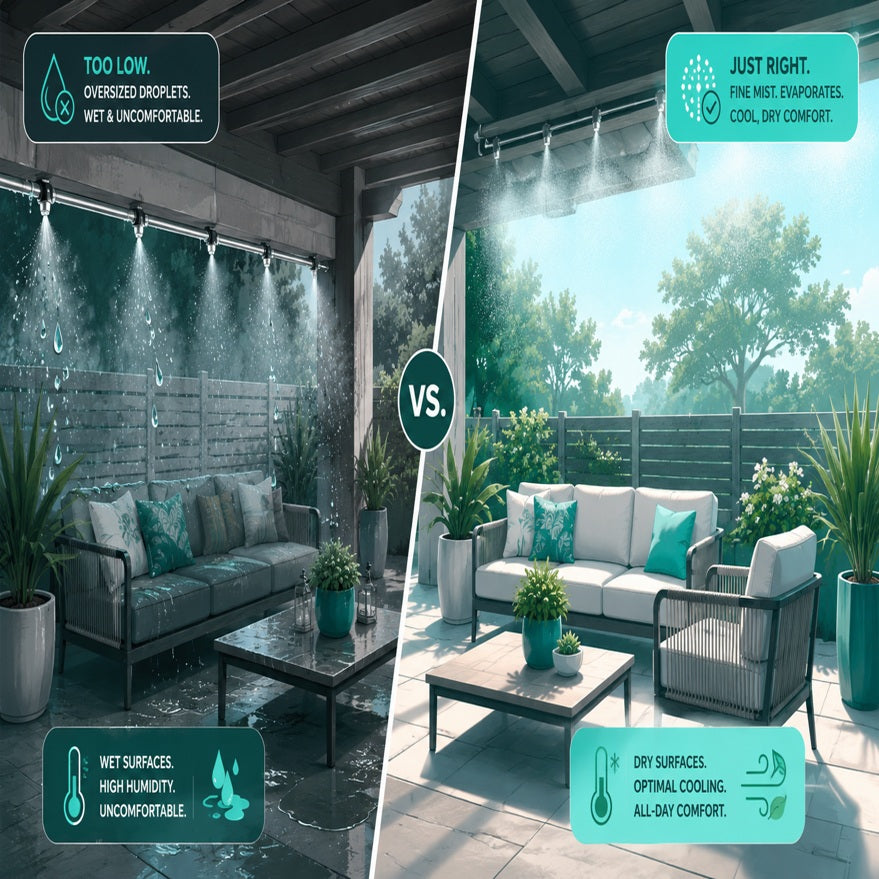
A 160 PSI booster pump produces droplets that are fundamentally too large to evaporate before reaching people and surfaces. These aren't microfine fog particles that flash-evaporate in mid-air. They're water droplets that fall like light rain, accumulating on cushions, pooling on tables, and creating exactly the kind of uncomfortable, swampy environment the client was trying to escape.
The real cost emerges in waves. First comes the callback—the client reporting that "the misters are getting everything wet." You drive back out, spend an unpaid hour adjusting nozzles that can't be adjusted enough to fix a fundamental pressure problem. The client is frustrated but willing to give it another chance.
Then comes the second callback. The cushions have mildew. The outdoor rug is permanently stained. And now the conversation isn't about tweaking the system—it's about whether you're going to pay for the damaged items or whether they're going to leave a one-star review explaining how you installed equipment that ruined their outdoor space.
The $1,350 you "saved" by using a booster pump instead of a proper 1000 PSI misting system has now cost you hundreds in drive time, thousands in potential replacement costs, and an incalculable amount in lost referrals. The client who was going to recommend you to three neighbors for similar projects is now telling those same neighbors to find someone else.
This pattern repeats across the industry. Contractors who try to bridge the price gap with mid-pressure equipment discover that there is no middle ground in misting technology. The system either operates at sufficient pressure to create true evaporative cooling, or it operates as an expensive sprinkler that makes outdoor spaces unusable.
Physics, Not Hype: Why 160 PSI Wets and 1000+ PSI Cools Dry

The difference between wet mist and dry cooling isn't about brand names or marketing claims. It's about droplet size, and droplet size is determined by pressure.
Understanding the pressure tiers helps frame client conversations. Low-pressure systems operate at 30 to 40 PSI and produce large droplets that will cause wetting. Mid-pressure systems run at 200 to 300 PSI with better atomization, but still may cause wetting. High-pressure systems operating at 1000+ PSI represent the practical threshold for optimal evaporative cooling without wetting.
High-pressure systems operating between 800 and 1,200 PSI produce water droplets measuring roughly 10 to 20 micrometers in diameter. At this size, the droplets behave as fog. They suspend in air, evaporate rapidly, and cool the surrounding atmosphere through the phase-change process—water absorbing heat energy as it transitions from liquid to vapor. This is flash evaporation, and it's the fundamental mechanism behind effective outdoor cooling.
Systems operating at 50 to 60 PSI—the range of typical booster pumps—produce droplets larger than 50 micrometers. These droplets are too heavy to remain airborne. They fall. And before they fall, they wet whatever they contact. The evaporative cooling effect is minimal because most of the water reaches surfaces before it has a chance to evaporate.
Research from North Carolina State University confirms that high-pressure fogging systems demonstrate measurably higher evaporation rates and cooling efficiency compared to low-pressure alternatives. The University of Florida's Institute of Food and Agricultural Sciences identifies high-pressure fog cooling as the most uniform and effective evaporative method when humidity conditions permit proper evaporation. The distinction isn't subtle. It's the difference between a system that cools air and a system that sprays water.
Professional fogging systems in agricultural and commercial applications routinely operate between 700 and 1,500 PSI. This isn't arbitrary. Decades of engineering research in greenhouse climate control established that this pressure range is necessary to produce the droplet size required for effective evaporative cooling without surface wetting.
The climate qualification matters, but it shouldn't discourage installation. High-pressure misting systems can deliver up to 25 degrees of cooling depending on temperature and humidity conditions. Drier climates see the most dramatic temperature drops because low humidity allows more complete evaporation. In more humid conditions, the cooling effect is less pronounced but still substantial—and critically, a properly designed 1000+ PSI system remains dry even when evaporation is slower. The droplets are small enough that they evaporate before reaching surfaces, even if that evaporation happens more gradually.
The physics explanation is straightforward. Ambient air has a certain capacity to hold water vapor, and that capacity increases with temperature. When fine mist evaporates into hot, dry air, it absorbs significant heat energy. The now-cooled, slightly more humid air is heavier than the surrounding hot air, so it descends and creates a comfortable microclimate at ground level. This is why properly designed systems deliver cooling throughout a 12- to 16-foot diameter area, not just directly beneath the nozzles.
Low-pressure systems can't create this effect because their droplets never fully transition to vapor. They partially evaporate at best, and mostly they just wet surfaces. There's some cooling from direct contact with skin—similar to stepping out of a pool—but this isn't the dry, ambient cooling that makes an outdoor space genuinely comfortable for extended periods.
Design Truths Professionals Live By
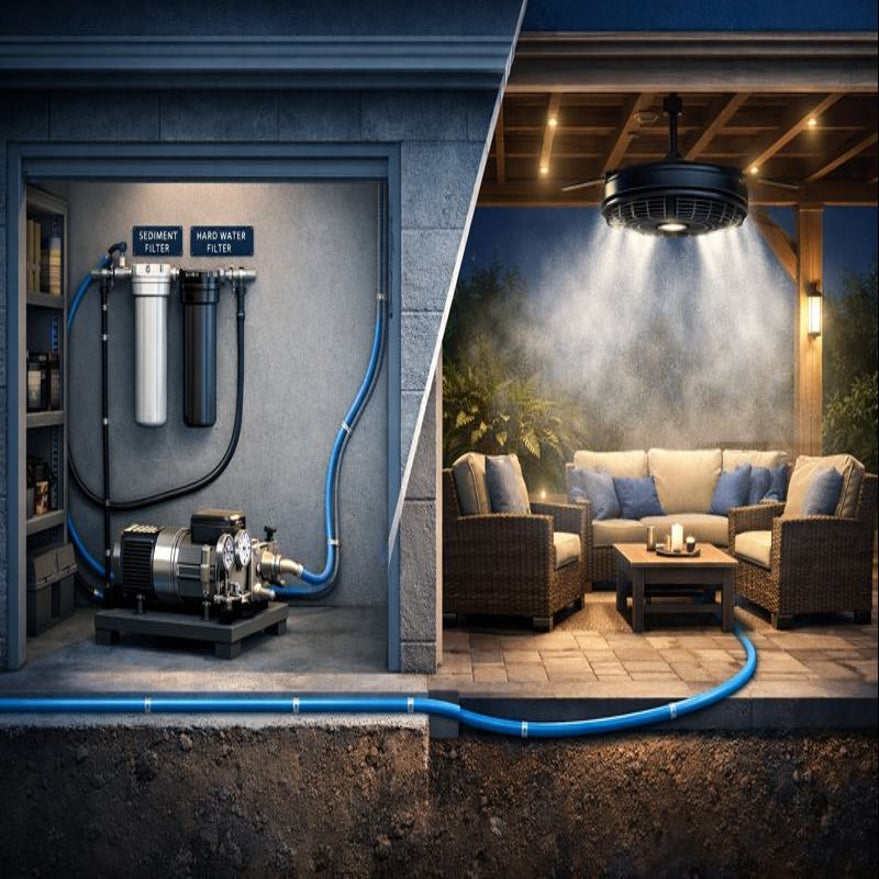
A high-pressure misting system has three distinct components, and understanding this architecture prevents costly mistakes. The system consists of an external high-pressure pump, the fan unit itself (18 to 24 inches in diameter), and the high-pressure line that connects them. The pump is always located remotely—typically in a garage, storage room, or weatherproof enclosure—and the high-pressure line routes from that pump to the fan location.
This is not a system where the pump integrates into the fan head. If someone is marketing a "high-pressure misting fan" with an integrated pump, they're either using misleading terminology or they've fundamentally misunderstood how these systems work. Real high-pressure requires a substantial pump with a three-piston design, similar to the piston arrangement in a car engine. That type of pump cannot fit inside a fan housing.
When high-pressure lines run behind ceiling surfaces, they must be installed inside a protective sleeve—typically PEX or PVC conduit. The line itself can handle the pressure, but the sleeve provides a critical safety layer. If a fitting were to fail behind a finished ceiling, the sleeve contains the water and directs it to a visible location rather than allowing it to saturate the ceiling structure. This isn't optional on concealed runs. It's a fundamental safety requirement that protects both the installation and your liability.
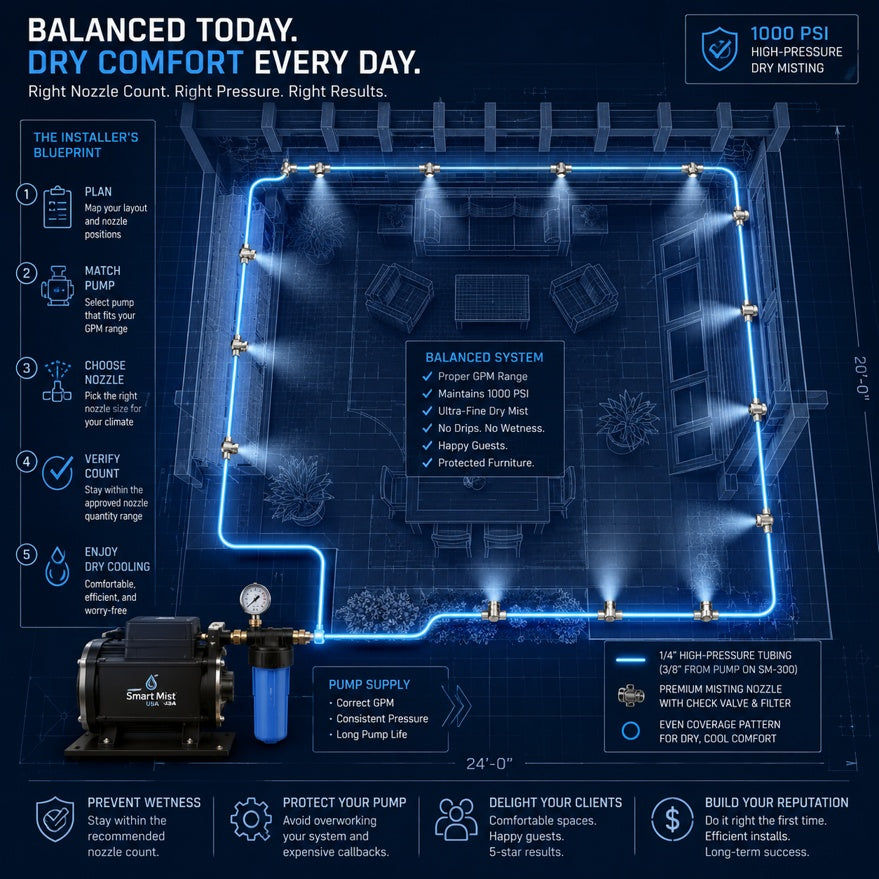
Flow rate is determined by two factors: nozzle size and nozzle quantity. These must be matched to the pump's GPM (gallons per minute) capacity. There are no user-adjustable pressure controls on these systems. When a project requires customization, that happens during initial design by selecting the appropriate nozzle size based on two parameters—local climate (specifically humidity levels) and mounting height. A qualified system designer or the manufacturer's technical support team makes these selections before installation begins.
The fan specifications are consistent across quality systems. The fan itself is 18 to 24 inches in diameter—not a large-blade ceiling fan, but a focused, high-velocity unit designed specifically for misting applications. When properly mounted at approximately 10 feet, these fans create a refreshing microclimate extending 12 to 16 feet in diameter from the fan's center. The coverage pattern is a circle, not just a zone directly beneath the unit. This is important for layout planning.
Water quality determines long-term system reliability. Many regions have hard water with high mineral content, particularly calcium. This creates two distinct problems. First, calcium deposits clog nozzles over time, reducing the fine mist to an irregular spray pattern. Second—and more seriously—calcium buildup inside the pump can cause catastrophic pump damage. High-pressure pumps have tight tolerances in their piston chambers, and mineral scale interferes with that precision.
Basic sediment filtration is essential for any misting system. But areas with hard water require additional treatment. For nozzle maintenance, cleaning or replacement is recommended, with CLR (Calcium, Lime, and Rust remover) being the appropriate cleaning solution for removing deposits. Vinegar, despite being commonly recommended in generic online advice, is not sufficiently effective for the calcium concentrations these systems encounter. When hard water is a known issue, investing in proper filtration and committing to a regular maintenance schedule is substantially cheaper than replacing a damaged pump.
Troubleshooting Wetness: The Four Root Causes

When a misting system produces wetness instead of dry cooling, the cause will be one of four issues. Working through this list systematically solves the problem faster than guessing.
Cause one: Temperatures too low and/or humidity too high for efficient evaporation. Misting systems are evaporative cooling devices, and evaporation requires the air to have capacity for additional moisture. On a cool, humid morning—say 68 degrees with 80% humidity—even a properly designed 1000 PSI system may produce some wetting because the air simply cannot absorb the mist fast enough. This is a physics limitation, not an equipment failure. The solution is to use the interval spraying feature available on app-controlled pumps, running the system in cycles (for example, six seconds on, three seconds off) to meter the mist output to match the air's evaporative capacity.
Cause two: The fan is mounted too low. Nozzles need adequate distance for droplets to evaporate before the mist reaches people or furniture. When a fan is mounted at seven feet instead of the specified 10 feet, even properly sized droplets from a high-pressure system don't have enough travel time. The mist reaches surfaces before full evaporation occurs. This is common when contractors try to maximize coverage by lowering the mounting height. It's counterproductive. The correct approach is to add another fan for additional coverage rather than compromising the evaporation distance.
Cause three: The nozzles are too large. Nozzles are sized by their orifice diameter, typically ranging from 0.008 inches to 0.016 inches for misting applications. A larger orifice allows more water flow and produces a larger droplet, even at high pressure. If nozzles sized for a dry climate (where faster evaporation allows larger flow rates) are used in a humid region, the system will produce wetting. The fix is straightforward—replace the nozzles with a smaller size. This reduces flow while maintaining pressure, producing finer droplets that evaporate more completely.
Cause four: The nozzle count or size exceeds the pump's capacity, resulting in pressure drop. A 1000 PSI misting pump rated at 1.5 GPM will maintain that pressure with a specific nozzle configuration. If you add more nozzles than the system was designed for, or use nozzles larger than specified, the total flow demand exceeds the pump's output. Pressure drops as a result—sometimes significantly. A system designed for 1000 PSI might only achieve 400 or 500 PSI when overloaded, and at that reduced pressure, droplet size increases and wetting occurs. The solution requires either reducing the nozzle count, decreasing nozzle size, or upgrading to a larger pump with higher GPM capacity.
Each of these problems has a specific fix. The key is to diagnose accurately rather than making random adjustments. Swiveling nozzles to different angles or adjusting fan speed won't solve a pressure problem or a nozzle-sizing issue.
Right Tool, Right Zone: Fans, Misting Fans, and Layout Choices
Not every cooling challenge requires misting technology. Understanding when to specify ceiling misting fans, when to recommend wall or pedestal misting fans, and when to simply install traditional fans improves both client satisfaction and system performance.
Ceiling misting fans excel in focused zones within wider spaces. Consider a large outdoor dining area—say 30 feet deep—where perimeter misting lines wouldn't effectively reach the center tables. Ceiling fans with integrated high-pressure misting create cooling zones exactly where guests gather. They're also valuable when a space has challenging geometry. An L-shaped patio with both a dining area and a separate lounge zone might need two ceiling misting fans rather than attempting to run perimeter lines around the complex layout.
Installation logistics matter. Ceiling misting fans require access above the mounting surface to route the high-pressure line from the remote pump location. If the ceiling is a finished structure with no attic access, installation becomes significantly more complex. In these situations, wall-mounted or pedestal misting fans offer easier installation because the high-pressure line can run along walls or through visible areas where the sleeve requirement is easier to accommodate.
Wall and pedestal misting fans provide flexibility for perimeter applications. When cooling is needed along one or two sides of a space—for example, a poolside cabana where guests primarily use chaise lounges along the pool edge—wall-mounted fans deliver targeted cooling without requiring overhead installation. Pedestal units add portability, though they still require connection to the external high-pressure pump via high-pressure line. These aren't standalone "portable" units with integrated tanks; they're components of a proper high-pressure system with the pump located remotely.
For serviceability, wall and pedestal misting fans have a meaningful advantage. The fan unit and nozzle ring are accessible at ground level or with a standard stepladder. Nozzle cleaning, filter replacement, and seasonal winterization are simpler. Ceiling fans require more effort to access, particularly in installations with high mounting heights.
Traditional fans remain valuable products with distinct advantages. When a space has good shade coverage and air circulation is the primary comfort need, a traditional fan delivers effective cooling through air movement alone—without the water infrastructure, filtration requirements, or ongoing maintenance that misting systems involve. For covered patios with solid roof structures blocking direct sun, or for evening entertaining when temperatures drop naturally, standard fans often provide the perfect balance of comfort and simplicity. These fans are excellent choices for spaces where evaporative cooling isn't necessary, and they continue to serve well throughout the season.
Commercial applications see particularly strong results from high-pressure misting systems. Bars and restaurants with outdoor seating areas extend their usable season substantially when they can keep patio sections comfortable during peak heat. A restaurant that closes its patio at 2 PM when temperatures exceed 95 degrees is losing revenue. That same restaurant with properly designed high-pressure misting can keep the space comfortable and occupied through the afternoon. The system pays for itself in increased table turns.
The layout choice affects long-term client satisfaction as much as the equipment quality. Matching the cooling method to the space's specific geometry, access limitations, and usage patterns demonstrates expertise. It's the difference between selling equipment and solving problems.
What Pro-Grade Looks Like (and Why It Pays)
Professional-grade misting systems begin with commercial pumps operating at 1000+ PSI. Our line of commercial pumps includes direct-drive, pulley-drive, and VFD (Variable Frequency Drive) options ranging from ½ GPM to over 20 GPM flow capacity. The distinction matters. Entry-level direct-drive pumps are rated for intermittent use—adequate for residential applications with moderate run times. Commercial installations requiring all-day operation need pumps rated for continuous duty, with proper heat management and heavy-duty construction.
Remote pump placement is a significant advantage in premium installations. When the pump is located in a garage, equipment room, or weatherproof enclosure 50 or 100 feet from the misting area, the cooling system operates in complete silence from the client's perspective. There's no pump noise interfering with conversation. The outdoor space remains tranquil while the system works invisibly in the background. This is a substantial quality-of-life improvement compared to systems with loud pumps mounted near the entertainment area.
Our app-controlled pumps add meaningful convenience without introducing complexity. These systems connect to a smartphone app that handles on/off control and daily scheduling. Set the system to activate automatically at 2 PM on weekdays and run until 8 PM, then adjust the schedule for weekend entertaining. The interval spraying feature mentioned earlier is controlled through the same app, allowing precise tuning of mist output to match daily humidity fluctuations.
It's important to note what the app does not control: pressure. Pressure is fixed by the pump and nozzle configuration. The app provides scheduling and on/off control only. This is by design. Pressure adjustments would undermine the system's calibration and could easily create the wetting problems that proper initial design prevents.
The total cost of ownership tells the real story. Compare two projects side by side. Project A uses a $150 booster pump and creates ongoing callbacks, requiring six service visits in the first season at an average of two hours per visit. That's 12 hours of unpaid labor, roughly $600 in opportunity cost if you value your time at $50 per hour, plus fuel and the intangible cost of client frustration. Project B uses a proper high-pressure system at $1,500, installs correctly the first time, and requires one routine service visit for nozzle cleaning. The higher up-front cost is recovered immediately through the elimination of repeated service calls.
The larger cost is reputational. A client with a malfunctioning system doesn't recommend you to their network. A client with a perfectly operating system that makes their outdoor space comfortable throughout summer becomes an advocate. They mention your name to neighbors. They leave positive reviews. They call you for the next project. In the landscape and outdoor living industry where referrals drive a substantial portion of new business, reputation is the asset that compounds over time.
Professional contractors who commit to specifying high-pressure equipment report stronger client relationships, fewer complaints, and significantly higher rates of repeat business. The quality gap between mid-pressure and high-pressure systems is obvious to homeowners and commercial property managers within days of installation. One contractor summed up the experience: "The pump and nozzle combination works perfectly as advertised." It's not a subtle difference.
Risk Assessment: Wet vs Dry (Downloadable Checklist)
Use this field checklist to evaluate whether a project is properly specified for dry cooling or likely to produce wetting issues.
System pressure check:
-
Is the pump rated for 1000+ PSI continuous operation?
-
Have you verified the pump model specification sheet, not just marketing copy?
Nozzle configuration check:
-
Are nozzle size and quantity matched to the pump's GPM rating?
-
Has nozzle size been selected based on local humidity levels?
-
Is nozzle spacing maintained at 24 to 30 inches (closer spacing causes droplet combination)?
Installation height check:
-
Are ceiling fans mounted at approximately 10 feet?
-
Is there adequate evaporation distance for the local climate?
Architecture verification:
-
Is the pump external and remotely located (not integrated into the fan)?
-
Is high-pressure line installed with proper sleeve protection for any concealed runs?
-
Are all components rated for high-pressure operation?
Water quality and filtration:
-
Is sediment filtration in place?
-
If the area has hard water, is additional calcium/mineral filtration installed?
-
Is there a maintenance plan for nozzle cleaning or replacement with CLR?
Climate appropriateness:
-
Have you set client expectations that cooling performance varies with humidity?
-
Is interval spraying capability available for high-humidity conditions?
If any item on this checklist reveals a gap, address it before finalizing the installation. The difference between a successful project and a callback-generating problem is often a single overlooked specification.
Frequently Asked Questions
Why does my current system get things wet?
The most common cause is insufficient operating pressure. Systems running at 160 PSI or similar mid-range pressures produce droplets that are too large to evaporate before reaching surfaces. The droplet size is determined by pressure, and only systems operating at 1000+ PSI produce the microfine fog necessary for complete evaporation. If your current system uses a booster pump or is marketed as "mid-pressure," the wetting is a fundamental equipment limitation, not a fixable adjustment issue.
Can I just reduce flow or adjust pressure to fix wetting?
No. Pressure is not user-adjustable in misting systems. The operating pressure is determined by the pump design and the nozzle configuration. Flow rate is set by nozzle size and quantity matched to the pump's GPM capacity during initial installation. If a system is producing wetting, the solution is either to reduce nozzle size (which decreases flow while maintaining pressure) or to upgrade to a properly sized high-pressure pump. Attempting to "turn down" a mid-pressure system won't solve the underlying droplet-size problem.
Is there an app to control pressure?
Apps available with modern misting pumps handle on/off control and daily scheduling. Some systems include interval spraying features that allow you to set mist-on and mist-off cycles (for example, six seconds on, three seconds off) to meter the total mist output. However, apps do not control pressure. Pressure is fixed by the pump and nozzle configuration. This is intentional—pressure must remain consistent to maintain proper droplet size and prevent wetting.
What about humid climates—will these systems work?
Cooling effectiveness depends on both temperature and humidity. High-pressure misting systems deliver the best results in drier climates where air has greater capacity to absorb moisture and facilitate evaporation. However, even in more humid regions, properly designed 1000+ PSI systems provide substantial cooling benefits while remaining dry. The key difference is that humid climates require more conservative nozzle sizing and may benefit from interval spraying to match mist output to the air's evaporative capacity. The system remains effective; the temperature drop is simply less dramatic than in arid conditions.
Next Steps: Specifying Your Project
When you're ready to move from callbacks to confident installations, the path forward is straightforward. Review High Pressure Misting System Kits for residential projects, or Commercial Misting System Kits for installations requiring continuous-duty operation. Match the application to the equipment: Ceiling Misting Fans for overhead installations in dining or entertainment zones, and Outdoor Wall & Pedestal Fans for perimeter cooling and spaces where serviceability matters.
For projects where scheduling flexibility is critical—particularly in humid climates or commercial settings with variable occupancy—our app-controlled pumps provide on/off control and interval spraying features that let you match system output to real-time conditions.
If you're working through a complex layout, dealing with hard water conditions, or need guidance on pump and nozzle matching for a specific climate, schedule a phone consultation. Technical support can walk through the design requirements and ensure your specification avoids the four common causes of wetting before installation begins.
For projects with finalized specifications, same-day processing is available where inventory allows. The difference between a system that performs and one that generates callbacks is almost always determined during the design phase, not during troubleshooting.
Disclaimer: This article provides general educational information about misting system specifications and industry practices. Specific installation requirements, pump sizing, and nozzle configurations vary based on site conditions, local climate, and application. Consult manufacturer specifications and technical support for project-specific guidance. Water quality issues, including hard water treatment requirements, vary significantly by location and should be evaluated based on local water testing results.
References:
[1] UMass Greenhouse & Floriculture: Mist & Fog Equipment
[2] NC State: High- vs Low-Pressure Fogging Efficiency
[3] UF/IFAS: Fan & Pad vs Fog Systems
[4] UArizona CEA: High-Pressure Fogging Systems
[5] University of Vermont: High-Pressure Fog Systems