(916) 308-3856


📌Key Takeaways
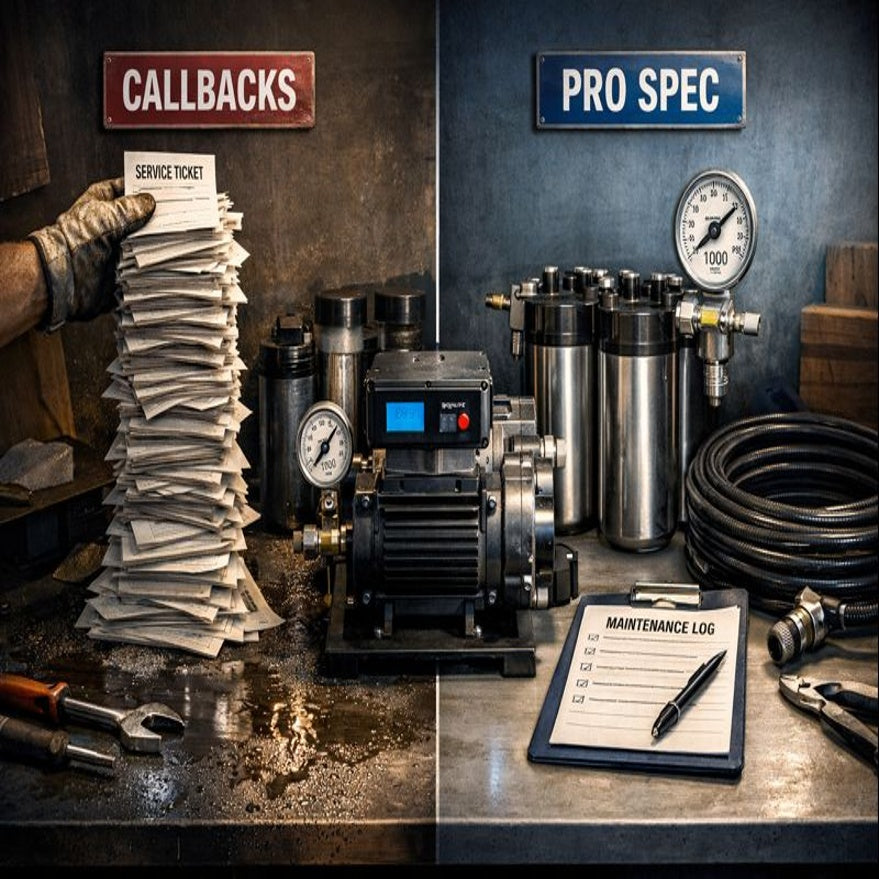
Budget misting systems cost contractors more over three years through callbacks, parts failures, and lost referrals than properly specified 1000 PSI equipment.
-
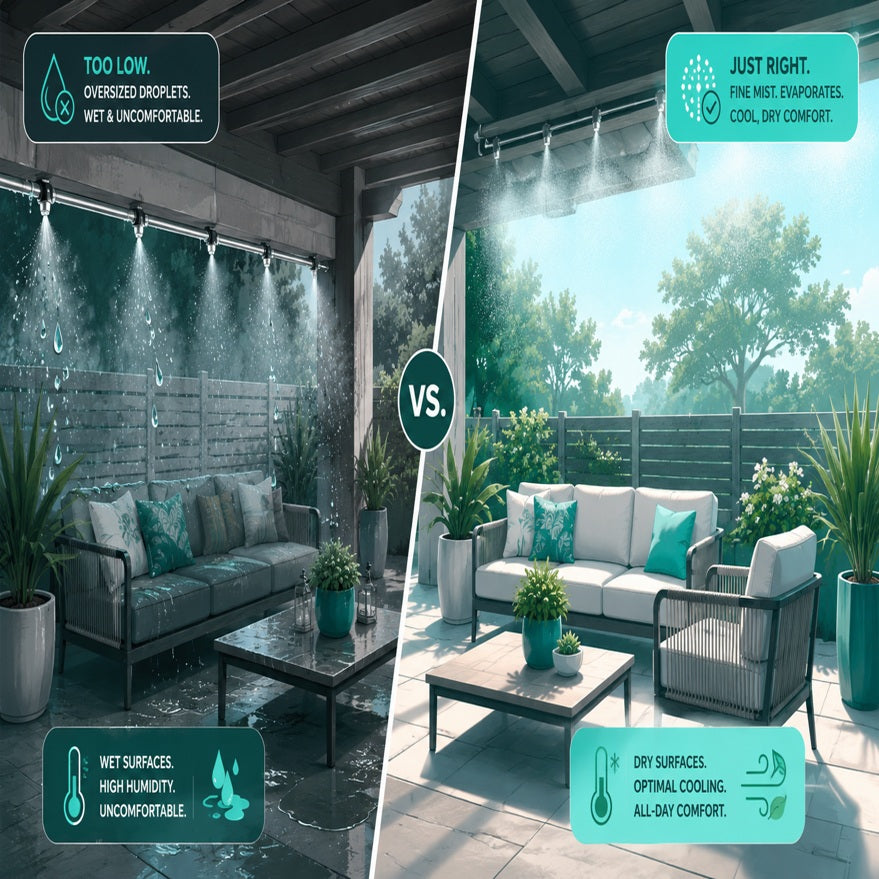
1000 PSI Enables Flash Evaporation: Systems below this threshold produce larger droplets that wet surfaces instead of evaporating, triggering immediate client complaints and service calls.
-
Four Wetting Variables Control Callbacks: Climate humidity, mounting height, nozzle orifice size, and nozzle count relative to pump capacity must align to prevent moisture complaints.
-
TCO Exceeds Equipment Price: Three-year ownership costs include filtration, seasonal maintenance, unscheduled service visits, replacement parts, travel time, and reputation damage from system failures.
-
Winterization Protects Warranty Coverage: Freeze damage from skipped seasonal procedures costs hundreds in repairs and voids manufacturer warranties, making proper shutdown non-negotiable.
-
Commercial Pumps Reduce Service Frequency: Continuous-duty rated equipment with proper filtration and remote placement minimizes callbacks while app-controlled models provide diagnostic alerts before failures occur.
Protect margin through proper specification, not initial savings.
Landscape contractors and outdoor living installers bidding fixed-price residential and commercial projects will gain specification frameworks that eliminate callback-driven profit erosion, preparing them for the detailed TCO modeling and design guidelines that follow.
A landscape contractor in Phoenix closes a $15,000 outdoor living project. The client loves the design. Three weeks after installation, the phone rings: "Everything's soaking wet under the mist system." That's callback number one. Two months later, the pump seizes. Callback number two. By the end of the season, the "budget-friendly" misting setup has consumed more profit than the original equipment savings.
This pattern repeats across the outdoor cooling industry because Total Cost of Ownership (TCO) for misting systems extends far beyond the purchase price. Total Cost of Ownership is the 3-year sum of equipment, installation, filtration, seasonal maintenance, service calls, replacement parts, and downtime risk.[^1] For contractors operating on fixed-bid projects, those unbillable truck rolls are margin killers.
The core issue isn't about choosing "expensive" over "affordable." It's about understanding what actually drives callbacks—and the physics behind why anything less than 1000 PSI creates wetting problems that erode both profit and reputation.
TCO, Defined for Contractors
What TCO Includes
Most contractors mentally calculate project costs as equipment plus labor. That's CapEx thinking. TCO requires looking at the full operational lifecycle.
The complete equation includes:
-
Initial equipment and installation labor
-
Filtration system (baseline sediment filter vs. hard-water treatment stack)
-
Seasonal startup and winterization procedures
-
Scheduled maintenance (nozzle cleaning, pump oil changes, seal replacements)
-
Unscheduled service calls triggered by wetting complaints or equipment failures
-
Replacement parts outside normal wear cycles
-
Travel time and fuel for service visits
-
Reputation risk when clients experience persistent issues
That last item doesn't appear on an invoice, but it's real. A commercial property manager who experiences repeated misting problems doesn't recommend your firm to other properties. The referral pipeline dries up alongside your margins.
The Margin Math on Fixed Bids
Here's where TCO becomes painful for outdoor living contractors. You bid a patio project at a healthy 30% margin. The misting system represents $3,000 of the total scope, and you selected components carefully to preserve profit.
Three months later, you're driving 45 minutes to address a wetting complaint. That's 90 minutes of windshield time, 60 minutes troubleshooting on-site, plus the goodwill gesture of replacing nozzles at no charge. Your effective hourly rate just dropped to $23 on a callback that generates zero revenue.
According to data from the National Association of Landscape Professionals, the average service call costs a contractor between $150-250 in unbillable time and expenses.[^2] When a single installation triggers three callbacks in its first year, you've erased the profit from that line item entirely.
The question becomes: what's causing these callbacks in the first place?
The Physics Behind Callbacks: Wetting at Low Pressure
Flash Evaporation vs. Wet Spray
There's a fundamental threshold in evaporative cooling that separates effective systems from problematic ones. At 1000 PSI and above, water is atomized into droplets measuring 10 microns or smaller—roughly one-tenth the width of a human hair. These ultra-fine droplets have such a high surface-area-to-volume ratio that they evaporate before reaching surfaces below.
This is flash evaporation: the instant conversion of liquid water to vapor that produces genuine cooling without wetness. Evaporative cooling works because water absorbs heat as it changes phase from liquid to vapor. The key constraint is the air's ability to accept moisture—what engineers call evaporative headroom, often measured through wet-bulb temperature and humidity levels.[^3]
Systems operating below 1000 PSI—whether they're marketed as "mid-pressure" at 160-300 PSI or standard booster pump setups at 40-60 PSI—produce larger droplets that behave differently. These droplets fall faster than they evaporate, creating the wet spray that triggers client complaints. The cooling effect is marginal because the water never fully transitions to vapor. What you've installed isn't an evaporative cooling system; it's an outdoor sprinkler.
The Four Root Causes of Wetting You Must Control

Even with proper high-pressure equipment, wetting can occur when installation parameters are ignored. Every service call for wetness traces back to one of four issues:
1. Climate and humidity conditions. Misting systems deliver cooling through evaporation, which means they perform differently across climates. In arid regions with low humidity, the evaporation rate is rapid, and systems can provide up to 25 degrees of cooling depending on temperature and humidity conditions. In humid environments, the same physics still applies, but contractors must size systems conservatively and set realistic expectations with clients about performance variations.
2. Mounting height below recommended minimums. Ceiling misting fans should be installed at approximately 10 feet. When mounted lower—often to match existing ceiling heights without considering the cooling mechanism—droplets have insufficient time to evaporate before reaching furniture, flooring, or guests. This isn't a defect; it's a violation of basic design parameters.
3. Nozzle orifice too large for the conditions. Nozzle sizing depends on two factors: the local climate's humidity levels and the mounting height of the misting line. In drier climates or with higher mounting positions, larger orifices can be used. In humid regions or lower installations, smaller orifices are essential. There's no universal "correct" size—the specification must match the application.
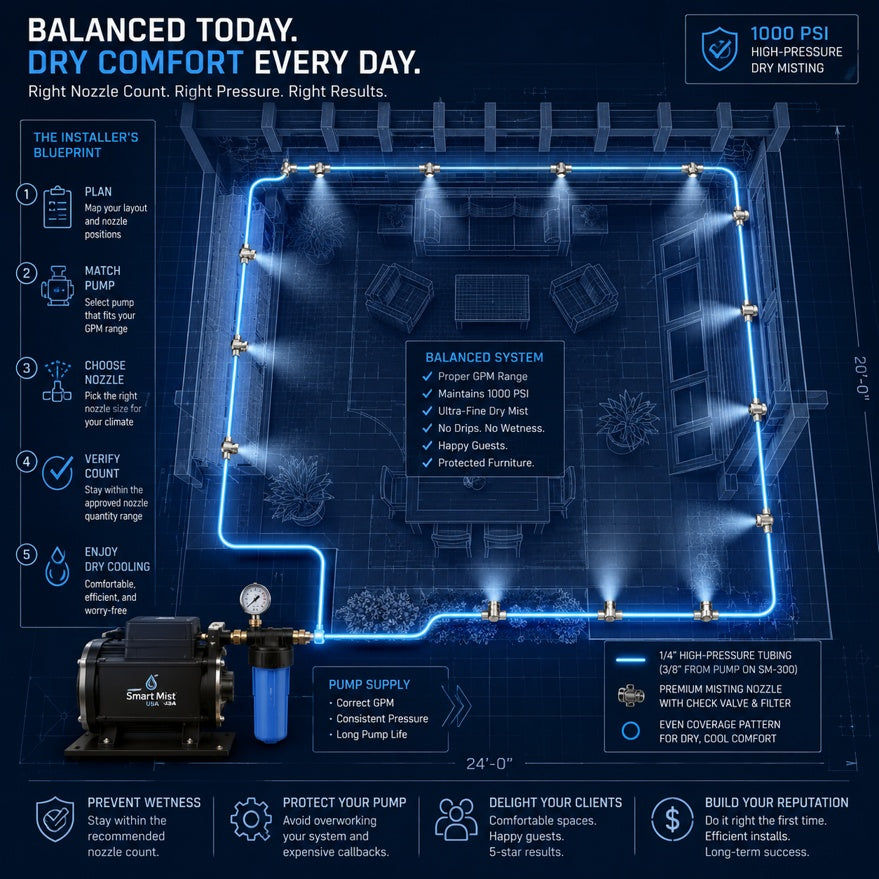
4. Nozzle count exceeding pump capacity. This is the mistake that turns a 1000 PSI system into a low-pressure problem. Each pump has a maximum flow rate measured in gallons per minute (GPM). When contractors add too many nozzles to a line, the pressure drops below the flash evaporation threshold even though the pump is rated for 1000 PSI. The math is straightforward: nozzle size multiplied by quantity must not exceed the pump's GPM capacity.
Addressing wetting complaints in the field means systematically checking these four variables. When you're confident the system operates at true 1000 PSI with properly sized and counted nozzles at adequate height, you've eliminated the most common callback triggers.
Failure Modes that Drive Service Calls

Under-Spec'd Pumps and Booster Units
The market offers various "misting solutions" at attractive price points. Many of these use booster pumps designed to increase household water pressure from 40-60 PSI to perhaps 160 PSI. For contractors, the appeal is obvious: lower equipment cost, simpler installation, and the perception that "misting is misting."
The problem surfaces within weeks. These pumps weren't engineered for continuous-duty outdoor cooling applications. They're designed for intermittent use in residential water systems. Run them for extended periods in summer heat, and seals begin to fail. Pressure drops. Wetting begins.
Even before mechanical failure, the physics work against you. At 160 PSI, droplet size is too large for reliable flash evaporation. You're installing a system that's fundamentally incapable of delivering dry cooling, regardless of how well it's maintained.
Replacing these units mid-season isn't just the cost of a new pump. It's the labor to diagnose the problem, order parts, schedule a return visit, perform the swap, test the system, and follow up with a client who's now questioning your expertise. A $200 equipment "savings" becomes a $1,000 loss after three service calls.
Water Quality Damage and Filtration Requirements
Hard water destroys misting systems through mineral accumulation. Calcium and magnesium precipitate out of solution as water evaporates, leaving deposits inside nozzle orifices, on pump seals, and throughout the high-pressure lines. These dissolved minerals are a well-known water quality factor that varies significantly by region.[^4]
For nozzle maintenance, CLR solution effectively dissolves calcium buildup when applied during regular cleaning. But pump damage from mineral-laden water is more severe. Calcium acts as an abrasive on seals and valves, accelerating wear cycles and causing premature failures that aren't covered under warranty exclusions for water quality issues.
The filtration solution depends on your water conditions. Every system requires a baseline sediment filter to remove particles that could clog the small orifice nozzles. In regions with documented hard water—generally defined as above 7 grains per gallon—you must add scale inhibition or reverse osmosis filtration to the specification.
This isn't an upsell; it's engineering. The equipment supplier's warranty likely excludes damage from inadequate water treatment. When a client's pump fails at 18 months due to scale buildup, and the manufacturer denies the claim, you're absorbing a several-hundred-dollar replacement to maintain the relationship.
Freeze Damage, Weather Exposure, and Warranty Alignment
Misting pumps must be brought indoors or into climate-controlled spaces before freezing temperatures arrive. This is non-negotiable. Water expands when frozen, and even a small amount of residual moisture in the pump housing will crack seals or damage internal components.
The winterization procedure is straightforward: unplug the system, disconnect the high-pressure line, and use compressed air to blow out all water from the lines and pump. Remove nozzles for cleaning. Drain any water from filters. Store the pump in a dry location protected from temperature extremes.
Contractors who skip this seasonal procedure face two problems. First, freeze damage is explicitly excluded from equipment warranties, making any spring repairs your financial responsibility. Second, pumps exposed to outdoor weather—even in moderate climates—experience accelerated deterioration from UV exposure, moisture, and temperature cycling.
Pump enclosures and covers provide protection for installations where indoor storage isn't practical, but they're supplements to proper winterization, not replacements. The warranty terms are clear: maintain the equipment according to manufacturer specifications or accept that failures become your cost center.
The 3-Year Cost Model: "Cheap" vs. 1000 PSI Pro
CapEx vs. OpEx
Initial equipment cost feels like the decision point when you're selecting components for a bid. A low-pressure or booster pump system might cost $600-800 less than a properly spec'd 1000 PSI pump with adequate filtration. That difference looks like preserved margin on your project spreadsheet.
The operational expense tells a different story. Let's model two scenarios over a 36-month period:
|
Cost Element |
"Budget" Setup (Sub-1000 PSI) |
Pro Spec (1000+ PSI) |
|---|---|---|
|
Initial Equipment |
$1,200 |
$2,000 |
|
Filtration System |
$150 (sediment only) |
$400 (sediment + scale inhibitor) |
|
Year 1 Service Calls |
3 callbacks × $200 = $600 |
1 callback × $200 = $200 |
|
Parts Replacements |
$350 (pump seals, nozzles) |
$100 (routine nozzle replacement) |
|
Year 2 Service Calls |
4 callbacks × $200 = $800 |
0 callbacks = $0 |
|
Parts Replacements |
$650 (pump replacement) |
$80 (scheduled maintenance) |
|
Year 3 Service Calls |
2 callbacks × $200 = $400 |
1 callback × $200 = $200 |
|
Reputation/Referral Risk |
Lost opportunities (unquantified) |
Minimal impact |
|
3-Year Total |
$4,150 |
$2,980 |
The "affordable" option costs $1,170 more over three years—and that's before accounting for the intangible cost of a client who questions your recommendations or declines to provide referrals after experiencing persistent problems.
Worked Comparison with Calculator Inputs
The model above uses conservative assumptions. Your actual costs will vary based on travel time to job sites, hourly rates, and local water quality. That's why a customizable worksheet is essential for accurate TCO analysis.
Key variables to input:
-
Your shop's average service call cost (labor + vehicle + overhead)
-
One-way travel time to typical job sites
-
Current hourly rate for service technicians
-
Local water hardness levels (available from municipal water reports)
-
Average ambient humidity during cooling season
For contractors bidding multiple projects annually, running these numbers transforms how you present options to clients. When a property manager asks why your bid is $1,500 higher than a competitor using low-pressure equipment, you're not defending a price—you're demonstrating three-year value.
The equipment choices that protect your margins are the same ones that deliver reliable performance for the client. High-pressure misting system kits standardize the specification while reducing installation complexity through pre-engineered components.
Designing Out Callbacks
System Architecture and Concealment
The fundamental architecture of a high-pressure misting system consists of three separate components: the fan units, an external high-pressure pump located remotely, and high-pressure feed lines connecting them. This separation is critical for both performance and serviceability.
The pump must be positioned away from the cooling area—typically in a mechanical room, garage, or weatherproof enclosure. This remote placement reduces noise in occupied spaces and simplifies maintenance access. High-pressure lines run from the pump to the misting fans, and for installations behind finished ceilings, these lines should be sleeved inside PEX or PVC conduit to protect them and facilitate future service if needed.
Ceiling misting fans are engineered as 18-24 inch diameter units that create a cooling zone extending 12-16 feet from the center of the fan. They're not general air circulation devices; they're precision cooling instruments for specific areas. Think of them as creating concentrated microclimates rather than conditioning entire outdoor spaces.
This matters when you're designing coverage. A 20×30 foot covered patio might require three strategically positioned ceiling misting fans to ensure even cooling throughout the seating area. Trying to use a single unit to cover that footage will disappoint the client and generate a callback.
Sizing by Nozzle Configuration
There are no adjustable pressure settings on misting pumps. The system's flow rate is determined entirely by the nozzle size and quantity you specify during installation, matched to the pump's GPM capacity.
This means pump selection is a design decision, not a field adjustment. You're choosing the pump size based on:
-
The number of nozzles required for adequate coverage
-
The nozzle orifice size appropriate for the climate and mounting height
-
The total GPM demand when those numbers are multiplied
A common specification error is selecting nozzles first, counting them up, then discovering the preferred pump doesn't have sufficient capacity. Work backward instead: understand the pump's maximum GPM, then determine how many nozzles of your chosen size can operate within that limit.
Commercial high-pressure misting pumps are engineered for continuous-duty operation with the thermal management and seal materials required for reliable outdoor cooling applications. App-controlled pumps add remote monitoring and scheduling capabilities that reduce unnecessary runtime and provide diagnostic alerts before minor issues become service-call-generating failures.
Filtration Stack and Pump Placement
Water quality testing should be the first step in every misting system design. Municipal water reports typically include hardness measurements, giving you the data needed to specify appropriate filtration.
Filtration Decision Guide:
-
Normal municipal water: Baseline sediment filtration
-
Hard-water regions (7+ grains per gallon): Sediment + scale-control options with explicit maintenance plan
-
High particulate environments: Prioritize serviceable sediment stages
For soft to moderately hard water (under 7 grains per gallon), a standard sediment filter captures particles that would clog nozzles. This is the baseline requirement for any installation.
For hard water conditions (7+ grains per gallon), add scale inhibition filtration or reverse osmosis treatment. The upfront cost is offset by extended pump life and eliminated callbacks for clogged nozzles. More importantly, it keeps you compliant with warranty terms that exclude water quality damage.
Filter placement should be easily accessible for regular maintenance. Filters hidden behind walls or buried in landscaping become filters that don't get serviced, which defeats their purpose. Position them where a homeowner or property manager can visually confirm they need replacement and where you can swap them quickly during scheduled maintenance visits.
The remote pump location deserves similar consideration. Aesthetic concerns are valid—no one wants to see industrial equipment in their outdoor entertaining space—but don't sacrifice serviceability. A pump buried in an inaccessible corner or mounted without adequate clearance becomes expensive to maintain. Pump enclosures and covers solve this tension by providing weather protection and noise dampening while maintaining service access.
Seasonal Playbook to Protect TCO
Startup and Shutdown Procedures
The transition into and out of cooling season represents the highest-risk period for equipment damage. Proper procedures at both ends of the season prevent the majority of premature failures.
Before the first use each spring:
-
Inspect all visible tubing and fittings for damage that might have occurred during winter
-
Check nozzles for debris or mineral buildup and clean with CLR solution if needed
-
Reconnect the pump and fill the system slowly to avoid pressure spikes
-
Run the system for 10 minutes and inspect for leaks
-
Verify pressure gauge readings fall within the expected range
At the end of each season before freezing temperatures:
-
Unplug the pump and disconnect from power
-
Remove the high-pressure line from the pump
-
Use compressed air to blow out all water from lines and pump
-
Remove and clean all nozzles, storing them in a labeled container
-
Drain the filter housing completely
-
Bring the pump indoors to climate-controlled storage
These procedures take 30-45 minutes. Skipping them can result in hundreds of dollars in freeze damage that's explicitly excluded from warranty coverage.
Maintenance Cadence and Warranty Expectations
Equipment manufacturers provide detailed maintenance schedules based on runtime hours. Following these schedules isn't just good practice—it's often a warranty requirement.
Typical maintenance intervals include:
-
Daily visual inspection during peak season (30 seconds)
-
Weekly filter check and nozzle inspection
-
Monthly pressure gauge verification
-
First formal maintenance at 300 hours runtime (pump oil change)
-
Major service at 1,500 hours (seals, valves, internal cleaning)
-
Comprehensive inspection at 2,000 hours
The warranty exclusions are equally specific: water quality damage, freeze damage, and weather exposure damage are your financial responsibility, not the manufacturer's. Understanding these terms lets you set proper expectations with clients during the sale and avoid disputes when seasonal maintenance is required.
For detailed maintenance procedures and component specifications, consult the comprehensive installation guide that documents best practices for long-term system reliability.
If Misting Isn't Right for This Zone
High-pressure misting delivers exceptional cooling in the right application, but not every outdoor space requires evaporative cooling. In some environments where evaporative headroom is limited due to high humidity, expectations must be set accordingly. Some areas benefit more from traditional air movement.
Non-misting outdoor fans serve spaces where water-based cooling is impractical or unnecessary—such as fully enclosed outdoor bars and restaurants where humidity control matters, or covered areas where clients prioritize air circulation over temperature reduction. These are complementary products, not compromises. The engineering that goes into proper misting system design applies equally to selecting the right non-misting solution when that's what the application demands.
The decision framework is straightforward: if the client's primary concern is temperature reduction in an open-air or semi-enclosed space, misting is the engineered solution. If air movement and comfort are the goals in a fully enclosed or naturally cool environment, traditional fans deliver that outcome more appropriately.
What Contractors Say
"The pump and nozzle combination works perfectly as advertised." — James G.
"I installed the system myself and found it pretty easy." — Daniel S.
"The mist inhibits mosquitos and other flying pests during dinner." — Daniel S.
"Jeff explained everything clearly; installation was seamless." — Mike H.
Frequently Asked Questions
Are cheap misting systems worth it?
Often not over a 3-year horizon. Initial savings can be erased by wetting complaints, clogs, freeze issues, and unplanned service calls. The system that minimizes wetting and unplanned visits is the system that protects your margin.
Why do misters get everything wet?
Usually one or more of four causes: humidity limits evaporation, mounting height is too low, nozzle orifice is too large for the conditions, or the nozzle count exceeds pump capacity and pressure drops below the flash evaporation threshold.
How do I reduce misting system service calls?
Standardize on a 1000+ PSI architecture, size by nozzle count and orifice matched to pump GPM, add the right filtration for your water conditions, place the pump where it's protected and serviceable, and enforce a winterization plan with every client.
Next Steps and Tools
Three-year TCO analysis transforms misting system specifications from a price comparison into a value conversation. When you can demonstrate to a commercial client that a higher initial investment protects their operational budget over time, you're selling expertise rather than defending cost.
The framework presented here gives you the structure. The specific calculations depend on your market, your service rates, your travel radius, and the water conditions in your region.
To make this actionable, download the 3-Year TCO Worksheet and input your actual costs. Run the analysis for your last three installations and compare projected TCO against what you actually experienced in callbacks and parts replacements. That historical data will refine your future specifications.
For installations requiring high-pressure reliability, explore pre-engineered solutions that reduce installation complexity: misting system kits for standard applications and commercial misting kits for larger venues provide tested component combinations that eliminate compatibility questions.
When you're ready to discuss a specific project, schedule a free phone consultation to review site conditions, water quality data, and client expectations. This front-end collaboration typically prevents the back-end callbacks that erode margins and reputation.
For contractors focused on protecting three-year profitability rather than initial purchase price, the specifications become clear. Anything less than 1000 PSI isn't cooling—it's getting things wet. And wet surfaces generate the callbacks that make "affordable" systems the most expensive choice you can make.
Disclaimer: This guide is intended as a comprehensive starting point. For decisions specific to your unique situation, we always recommend consulting a qualified professional.
[^1]: IBM. "What is total cost of ownership (TCO)?" IBM Think Topics. https://www.ibm.com/think/topics/total-cost-of-ownership
[^2]: National Association of Landscape Professionals. "2024 Operational Cost Benchmarks for Service Contractors." NALP Industry Research, 2024.
[^3]: U.S. Department of Energy. "Evaporative Coolers." Energy Saver. https://www.energy.gov/energysaver/evaporative-coolers
[^4]: U.S. Geological Survey. "Hardness of Water." USGS Water Science School. https://www.usgs.gov/water-science-school/science/hardness-water