(916) 308-3856


📌Key Takeaways
Commercial misting durability protects contractor margins by eliminating callbacks, warranty claims, and reputation damage from premature equipment failures.
-
1000 PSI Prevents Wetting Complaints: High-pressure systems create flash evaporation that eliminates surface moisture, while low and mid-pressure systems cause gradual wetting.
-
Filtration Protects Pump Investment: Stainless mesh plus phosphate treatment in hard-water regions prevents calcium scale buildup that voids warranties and destroys precision components.
-
Protected Pump Placement Extends Lifespan: Ventilated, weather-protected locations with GFCI power prevent the environmental damage that triggers most premature failures.
-
TCO Reveals True Equipment Cost: Budget systems cost 19% more over three years when callbacks, replacements, and lost projects are calculated against commercial-grade alternatives.
-
Proper Nozzle Sizing Eliminates Adjustments: Flow is determined by climate, mounting height, and pump capacity during design—not by field adjustments that don't exist.
Specify once correctly, or spend years managing consequences.
Landscape architects and outdoor living contractors working on commercial restaurant and venue projects will gain specification frameworks that protect profitability, preparing them for the detailed equipment selection guide that follows.
The loading dock falls silent. Twenty pallets of outdoor furniture arrived this morning for the new restaurant patio, and the general contractor just asked about your misting system recommendation. You know the owner's budget is tight, but you also know what happens when a pump fails mid-July during the dinner rush. The callbacks. The reputation hit. The unbillable hours spent troubleshooting a system that should never have been installed in the first place.
Contractors who've made the right choice understand the distinction. "Solid quality, performs as hoped. The pump and nozzle combination works perfectly as advertised," notes James G., reflecting the experience that separates durable installations from constant service headaches.
A commercial misting kit is a long-term infrastructure investment, not a seasonal accessory. The difference between a kit that lasts one season and one that delivers five years of reliable service comes down to engineering—specifically, the pump pressure, filtration design, component quality, and installation approach. For landscape architects and outdoor living contractors working on commercial projects, understanding these durability factors isn't optional. It's the foundation of profitability.
Why Durability (Not Price) Decides Profitability
The sticker price tells you what a kit costs to buy. Total Cost of Ownership tells you what it costs to own. For contractors, that distinction matters because your margin isn't just the difference between wholesale and retail—it's what's left after you've handled warranty claims, emergency service calls, and the reputational damage that comes from recommending a system that fails.
Consider the hidden costs that don't appear on any invoice. A restaurant patio system that stops working on a Saturday evening doesn't just inconvenience the owner—it creates lost revenue during peak hours, triggers an emergency site visit you can't bill for, and raises questions about whether you should have specified a different solution. When a venue has invested considerable resources in creating an inviting outdoor space, a misting system failure becomes your problem, not just theirs.
The math is straightforward but often overlooked. An emergency callback during install season might cost you four billable hours plus travel. If the pump fails because it couldn't handle hard water, you're replacing components at your expense to maintain the relationship. If the client experiences wetting complaints because the system was never designed to achieve flash evaporation, you're either refunding money or spending unpaid time adjusting a system that can't be fixed. These costs accumulate quickly, and they're entirely predictable based on the initial equipment choices.
What Makes a Kit "Commercial-Durable"
Durability isn't discovered through trial and error. It's engineered into the system through four specific design choices that separate installations lasting multiple seasons from those requiring constant intervention.

1000 PSI High-Pressure Pump as the Core
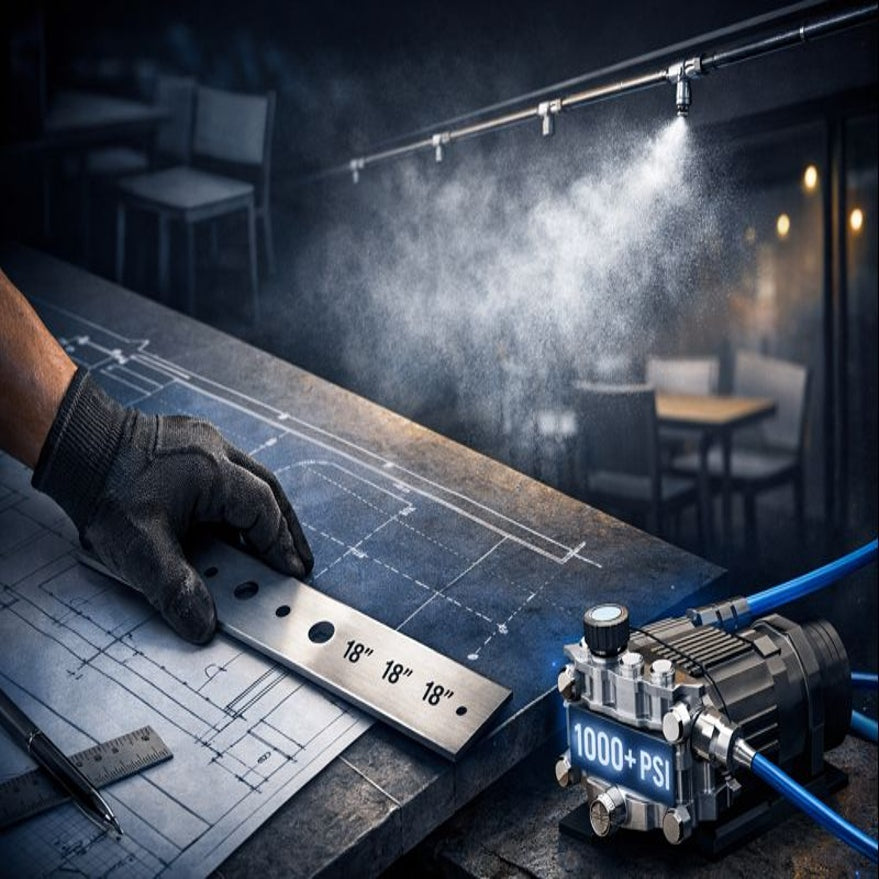
The pump is the heart of any misting system, and pressure determines whether you're delivering comfort or complaints. A high-pressure misting system operating at 1000 PSI or higher generates the ultra-fine mist particles required for flash evaporation—the cooling effect where water transitions to vapor before reaching people or surfaces.
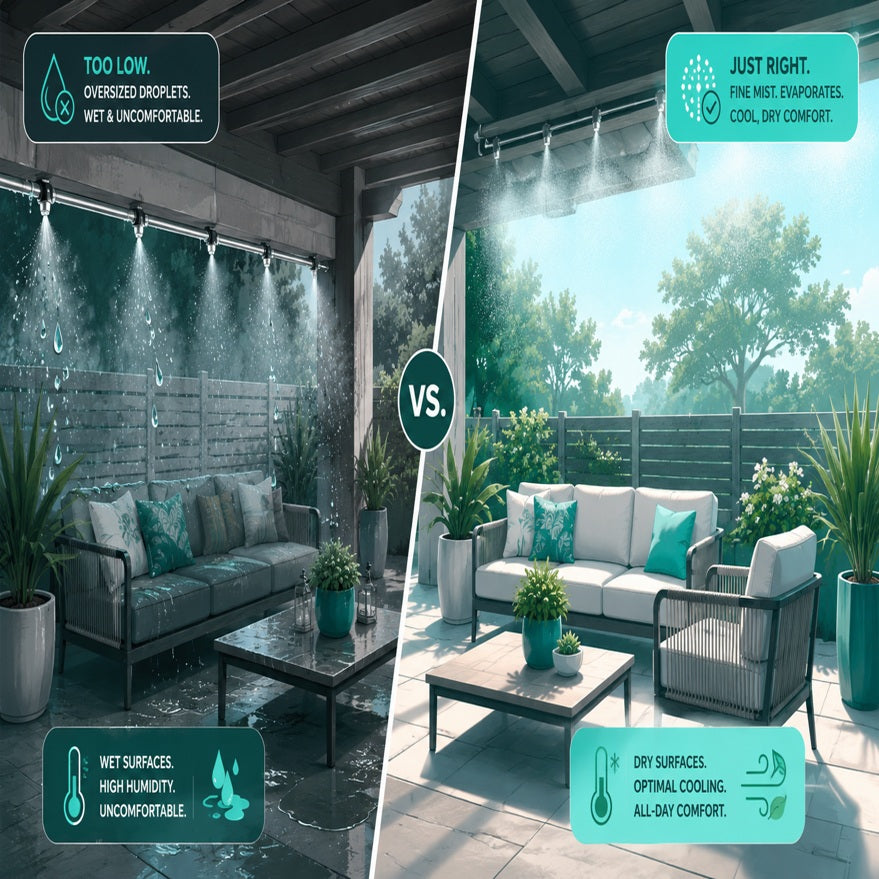
Lower-pressure systems operating at standard water pressure (40-80 PSI) produce larger droplets that will cause wetting. Mid-pressure systems in the 200-300 PSI range offer better evaporative cooling than low-pressure systems but still may cause wetting. For a commercial installation where clients are paying premium prices to dine outdoors or host events, that wetness creates the exact problem you were hired to solve. The relationship between droplet size and evaporation rate is fundamental—smaller particles created by higher pressure evaporate faster and more completely, with wet-bulb temperature reflecting the cooling effect of evaporation and being influenced by ambient humidity conditions.
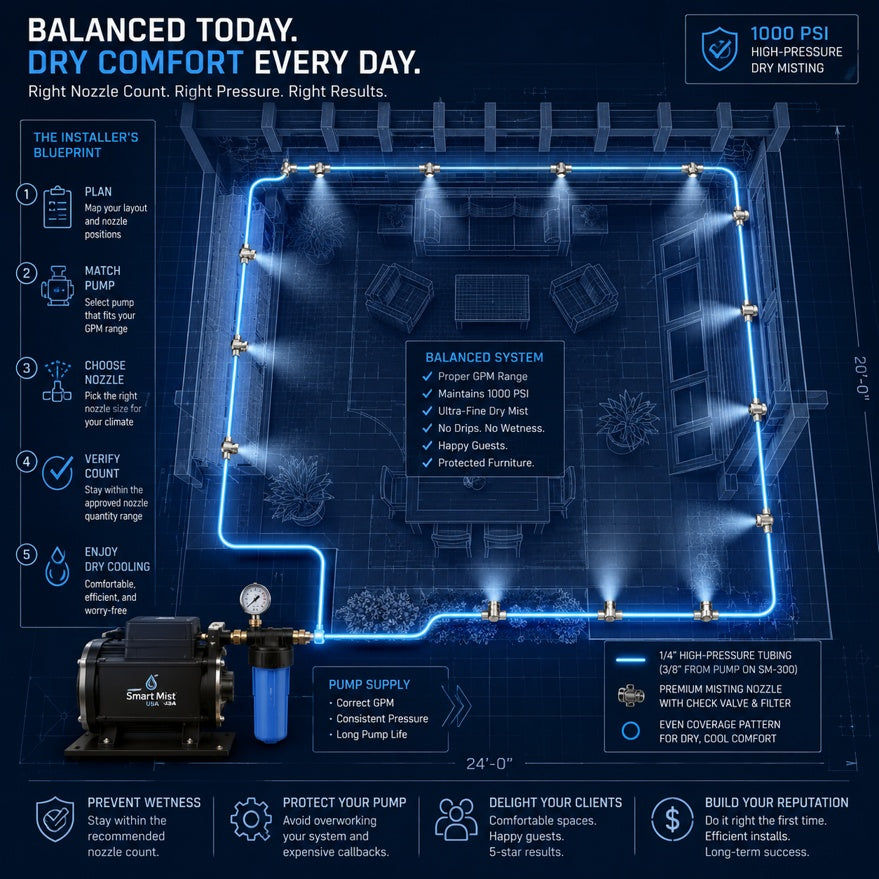
Commercial high-pressure pumps have no user-adjustable flow controls. Instead, flow rate is determined entirely by the nozzle size and quantity selected during system design. Commercial high-pressure misting pumps are matched to the specific nozzle configuration during specification based on two key parameters: the climate and humidity conditions of your location, and the mounting height of the nozzles. Different applications require different pump sizes—when higher or lower flow rates are needed, you specify a larger or smaller pump respectively, not adjust an existing pump.
Installations can see up to 25 degrees of temperature reduction in optimal conditions, with performance depending on temperature and humidity. Drier climates experience particularly impressive results because basic physics governs evaporation rates—when ambient air contains less moisture, it has greater capacity to absorb water vapor, accelerating the evaporation process that creates the cooling effect. The technology performs effectively across various climate conditions when properly engineered.
Filtration That Protects Pumps and Nozzles
Water quality determines system longevity more than any other single factor. A 1000 PSI pump uses precision internal components—typically piston-based designs—that demand clean water to function reliably. Hard water containing dissolved calcium carbonate will gradually build up inside pump valves and on nozzle orifices, eventually causing catastrophic failure.
The stainless steel mesh sediment filter included with quality systems handles particulates like sand, rust, and debris. But sediment filtration alone doesn't address dissolved minerals. Hardness is commonly reported as mg/L as calcium carbonate, and calcium and magnesium values can be used to calculate hardness when needed. In regions with hard water—classified by the USGS as moderately hard (61-120 mg/L), hard (121-180 mg/L), or very hard (over 180 mg/L)—a phosphate treatment system becomes essential for protecting equipment. The phosphate doesn't "filter" calcium; it chemically treats the water to keep minerals in suspension rather than allowing them to precipitate and form scale deposits. Calcium carbonate scaling is associated with flow restriction and clogging in water systems, making prevention through proper treatment critical for equipment longevity.
A five-micron canister filter adds another layer of protection for installations using well water or municipal supplies with known quality issues. The investment in proper filtration is measured in hundreds of dollars during initial installation. The cost of pump replacement due to scale damage—which falls outside warranty coverage—is measured in thousands, plus the labor to diagnose, remove, and reinstall the system.
Fittings, Tubing, and Line Routing That Survive Seasons
The connection points in a misting system experience constant pressure cycling and exposure to environmental conditions. Stainless steel fittings and compression connections provide the durability required for commercial applications, while nylon fittings and push-to-connect designs may be acceptable for concealed runs where replacement access is straightforward.
High-pressure tubing in commercial systems typically uses nylon or stainless steel construction rated for continuous 1000+ PSI operation. For runs that must be concealed behind ceilings or within walls, the tubing should be sleeved inside PEX or PVC conduit. This approach protects the high-pressure line from physical damage and provides a chase for future replacement without demolition. When installing high-pressure lines behind ceiling surfaces specifically, this sleeving requirement is essential for both protection and future serviceability.
Line routing deserves the same attention you'd give to any permanent plumbing installation. Sharp bends create stress concentration points where tubing can fatigue and fail. Insufficient support allows lines to vibrate under pressure, gradually working connections loose. Running lines through areas that experience freezing without proper winterization guarantees burst tubing and fitting failures. These aren't theoretical risks—they're the most common reasons contractors get called back to sites months after installation.
Protected, Ventilated, Remote Pump Placement
Commercial misting pumps are designed for continuous operation, but that doesn't mean they're weatherproof appliances. The pump must be installed in a location that's protected from direct sun and rain, has adequate ventilation to dissipate heat, and provides GFCI-protected electrical service according to outdoor electrical safety practices.
A pump enclosure or weather cover extends equipment life by creating a controlled microenvironment around the pump. Ventilation remains critical—enclosures must allow air circulation to prevent heat buildup during operation. The pump should be readily accessible for seasonal maintenance but positioned away from high-traffic areas where noise or vibration might become issues.
Remote placement also means planning for water supply and drainage access. The pump needs to draw from a reliable source—typically a dedicated hose bib or hard-plumbed connection—and should have a way to drain the system for winterization. These requirements sound basic, but they're frequently overlooked during initial planning, leading to compromised installations that sacrifice longevity for convenience.
The Hidden Cost of "Cheap" Kits
Every contractor has heard the pitch: "Why pay $2,500 for a commercial kit when this retail system costs $300?" The answer reveals itself over the first 12 months of operation, but by then the damage is done.
|
Spec Area |
"Cheap" Kit Pattern |
Commercial-Durable Spec |
|---|---|---|
|
Pressure |
Low/mid pressure; wetting risk |
1000+ PSI baseline for dry comfort |
|
Filtration |
Limited or inconsistent |
Stainless mesh baseline; add phosphate and/or finer filtration where needed |
|
Fittings & Line |
Mixed materials; weak connectors |
Commercial-grade fittings; stainless or protected nylon runs; sleeves for ceiling routing |
|
Pump Placement |
Exposed to sun/rain |
Remote pump with ventilation; protected placement; enclosure/cover where needed |
|
Warranty Reality |
More exclusions become your cost |
Clear install and maintenance plan aligned with warranty terms |
|
Service Risk |
Higher: clogs, wetting complaints, pressure drop |
Lower: stable performance and planned maintenance |
Budget kits typically use pumps in the 200-300 PSI range marketed as "booster pumps" or "mid-pressure systems." These create visible mist, which looks impressive during demonstration. But the larger droplets don't fully evaporate before reaching surfaces, resulting in gradual wetting that accumulates over time. For a restaurant patio with expensive furniture and finishes, that wetting triggers complaints, requires constant adjustment, and ultimately undermines the entire investment in outdoor space.
Cheap kits often lack filtration beyond a basic screen, if they include filtration at all. Without proper protection, even residential water quality will eventually clog nozzles and deposit scale inside the pump. The customer experiences declining performance—weaker mist, uneven spray patterns, intermittent operation—and calls you to fix it. The warranty on quality commercial equipment explicitly excludes damage from hard water and freeze events, but it covers manufacturing defects for up to three years on pumps rated for continuous use. Budget equipment typically offers 90-120 day coverage, if any.
The cost calculation extends beyond the hardware itself. An emergency service call during peak season costs you the billable hours you could have earned on new installations. The reputation damage from recommending equipment that fails is harder to quantify but arguably more expensive—especially in the tightly networked world of landscape architecture and outdoor construction where projects come through referrals.
How to Specify for Longevity

Durable installations start with a systematic approach to equipment selection and installation planning. Use this framework to ensure commercial projects deliver the reliability your clients expect. While professional installation provides valuable expertise and warranty protection, capable DIY execution is also viable when you follow manufacturer guidelines and applicable codes.
Confirm pump sizing matches the nozzle plan. A 1000+ PSI pump must be sized appropriately for the total nozzle count and configuration. Pumps have no user-adjustable flow controls—flow is determined entirely by nozzle size (typically .006" to .012" orifice diameter) and quantity. Nozzle size selection is based on two parameters: your local climate and humidity conditions, and the mounting height of the nozzles. When applications require higher or lower flow rates, specify a larger or smaller pump respectively. Undersized pumps running at maximum capacity will fail prematurely. Oversized pumps waste energy and may require pressure regulation.
Stack filtration for water quality. Start with sediment filtration using stainless steel mesh (included with quality pumps). Add a phosphate treatment system if operating in hard water regions—this is non-negotiable for longevity. Consider a five-micron canister for well water sources or municipal supplies with known sediment issues. Test water quality before specifying; many manufacturers offer free testing to help contractors make informed decisions.
Plan protected remote placement. Identify a location that's out of direct weather, has strong ventilation, and provides convenient access for maintenance. Verify GFCI-protected electrical service and reliable water supply access. Budget for an enclosure if the only suitable location has partial weather exposure. Ensure the pump will remain within recommended run lengths and pressure specifications based on tubing diameter and total length.
Implement seasonal procedures. Winterization prevents the single most common cause of system failure in cold climates. At season's end, drain all lines completely, remove nozzles to prevent implosion from expanding ice, and bring the pump indoors for storage. For calcium buildup on nozzles or internal components, use CLR solution according to manufacturer specifications—vinegar lacks the chemical strength to dissolve calcium carbonate effectively.
These specifications should appear in your project documentation just like any other infrastructure system. For additional technical guidance, consult the installation guides and FAQ resources that cover site-specific considerations.
When Fans Without Misting Are the Right Call
Not every outdoor space requires evaporative cooling. Traditional outdoor wall and pedestal fans provide effective air movement for spaces where the goal is circulation rather than temperature reduction, and they offer their own advantages in terms of simplicity and maintenance requirements.
Fans without misting eliminate water supply requirements, filtration concerns, and winterization procedures. They're appropriate for covered spaces where evaporative cooling would be less effective, or for clients who want to maintain maximum flexibility in furniture arrangement without considering spray patterns and coverage zones.
The choice between misting and non-misting isn't about superiority—it's about matching technology to requirements. A well-engineered outdoor space might use both: traditional fans for air circulation in covered dining areas, and misting systems for open-air sections where temperature reduction justifies the additional infrastructure.
Addressing Real-World Competitive Claims
Two arguments appear repeatedly when contractors evaluate commercial misting options. Both deserve direct responses based on physics and field performance.
"200 PSI booster pumps cool just fine—why overpay for 1000 PSI?" This claim confuses cooling effect with cooling method. A 200-300 PSI system does create cooling, but it does so through wet cooling—the gradual accumulation of moisture on surfaces and clothing. The larger droplets produced at lower pressure don't achieve flash evaporation consistently and will cause wetting. For residential applications where occasional dampness might be acceptable, this approach can work. For commercial environments where clients expect dry comfort, it creates the liability you're trying to avoid. The difference isn't marketing—it's measurable droplet size and evaporation rate.
"Hose-pressure kits are simpler to install." Simpler initial installation that leads to performance complaints isn't actually simpler—it's shortsighted. Residential water pressure (typically 50-70 PSI) can't generate the fine mist required for evaporative cooling. These systems essentially become outdoor sprinklers that gradually wet everything in range. Professional-grade systems require more upfront planning for pump placement, filtration, and power supply, but they're engineered to deliver the dry cooling performance that commercial clients expect. The complexity is in the initial engineering, not in ongoing operation.
Understanding System Wetting Issues
Even properly designed high-pressure systems can experience wetting under certain conditions. Before assuming equipment failure, evaluate these four factors that affect evaporation performance:
-
Temperature and humidity conditions. When ambient temperature drops below optimal ranges or humidity rises significantly, evaporation slows regardless of system pressure. This is physics, not equipment failure.
-
Mounting height. Nozzles or fans positioned too low don't provide adequate distance for complete evaporation before mist reaches occupied areas.
-
Nozzle size. Larger orifice nozzles (.012" vs .006") produce greater flow but also larger droplets that require more distance to evaporate completely.
-
System capacity mismatch. If total nozzle count and size exceed pump capacity, system pressure drops below the 1000 PSI threshold required for flash evaporation. This commonly occurs when installations are expanded without verifying pump specifications.
Troubleshooting these variables systematically prevents unnecessary service calls and helps clients understand the relationship between environmental conditions and system performance.
TCO Analysis: The Numbers That Matter
Understanding the true cost of commercial misting equipment requires looking beyond acquisition price to the total cost of ownership over the system's functional life.
Consider a hypothetical commercial installation scenario for illustration purposes. A budget kit costs $800 initially but uses a 200 PSI pump without adequate filtration. A commercial-grade 1000 PSI system costs $2,500 with proper filtration and components designed for continuous use. Over 36 months, the budget option might accumulate these costs:
Budget System Costs (Example):
-
Initial kit: $800
-
First pump replacement (hard water damage, month 14): $350 parts + $200 labor
-
Second pump replacement (wear, month 28): $350 parts + $200 labor
-
Four service calls for wetting complaints: $400 unbilled time
-
Lost margin from one project due to reputation concerns: $1,200
-
Total: $3,500
Commercial System Costs (Example):
-
Initial kit: $2,500
-
Phosphate filtration: $150
-
Annual maintenance (oil changes, inspection): $300
-
Total: $2,950
In this example, the budget option costs 19% more over three years while delivering inferior performance and consuming your time on unbillable service work. This calculation doesn't account for the stress, relationship damage, or opportunity cost of having your reputation questioned.
For planning purposes, factor these ownership elements into project bids:
-
Seasonal maintenance time (2-3 hours annually for winterization and startup)
-
Filter replacement or cleaning (quarterly for hard water regions)
-
Nozzle inspection and replacement (annually or as needed)
-
Pump oil changes per manufacturer schedule (typically every 500-1000 hours depending on model)
These ongoing costs are predictable and manageable when you specify durable equipment initially. They become unpredictable and expensive when you're constantly addressing premature failures.
Common Questions About Commercial Misting Durability
How do high-pressure (1000+ PSI) kits reduce wetting complaints?
High pressure combined with correct nozzle planning and placement creates the fine droplet size required for flash evaporation. The smaller particles evaporate completely before reaching surfaces, eliminating the gradual moisture accumulation that triggers complaints in lower-pressure systems.
What filtration is required in hard-water regions to protect pumps and nozzles?
Stainless mesh filtration provides the baseline protection against sediment. In hard-water regions, add phosphate treatment to prevent scale formation, and consider finer filtration stages (such as five-micron canisters) based on observed hardness levels and scaling patterns. Water quality testing before installation helps determine the appropriate filtration stack for your specific conditions.
Where should a commercial pump be located for best longevity?
Install the pump in a ventilated, protected location out of direct weather exposure. The site should offer convenient access for maintenance while keeping the pump away from high-traffic areas. GFCI-protected electrical service is essential for outdoor installations. If no fully protected location exists, use a ventilated enclosure designed for pump equipment.
What does the warranty cover and exclude in real-world use?
Quality warranties typically cover manufacturing defects under stated time periods, often up to three years for commercial-duty pumps. Common exclusions include installation issues, weather exposure damage, freeze events, and water-related damage from scale or minerals. Nozzles are commonly treated as consumable components with limited coverage.
When are fans without misting the better option?
Choose fans without misting when airflow alone provides sufficient comfort, when water management adds complexity without proportional benefit, or when maintaining maximum furniture flexibility matters more than temperature reduction. Covered spaces where evaporative cooling would be less effective are natural candidates for air circulation rather than misting.
Proof Paths and Next Steps
Making informed equipment decisions requires access to detailed technical documentation and support resources. For commercial misting system kits designed for professional installation, review complete specifications including pump capacity, filtration requirements, and warranty coverage.
Compare layout approaches with resources like the Perimeter Misting vs. Misting Fans guide to understand which configuration best serves specific venue types.
Before committing to a specific system, verify three critical elements: pump capacity matches your nozzle plan, filtration is appropriate for local water quality, and installation location allows protected placement with adequate ventilation. Schedule a consultation to review site-specific requirements and avoid costly specification errors that become apparent only after installation.
The investment in commercial-grade misting infrastructure protects both your client's outdoor space investment and your professional reputation. Durability isn't about paying more—it's about spending once instead of constantly managing the consequences of inadequate equipment.
Disclaimer:This article provides general information about commercial misting system durability factors for educational purposes. Specific installation requirements, warranty terms, and maintenance schedules vary by manufacturer and local conditions. Always consult product documentation and qualified professionals when specifying equipment for commercial applications. Water quality testing is recommended before installation to determine appropriate filtration requirements.
References
[1] ASHRAE Guideline 10-2023 (Addendum a, Aug 22, 2024): wet-bulb temperature reflects evaporative cooling and is influenced by humidity.
[2] U.S. EPA Proposed 2026 MSGP Appendix J (Dec 2024): hardness calculation and reporting as mg/L CaCO₃.
[3] Bhattacharjee et al. (First Online Jan 12, 2024): CaCO₃ scaling can cause flow restriction and clogging in water systems.
[4] OSHA eTool (Electrical incidents): GFCI use and weather-rated protection practices for outdoor power connections.