(916) 308-3856


📌Key Takeaways
Pre-engineered high-pressure misting kits deliver coordinated components at 1000+ PSI, eliminating the compatibility guesswork that burns install time and triggers callbacks.
-
Compatibility Engineering Prevents Mid-Install Chaos: Turnkey kits arrive with pump, filtration, tubing, nozzles, and fittings designed to interface cleanly, eliminating the adapter hunts that waste half-days.
-
Four Wetting Causes Drive Most Callbacks: Temperature/humidity limits, mounting height errors, oversized nozzles, or pump-nozzle imbalance all prevent proper evaporation—each has a specific fix.
-
Nozzle Configuration Sets Flow Rate: Flow is determined by nozzle size and quantity, not adjustable pump settings; different applications require different pump sizes, not adjustments.
-
Ultra-Fine Atomization Delivers Dry Cooling: At 1000+ PSI, water breaks into micro-droplets smaller than 10 microns that flash-evaporate before wetting surfaces, delivering up to 25 degrees of cooling.
-
Filtration Guards Against Premature Failure: Sediment filters prevent clogs while phosphate treatments stop calcium deposits that restrict flow and damage pump valves.
Engineered compatibility means faster installs and fewer service calls.
Landscape contractors and pool builders installing outdoor cooling systems will find actionable installation workflow guidance and callback prevention strategies here, preparing them for the technical specifications that follow.
The loading dock. 2:00 PM in July. Your crew is halfway through a patio build when the homeowner asks about cooling. You pull up the supply catalog. Pumps on page twelve. Nozzles on page forty-seven. Tubing somewhere in between. Each one from a different vendor, each with its own compatibility quirks.
You already know how this ends: the pump arrives, the fittings don't match, and you're burning a half-day tracking down adapters that should have been in the box from the start.
High-pressure misting kits eliminate that friction. These pre-engineered packages deliver coordinated components—pump, filtration, tubing, nozzles, and fittings—designed to work together at 1000+ PSI. That pressure threshold isn't arbitrary. It's the baseline for effective atomization: the point where water is forced into ultra-fine micro-droplets (typically smaller than 10 microns) that flash-evaporate before they can wet surfaces. This phase change delivers up to 25 degrees of cooling, depending on temperature and humidity conditions.
For landscape contractors and pool builders, this compatibility engineering translates directly to faster installs and fewer callbacks related to wetting complaints or early component failure.
High-Pressure Atomization Prevents Wetting Problems
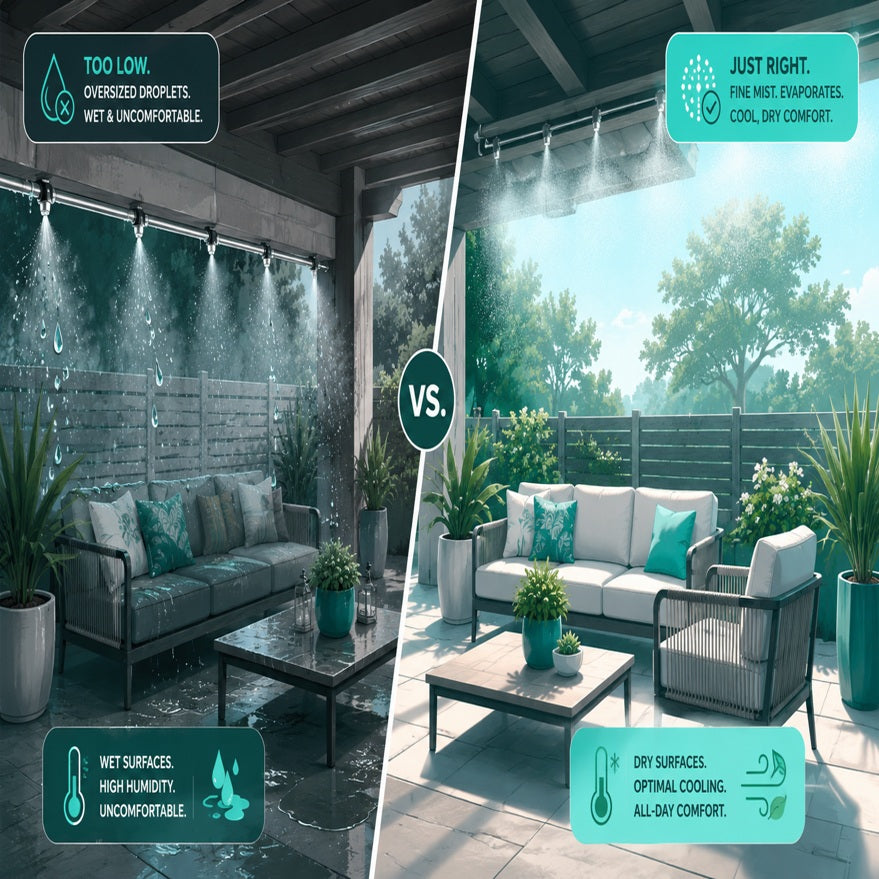
Lower-pressure systems—those running at 30–40 PSI—produce larger water droplets that will cause wetting. Mid-range systems around 200–300 PSI perform better but still may cause wetting.
At 1000+ PSI, the pump forces water through precision nozzles that shatter it into a fine mist. The droplets are small enough to absorb heat from the surrounding air and transition to vapor almost instantly. This process—flash evaporation—is what separates dry cooling from merely spraying water into the air. The principle behind this is well-established in HVAC engineering: water absorbs energy as it changes from liquid to vapor, pulling heat from the air in the process.
Climate affects this performance. In dry environments, the air's low moisture content accelerates evaporation—the basic physics of evaporative cooling means drier air can absorb more moisture, creating more cooling—often delivering the full cooling range. In humid climates, the air is already saturated with moisture, so evaporation happens more slowly. The cooling effect is still present, but the temperature drop may be less dramatic. The 1000+ PSI standard ensures the system performs as effectively as physics allows in any given environment.
A Professional Kit Includes Components That Reduce Install Friction
When you open a turnkey misting kit, you're looking at five core elements. Each one addresses a specific failure mode that wastes time or triggers callbacks.

The pump maintains 1000+ PSI to enable flash evaporation. It's mounted remotely—typically around a corner 20–30 feet from the coverage area to reduce perceived noise. The included high-pressure tubing allows placement up to 50 feet away while maintaining system pressure. The pump can't be integrated into a fan or hidden inside a patio structure; it's a standalone component that requires access to water and power. Nylon pipe must be used for the initial connection from the pump to the first fitting to prevent shaking. From there, stainless steel, nylon, or a combination can carry the line through the rest of the layout. When using app-controlled pumps, confirm the bluetooth connection before finalizing the mounting location. These pumps wait for a manual command after power-up; they don't automatically start spraying when electricity is restored. For detailed pump placement strategies, consult the Knowledge Center.
Filtration protects expensive components and prevents callbacks. Basic sediment filters catch particles—dirt, rust, debris—that would clog nozzle orifices. Hard-water treatment is a separate function. Phosphate-based solutions (sodium hexametaphosphate) sequester calcium and magnesium, preventing mineral deposits from building up inside nozzles and pump valves. These deposits don't just affect spray quality—they restrict flow and reduce equipment lifespan. In areas with severe hard water, minerals like calcium carbonate form scale that accumulates in pipes and water-using equipment. This buildup can impair performance and require premature component replacement. Upgraded options like Scalex Pro offer enhanced protection in areas with severe water-quality issues.
Lines and fittings vary by kit type. Standard residential kits often use 1/4-inch slip-lock fittings with grooved tubing ends. Commercial misting system kits designed for continuous usage may use 3/8-inch compression fittings, which create permanent connections by tightening a nut that compresses inner ferrules. Both systems are reliable; the choice depends on project scope and anticipated runtime.
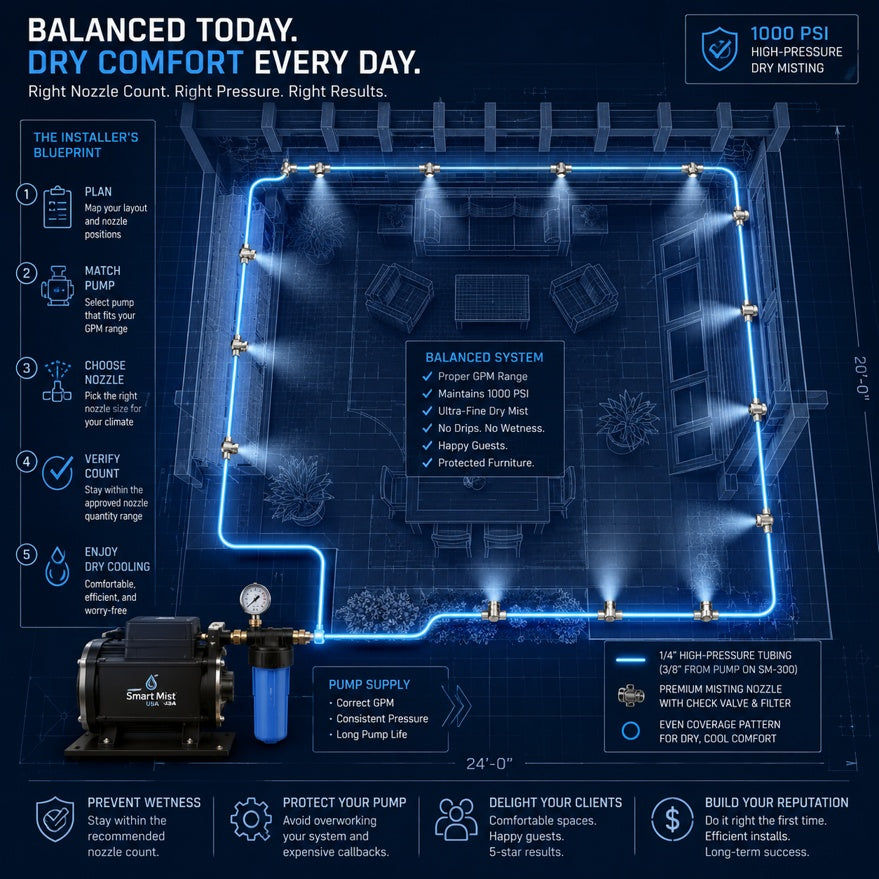
Nozzles control droplet size. Smaller orifices paired with high pressure create finer mist. Nozzle size is determined during initial setup based on three factors: climate humidity, mounting height, and pump flow capacity. A standard starting-point spacing is 24–30 inches between nozzles. This isn't code; it's guidance. Actual spacing depends on the specific layout and coverage goals.
Optional app-controlled interval spraying provides timed on/off cycles—short bursts of mist followed by short pauses. This isn't pressure adjustment or flow control. The pump still operates at full capacity; interval timing simply helps maintain dry cooling as temperature and humidity shift throughout the day. For instance, a system might spray for ten seconds, pause for twenty, then repeat. The goal is to match cooling output to changing conditions without overwhelming the air's capacity to absorb moisture. Learn more about the benefits of interval spraying.
Kits Reduce Install Time by Removing Sourcing Complexity
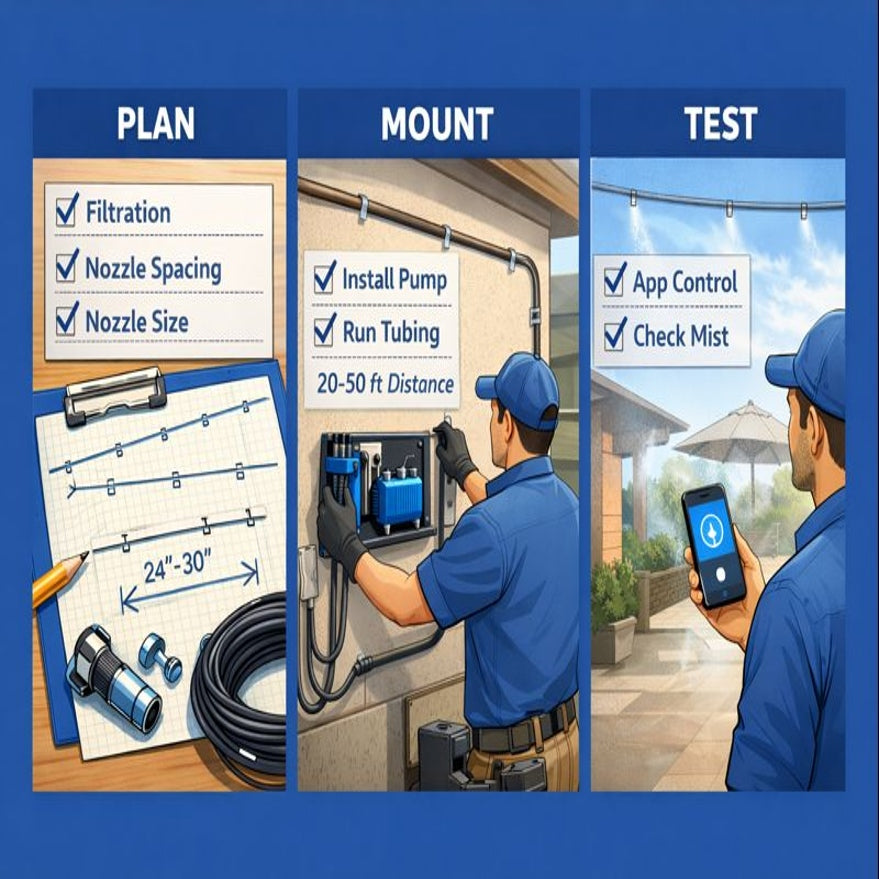
The typical misting install workflow has five steps: plan the layout, mount the pump, run the supply lines, place the nozzles, and test the system. Turnkey kits compress the front end by eliminating compatibility guesswork.
Pre-planning the loop prevents mid-install supply runs. Sketch the coverage area. Identify structural attachment points. Confirm water and power access at the pump location. With a pre-engineered kit, you're working from a known parts list rather than improvising connections between components that weren't designed to interface cleanly.
Basic spacing guidance provides a starting baseline. Position nozzles roughly 24–30 inches apart along the mist line. This creates even coverage in most scenarios. Adjustments happen during the test phase, not during procurement. If a section needs denser mist, add nozzles. If coverage is too aggressive, reduce nozzle count. The kit's modular design supports field modifications without requiring a different pump or filtration setup—within capacity limits.
Pump placement balances noise management and system performance. Locate the unit where the sound won't disrupt the space, but maintain easy access for seasonal maintenance. The included high-pressure tubing bridges the gap between the pump and the mist line, acting as a vibration dampener to prevent pump pulsation from shaking the rigid structure.
For detailed installation steps specific to your kit configuration, refer to the installation guides available on the Smart Mist USA website.
Callback Prevention Checklist
Four issues drive most service calls after a misting system install. Each one has a clear root cause.

Wetting complaints occur when water droplets land on surfaces instead of evaporating. This happens for four reasons:
-
Temperature too low or humidity too high: The air can't absorb additional moisture. While you cannot change atmospheric physics, you can mitigate saturation. In these conditions, switch to smaller nozzle orifices (e.g., 0.006" or 0.008") to reduce water output, reduce runtime using interval timers, or accept that wetting is temporary.
-
Nozzles mounted too low: Droplets don't have enough time to evaporate before reaching the ground. Raise the mist line.
-
Nozzle size too large: Larger orifices produce larger droplets that evaporate more slowly. Swap in smaller nozzles.
-
Nozzle quantity or size exceeds pump capacity: If the pump can't maintain 1000+ PSI across the system, pressure drops and droplet size increases. Reduce nozzle count or select a larger pump.
Clogged nozzles stem from calcium buildup. Hard water deposits accumulate over time, restricting flow and distorting spray patterns. Clean nozzles with CLR solution—not vinegar, which is less effective against mineral scale—or replace the nozzle. Soak clogged nozzles in CLR and rinse thoroughly before reinstalling. If buildup is severe or recurring, upgrade the filtration system to address the water-quality issue at the source. For guidance on selecting appropriate filtration, see the Knowledge Center.
Freeze damage results from water trapped in lines during winter. Drain the system completely. Use compressed air to blow out residual moisture from tubing and pump chambers. Store the pump in a protected location where temperatures won't drop below freezing. Detailed winterizing procedures are available in the Knowledge Center.
Pump and nozzle imbalance occurs when nozzle demand exceeds pump output. Flow rate is determined by nozzle size and quantity—not by adjustable settings on the pump. If a system requires higher flow, a larger pump is needed. If lower flow is appropriate, a smaller pump or fewer nozzles is the solution. For help matching pump capacity to nozzle configuration, consult the balancing guide or reference the nozzle size and quantity chart.
Which Kit Type Fits the Job Without Over-Engineering It
Standard high-pressure misting system kits handle most residential and light commercial applications. They're sized for intermittent use: cooling a backyard during a gathering, maintaining comfort on a restaurant patio during peak hours.
Commercial kits are designed for continuous operation. These systems run all day without overheating or experiencing performance degradation. They often use 3/8-inch compression fittings and may offer additional pump capacity. If a project involves hospitality environments, large outdoor dining areas, bars, restaurants, or industrial cooling, commercial-grade components reduce long-term maintenance and extend system lifespan.
App-controlled interval spraying suits projects where cooling needs shift throughout the day. As temperature rises and humidity falls, the system can increase spray frequency to maintain comfort. As conditions moderate, it can pull back to prevent over-saturation. This isn't about adjusting pressure or flow—those are fixed by the pump and nozzle configuration. It's about timing: controlling when the system activates to match the air's capacity to absorb moisture.
For projects requiring integration with outdoor fans, explore misting ceiling fans and related kits. These combine air movement with evaporative cooling in spaces where perimeter misting lines aren't practical.
Select a Kit Based on Project Scope
When choosing your kit, focus on the coverage area and intended use—residential or commercial. The kit's pump and nozzle configuration are designed to work together for reliable 1000+ PSI performance. During initial setup, nozzle size is selected based on climate humidity and mounting height, ensuring the system delivers effective cooling in your specific environment.
For contractors working across multiple climate zones or project types, standard kits provide flexibility for most scenarios. Commercial kits offer reliable performance in high-demand environments. App-controlled options add convenience for clients who want responsive, automated operation. For additional resources, including detailed pump placement strategies and interval spraying benefits, browse the Knowledge Center for technical articles on system optimization. If you're upgrading an existing system, explore options to retrofit your existing system. For common installation questions, visit our frequently asked questions page.
Disclaimer: This guide is intended as a comprehensive starting point. For decisions specific to your unique situation, we always recommend consulting a qualified professional.
Our Editorial Process
At Smart Mist USA, our content is created to educate contractors and outdoor living professionals about high-pressure misting technology. Our articles draw from installation experience, technical documentation, and industry best practices to provide practical guidance for real-world applications.
About the Smart Mist USA Insights Team
The Smart Mist USA Insights Team is our dedicated engine for synthesizing complex topics into clear, helpful guides. While our content is thoroughly reviewed for clarity and accuracy, it is for informational purposes and should not replace professional advice.