(916) 308-3856



📌Key Takeaways
Material choice determines whether your misting installation delivers professional results or generates service callbacks.
-
Hybrid Installations Prevent Problems: Nylon from the pump absorbs vibration while stainless steel on visible runs maintains straight, architectural lines that clients expect.
-
Never Cut Slip-Lock Stainless Sections: Cutting creates sharp edges that slice internal O-ring seals, causing leaks that compression fittings or factory-chamfered ends avoid.
-
Temperature Movement Requires Different Support: Stainless steel's minimal thermal expansion keeps exposed runs straight, while nylon's higher expansion demands mounting near each nozzle to prevent sagging.
-
Flash Evaporation Depends on Tubing Performance: Proper material selection maintains the 1000+ PSI droplet formation needed for dry cooling without wetting surfaces.
-
Field Experience Drives Material Upgrades: Contractors installing nylon in visible areas frequently replace those sections with stainless as client finish expectations increase.
Right material, right location = no callbacks.
The site visit went perfectly. The client loved the design, the crew finished on schedule, and you handed over a pristine outdoor space. Then, three weeks later, the call comes: the misting lines are sagging near the pergola, or worse, the patio's getting wet instead of staying dry. What should have been a showcase project now needs a service visit—and an uncomfortable conversation about what went wrong.
For landscape professionals installing high-pressure misting systems, the tubing choice isn't just a technical detail. It's the difference between a clean, professional finish and a callback that eats into your margin. The right material keeps lines straight and systems performing as engineered; the wrong choice leads to visible sag, vibration issues, or compromised flash evaporation that leaves surfaces wet instead of comfortably cool.
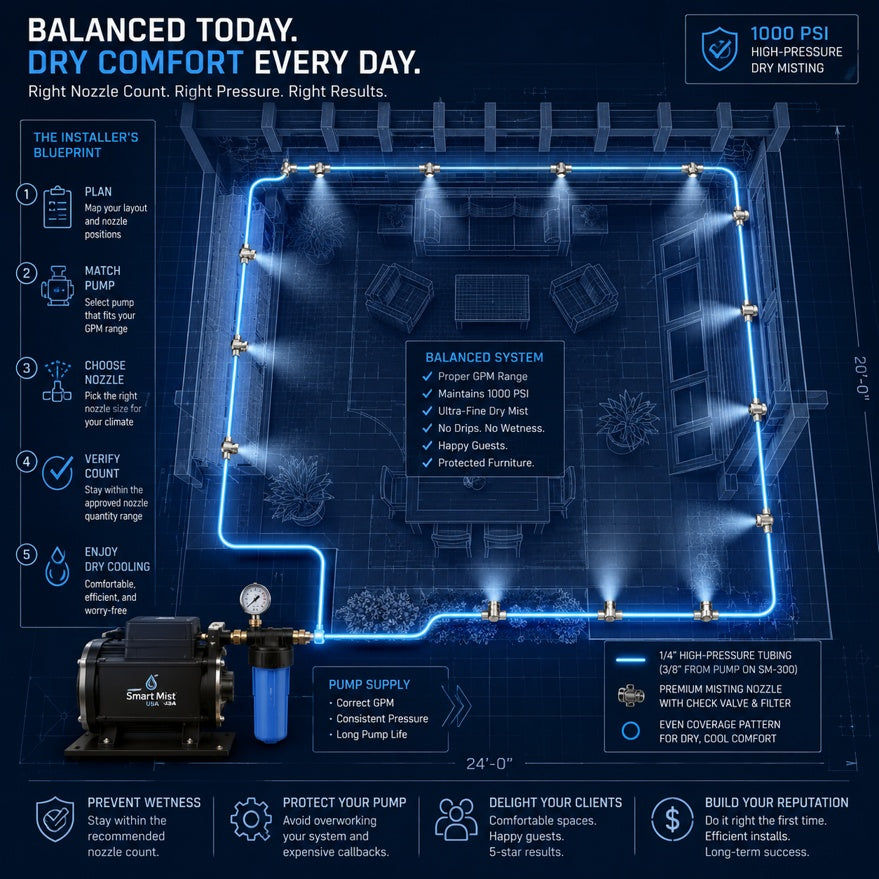
High-pressure misting systems operate at 1000+ PSI to create ultra-fine droplets that evaporate instantly on contact with air—delivering dry cooling without wetting surfaces. This flash evaporation process is what separates professional installations from basic spray systems, and the tubing you select plays a direct role in maintaining that performance. Both stainless steel tubing (SS 304) and nylon tubing (PA12) have earned their place in professional installs, but each excels in different applications. Understanding when to use each—and when to combine both in a hybrid approach—is what separates installations that impress from those that disappoint.
Matching Material to Application
For landscape contractors planning a misting installation, the decision comes down to three proven approaches:
Choose stainless steel when lines are visible and aesthetics matter. Stainless delivers straight, professional runs that won't bow with temperature changes. It's the premium choice for pergolas, covered patios, and any area where the tubing becomes part of the finished design. Widely accepted industry best practices favor stainless for visible sections, and for good reason: it maintains crisp lines that reflect installation quality.
Choose nylon when routing requires flexibility or when lines can be concealed. Nylon excels in hidden runs—routed through structures, tucked behind beams, or buried in landscaping. Its flexibility simplifies complex routing and reduces the need for multiple fittings. Nylon also plays a critical role in vibration management, which is why it's specified for the pump-to-first-nozzle run in most professional installs.
Choose a hybrid approach for the majority of installations. This combines nylon's practical advantages (flexibility, vibration dampening) where it's hidden with stainless steel's premium appearance where it's exposed. The hybrid approach is what experienced contractors actually use: nylon from the pump to the first connection point to prevent shaking, then stainless for all visible runs that showcase the system's clean, engineered design.
Material Comparison: Stainless Steel vs. Nylon
|
Criteria |
Stainless Steel (SS 304) |
Nylon (PA12) |
|---|---|---|
|
Cost |
Higher initial investment |
Lower material cost |
|
Durability |
Exceptional; corrosion-resistant for decades |
Very good; UV-stabilized for outdoor use |
|
Aesthetics |
Professional, architectural appearance |
Functional; less visually refined when exposed |
|
Install Difficulty |
Moderate; requires careful planning for bends |
Easier; flexible routing through structures |
|
Temperature Response |
Minimal expansion/contraction; stays straight |
Can bow with temperature changes if not properly mounted |
|
Best Use Cases |
Visible pergola runs, patio perimeters, architectural features |
Concealed routing, pump connections, areas with complex turns |
|
Rework Path |
Permanent; designed for long-term installations |
Approximately half of nylon users upgrade visible sections to stainless later |
Stainless Steel Tubing: When Premium Appearance Matters
Stainless steel tubing delivers the professional finish that clients notice. When misting lines are integrated into covered outdoor living spaces—running along pergola beams, framing patio edges, or defining entertainment areas—stainless creates the clean, intentional look that signals quality craftsmanship.
Key advantages for professional installations:
The material's rigidity is its primary asset. Stainless maintains straight runs without the bowing or sagging that can occur with nylon, particularly in exposed applications where temperature fluctuations are significant. As one contractor noted in project feedback, "The stainless is a great way to go in those areas where the tubing is exposed. It doesn't bow due to temperature change like the nylon tubing." This stability means the installation looks as professional three years later as it did on day one.

The dimensional stability of SS 304 stainless steel stems from its low thermal expansion coefficient—approximately 17.3 × 10⁻⁶ per °C across typical outdoor temperature ranges.¹ This property ensures that exposed runs maintain their geometry through seasonal temperature swings, a critical factor in installations where visual precision matters to clients who've invested in premium outdoor spaces.
Stainless steel's corrosion resistance ensures longevity in harsh outdoor environments. The SS 304 specification used in professional misting systems provides excellent resistance to chlorine exposure (important near pools), salt air in coastal installations, and the general weathering that occurs in outdoor applications.² This durability translates to fewer service calls and a system that reflects well on your work long-term.
Installation considerations:
The primary constraint with stainless is flexibility—or rather, the lack of it. Complex routing with multiple direction changes requires careful planning and additional fittings. Each elbow or tee represents another connection point to seal and inspect, which increases both material cost and installation time.
Many professional stainless sections come pre-assembled with nozzles installed at standard intervals (commonly 24-inch spacing). This fabrication speeds installation for straightforward runs but reduces flexibility for custom layouts. When using stainless steel tubing with slip-lock fittings, the smooth, factory-chamfered finish and shallow groove at each end are essential for the fittings to grip and seal properly. If you need custom lengths, stainless steel tubing can be cut, but only with a proper tube cutter—never use hacksaws or similar tools, which create jagged edges that damage the internal O-ring seal and cause leaks. A quality tube cutter produces a clean, chamfered cut. However, cutting removes the factory groove, so any cut ends must use compression fittings rather than slip-lock fittings. Compression fittings are designed specifically for cut tubing ends and provide reliable sealing without requiring the factory groove.
Nylon Tubing: Flexibility for Complex Routing
Nylon tubing solves routing challenges that would be impractical with rigid stainless. When installations require lines to snake through structures, make tight radius turns, or follow irregular paths, nylon's flexibility becomes the practical choice that keeps projects moving forward.
Where nylon excels:

The material's flexibility is most valuable in concealed applications. Routing behind fascia boards, through wall cavities, or along hidden structural members is straightforward with nylon but would require multiple fittings and careful planning with stainless. This ease of routing reduces installation time in complex layouts and minimizes visible connection points that could detract from the finished appearance.
Nylon plays a critical role in vibration management. The pump-to-first-nozzle run should be nylon tubing to prevent the shaking and vibration that can occur when rigid stainless connects directly to the pump. This isn't just about noise—excessive vibration can stress fittings over time and create potential leak points. Even in predominantly stainless installations, that first section of nylon provides essential dampening.
Cost considerations favor nylon for projects with tight budgets or where extensive hidden routing is required. The material itself is less expensive than stainless, and the ability to cut nylon to exact lengths reduces waste. For installations where tubing will be completely concealed, nylon delivers reliable performance without the premium cost.
Practical limitations:
When exposed to direct sunlight and temperature fluctuations, nylon has a greater tendency to bow or sag between mounting points compared to stainless. This isn't a failure—it's a material characteristic that requires proper mounting strategy. PA12 nylon exhibits a coefficient of linear thermal expansion in the range of 100-140 × 10⁻⁶ per °C,³ approximately six to eight times higher than stainless steel. Over long exposed runs, this differential movement becomes visible if support spacing is inadequate. Tube mounts or hose clamps positioned near each nozzle prevent sagging and maintain the clean appearance that clients expect.
The visual finish of nylon is functional rather than architectural. While it performs its cooling function effectively, nylon doesn't provide the refined, intentional aesthetic that stainless delivers in visible applications. Field experience reflects this reality: contractors who initially install nylon in visible areas frequently end up upgrading those sections to stainless later as client expectations for finish quality increase.
UV exposure can gradually affect polymer properties over extended outdoor use, though UV-stabilized PA12 formulations resist this degradation significantly better than unstabilized materials.⁴ For concealed applications where UV exposure is minimal, this consideration becomes largely irrelevant to system performance.
The Hybrid Approach: Combining Both Materials Strategically
The most effective professional installations don't choose one material over the other—they use both strategically. The hybrid approach places each material where it performs best: nylon where flexibility and vibration dampening matter, stainless where appearance and long-term straightness are priorities.
Standard hybrid configuration:
Start with nylon for the critical pump-to-first-connection run. This section should always be nylon to prevent vibration and shaking that occurs when rigid tubing connects directly to the pump's pulsing output. This nylon section can be completely concealed—routed through walls, underground, or along hidden structural paths—so its appearance is irrelevant.
Transition to stainless for all visible sections. Once the line reaches the areas clients will see—pergola beams, patio perimeters, or entertainment zones—switch to stainless steel sections for that premium, architectural appearance. The transition point is typically a concealed location where both tubing types can connect via an adapter union or appropriate compression fittings.
Use nylon for any hidden secondary runs. If the system requires routing behind structures, through landscaping, or along concealed paths to reach additional zones, nylon provides flexibility and cost efficiency that makes sense for portions of the system that no one will see.
Installation sequence that prevents problems:
Plan the entire route before ordering materials. Identify which sections will be visible (stainless) and which will be concealed (nylon). This planning prevents the common scenario of ordering all stainless only to discover that routing complexity would be much simpler with flexible nylon in specific sections.
Order fittings that match your tubing strategy. Slip-lock fittings work with uncut stainless sections that retain their factory-chamfered ends. Compression fittings are required when cutting stainless or when transitioning between nylon and stainless sections. Having the correct tools on site—particularly a quality tube cutter for nylon—prevents field improvisation that compromises seal quality.
Installation Reality Checks: Avoiding Common Mistakes
Professional installations succeed by following material-specific handling rules that prevent callbacks. The most frequent issues stem from not understanding how each tubing type must be worked.
Cutting Stainless Steel Tubing: Use Proper Tools and Fittings
Stainless sections designed for slip-lock fittings feature a precision-chamfered end with a shallow groove. This smooth taper and groove are critical for the slip-lock fitting to grip properly without causing damage. While stainless steel tubing can be cut to custom lengths, you must use a proper tube cutter—never a hacksaw or similar cutting tool. Hacksaws and similar tools create sharp, jagged edges that can slice the internal O-ring seal and cause leaks. A quality tube cutter produces a clean, chamfered cut that protects fitting integrity.
When you cut stainless steel tubing (even with a proper tube cutter), the factory groove is removed from the cut end. This means you must use compression fittings on any cut ends—slip-lock fittings cannot be used on cut ends because they require the factory groove to function. Compression fittings are specifically designed to work with cut tubing ends and provide reliable seals without requiring grooves.
Cut Nylon Square and Support Near Nozzles
When cutting nylon to length, use a proper tube cutter and ensure cuts are perpendicular—exactly 90 degrees to the tubing axis. Angled cuts reduce the sealing surface area and create potential leak points that may not appear during initial testing but can develop as the system cycles through pressure changes.
Nylon requires physical support to maintain professional appearance. Install tube mounts or hose clamps near each nozzle to prevent sagging. Use stainless steel mounting screws rather than standard hardware to avoid rust stains on structures—a detail that matters to clients who've invested in premium outdoor spaces.
Respect Nozzle Spacing Guidance
The specified spacing of 24 to 30 inches between nozzles is engineered for proper droplet evaporation. Closer spacing seems like it would improve cooling, but it creates the opposite problem: droplets from adjacent nozzles can combine into larger droplets that don't evaporate as efficiently, resulting in wetting rather than dry cooling.
Stainless sections come pre-spaced at 24-inch intervals. Nylon installations require measuring and marking spacing during the layout phase. This spacing is part of the flash evaporation physics that makes high-pressure misting work as engineered—don't modify it based on intuition.
Keep the Pump-to-First-Nozzle Run Under 50 Feet
The distance from pump to first nozzle should not exceed 50 feet. Longer distances can introduce performance and response issues depending on layout complexity. Keeping this initial run short ensures the system behaves predictably and maintains the pressure characteristics needed for proper flash evaporation.
Contractor FAQs: Practical Installation Questions
Can I swap nylon for stainless later without redoing the entire system?
Yes, but it's easier if you plan for it initially. The pump-to-first-connection nylon section should remain nylon for vibration reasons. Visible nylon sections can be replaced with stainless ones by disconnecting at fittings and installing stainless sections in their place. This is why approximately half of installations that start with visible nylon end up upgrading—the performance is fine, but clients prefer the stainless appearance. Planning a hybrid system from the start avoids this rework.
How do I prevent sagging on long horizontal runs?
Add intermediate support points using tube mounts or clamps. For nylon, position a mounting point within 12 inches of each nozzle as a baseline, with additional support every 36 to 48 inches on long runs. Stainless requires less frequent support due to its rigidity, but any unsupported span over 6 feet should have at least one intermediate mount. Use stainless mounting hardware to prevent corrosion stains.
Are fittings interchangeable between stainless and nylon?
Fitting compatibility depends on type, not material. Compression fittings work with both stainless (cut ends) and nylon. Slip-lock fittings require uncut stainless sections with factory grooves. When transitioning between materials in a hybrid system, compression fittings provide the universal connection method that works reliably with both tubing types. The tubing collection page specifies which fittings work with each material.
What causes vibration or shaking in the lines?
Vibration typically occurs when rigid stainless connects directly to the pump without a nylon dampening section. The pump's pulsing output creates oscillation that travels through rigid tubing, causing noise and potential fitting stress. The solution is to ensure that the first 10 to 20 feet from the pump is nylon, which absorbs this vibration before the line transitions to stainless. If vibration appears in an existing all-stainless system, retrofitting a short nylon section at the pump connection resolves it.
Decision Framework: Choosing Your Tubing Strategy
When planning your installation, work through these questions to determine the right approach:
1. Will the tubing be visible to the client?
-
If yes → proceed to question 2
-
If no → proceed to question 3
2. Is a straight, premium finish required along the visible perimeter?
-
If yes → specify stainless for exposed runs
-
If mixed visibility → plan hybrid (stainless exposed, nylon concealed)
3. Does the layout require tight turns, offsets, or attachment to curved or non-rigid surfaces?
-
If yes → nylon is the practical choice (or hybrid if some sections are visible)
-
If no → proceed to question 4
4. Is vibration control near the pump a concern?
-
Typically, yes in engineered high-pressure installs → ensure nylon from pump to first nozzle/fitting, then choose material based on visibility
5. Is future upgrade risk high (client may later demand a premium exposed finish)?
-
If yes → design hybrid now to avoid rework later
Ready to Specify Your System Materials?
Choosing between stainless steel and nylon tubing—or planning a hybrid installation—depends on balancing appearance requirements, routing complexity, and budget constraints for each specific project. Both materials deliver reliable performance in high-pressure misting applications when installed according to their material-specific requirements.
For detailed specifications on each tubing type and to explore compatible fittings, review Smart Mist USA's complete tubing collection. When planning complex installations or considering custom configurations, Smart Mist USA's technical support team can provide project-specific guidance to help you specify the right materials for clean, professional results.
Browse the tubing collection with same-day order processing
Schedule your free phone consultation with Smart Mist USA at (916) 345-7974 to discuss your specific project requirements
References
-
NIST — Cryogenic Material Properties: 304 Stainless (UNS S30400), linear expansion data
-
Nickel Institute — Design Guidelines for the Selection and Use of Stainless Steel (Type 304 overview)
-
NETZSCH Polymers — PA12: coefficient of linear thermal expansion
-
OSTI.gov (Sandia/TAMU authors) — Polyamide UV/photo-oxidative degradation mechanisms
Disclaimer: This article provides general guidance on material selection for high-pressure misting system installations. Specific installation requirements vary by project scope, local codes, and site conditions. Always consult manufacturer specifications and follow local building codes. For project-specific technical guidance, contact Smart Mist USA directly.
Our Editorial Process
Smart Mist USA's content is developed by experienced professionals in outdoor cooling systems and is based on manufacturer specifications, installation best practices, and real-world contractor feedback. Technical accuracy is verified against product documentation and industry standards.
About the Smart Mist USA Insights Team
The Smart Mist USA Insights Team is our dedicated engine for synthesizing complex topics into clear, helpful guides. While our content is thoroughly reviewed for clarity and accuracy, it is for informational purposes and should not replace professional advice.