(916) 308-3856



📌Key Takeaways
Every high-pressure misting pump needs regular care—"maintenance-free" is a sales pitch, not reality.
-
Physics Doesn't Take Breaks: Pumps pushing water at 1,000+ PSI through hair-thin openings will always have parts that wear out and need attention.
-
Hard Water Is the Hidden Killer: Dissolved minerals pass right through standard filters and build up inside pumps, causing clogs and damage over time.
-
Oil Changes Aren't Optional: Most pumps need fresh oil every 300 hours—skip this and you're heading toward an expensive breakdown.
-
Running Dry Destroys Instantly: Even a few seconds without water flowing can burn out internal parts because water provides cooling and lubrication.
-
Design for Easy Access: Mount filters and pumps where you can actually reach them—if checking takes an hour, it won't get done.
Deferred maintenance becomes expensive maintenance—and a ruined reputation.
Contractors and installers working with high-pressure misting systems will find practical prevention strategies here, preparing them for the detailed maintenance checklist that follows.
~ ~ ~ ~ ~ ~ ~ ~ ~ ~ ~ ~ ~ ~ ~ ~ ~ ~ ~ ~ ~ ~ ~ ~ ~ ~ ~ ~ ~ ~ ~ ~ ~ ~ ~ ~ ~ ~ ~ ~ ~ ~ ~ ~ ~ ~ ~ ~ ~ ~ ~ ~ ~ ~
Saturday night. The patio party starts in 43 minutes. Your phone buzzes—the client is furious. The misting system you installed last spring is dripping instead of cooling. The guests are arriving. And you're three hours away.
This scenario replays across the country every summer because someone believed a sales pitch that simply cannot be true. If you're the contractor who sold or installed a system marketed as "maintenance-free," that callback is yours to own.
Misting pumps are mechanical devices that force water through passages as remarkably fine as a human hair¹ at pressures exceeding 1,000 PSI. The laws of physics don't take marketing breaks. Minerals don't disappear. Seals don't last forever. Oil doesn't stay fresh indefinitely.
Here's what actually happens inside these systems and what you can do to keep your installations running—and your reputation intact.
The "Maintenance-Free" Pitch: Why It Sounds Good but Falls Apart
Clients love hearing that a piece of equipment will run forever without attention. They're picturing a ceiling fan: install it once, maybe wipe dust off twice a year, and forget it. Vendors know this. The phrase "maintenance-free" closes deals.
A high-pressure misting system is the opposite. It's a work truck, not a disposable toy. Work trucks don't run five years without oil changes—and pumps don't either.
Here's the reality check any experienced contractor already knows: anything that moves water at high pressure has wear points. Hard water contains dissolved calcium and magnesium. As water moves through equipment, it deposits these minerals. Three-piston pumps operate under enormous stress. Seals degrade. Nozzle orifices measure in thousandths of an inch—debris finds its way in.
If a manufacturer claims their pump needs zero maintenance, ask yourself: would you drive a work truck for five years without an oil change? That 3,500-pound diesel engine operates under far less pressure than a 1,000 PSI misting pump operating at full duty cycle in Arizona summer heat.
"Maintenance-free" really means "maintenance-deferred." And deferred maintenance becomes expensive maintenance—whether that expense shows up as callbacks you absorb or bad reviews you can't undo.
What Actually Wears Out (And Why)

Water Quality Creates the First Problem
Hard water is water with higher levels of dissolved minerals, commonly calcium and magnesium. That white crusty buildup you see around faucets? It's calcium carbonate, and it doesn't stay on the outside. Scale deposits are a typical indicator of hard water, and those deposits accumulate inside pump valves, coat internal passages, and gradually choke nozzle orifices.
High-pressure pumps create two problems when fed hard water: clogged nozzles and potential catastrophic pump damage. Calcium builds up inside the pump and eventually causes failure.
Sediment filtration catches particles. It does nothing for dissolved minerals. Treating hard water requires phosphate filtration—a different technology that actually addresses the calcium flowing freely through standard filters. In hard-water areas, assume the system is on a clock unless filtration and treatment are designed for serviceability from the start.
Mechanical Components Have Service Lives
Three-piston pumps require lubrication. The internal crankcase needs oil, and that oil breaks down with heat and use. Smart Mist USA pumps include a 300-hour oil change reminder system for exactly this reason—the pump itself tracks operating hours and triggers a warning when service is due.
Seals and O-rings wear against metal surfaces under high pressure. Water seals eventually need replacement. Cat Pumps' service documentation notes that seal and valve life depends heavily on the pumped liquid, inlet conditions, filtration quality, duty cycle, and maintenance frequency. These aren't defects; they're consumables built into the pump's design.
Smart Mist USA's warranty language reflects this reality: coverage assumes necessary maintenance is performed and oil is changed according to manual guidelines.
Nozzles themselves are consumable items and are not covered under warranty. The tiny orifices that create fine mist gradually erode or clog, and no amount of cleaning restores a worn nozzle to original specifications.
The Dry-Run Danger
One mistake can destroy a pump instantly: running it without water. Even brief operation without water flowing through the system can burn out internal components. The water itself provides cooling and lubrication—without it, friction generates enough heat to cause immediate damage.
This warning applies during commissioning and service, not just daily operation. When testing Bluetooth connectivity for app-controlled pumps, perform only momentary on/off tests. A two-second test with dry lines is two seconds too many.
What Happens When Maintenance Gets Ignored
The failure chain follows a predictable sequence. It starts quietly and ends loudly.

Restriction builds. Scale accumulates in passages. Debris collects in filters that haven't been cleaned. Flow decreases.
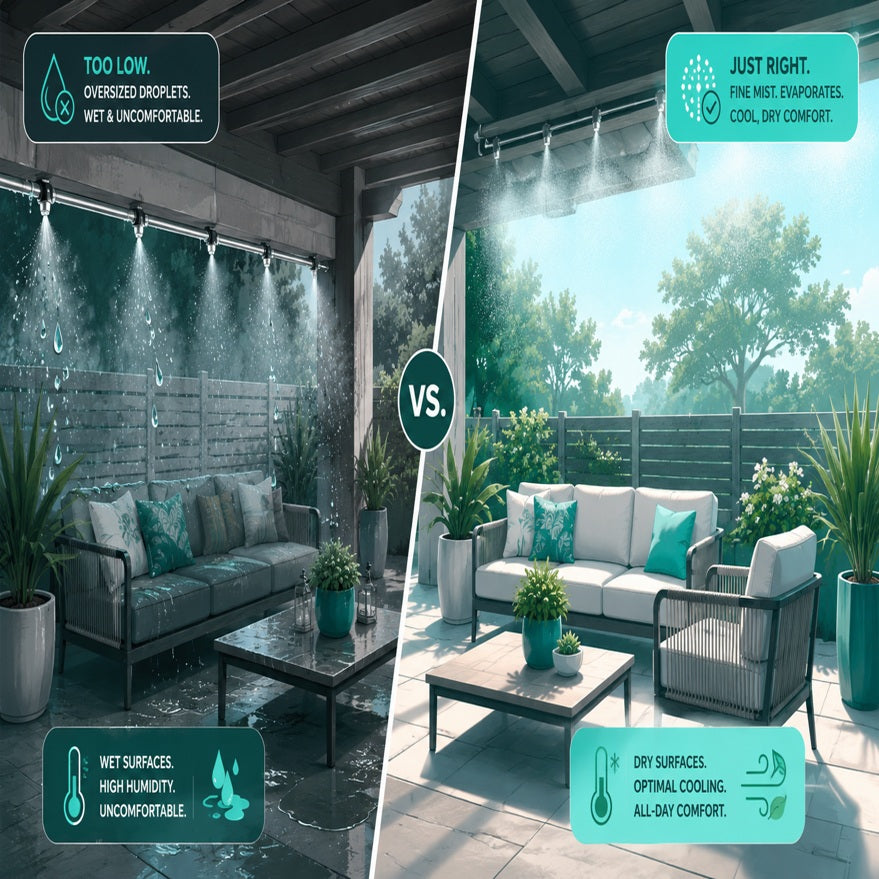
Symptoms appear. Mist output becomes uneven. Some nozzles spray; others drip. Pressure readings fluctuate. On humid days or when temperatures drop, surfaces get wet instead of staying dry. Wetting problems can stem from four causes: temperatures too low or humidity too high for efficient evaporation, nozzles mounted too low, nozzle size too large for conditions, or too many nozzles for the pump capacity resulting in low pressure.
The pump strains. With restricted flow, the motor works harder to maintain pressure. It runs hotter. Internal temperatures climb.
Wear accelerates. Heat degrades seals faster. Oil breaks down. Bearings feel the stress.
Failure arrives. The system shuts down mid-event. The client calls. The callback begins.
The expensive part isn't the repair. It's the damage to your reputation when a system you installed fails during peak season because nobody checked a filter or noticed the oil change indicator.
The 11-Minute Misting Pump Maintenance Reality Checklist
This checklist works whether you're handling maintenance yourself or handing it to a client. It's designed for the field—no special tools, no engineering degree required.
Pre-Season Startup (Before First Use)
Inspect filters. Remove the stainless steel mesh filter and check for debris. Clean or replace as needed.
Check phosphate levels if using a scale-prevention canister. Phosphate beads deplete over time.
Flush the system. With the last nozzle removed, run water through for 3-4 minutes to clear lines of debris and air.
Verify stable pressure. Once running, confirm the gauge reads between 40-70 bar (4-7 MPa) without fluctuation. Watch for surging or pulsing—these indicate air in lines or restriction building.
Inspect nozzle condition. Look for mineral deposits or worn orifices. Replace any that show visible buildup.
In-Season Quick Checks (Weekly or Bi-Weekly)
Visual filter inspection. Check water clarity in the filter housing.
Nozzle spray pattern. Walk the line. All nozzles should produce uniform fine mist, not streams or drips.
Oil change indicator status. If the lamp is illuminated, schedule oil service before the next heavy-use period.
Pressure stability. Watch the gauge during startup. Fluctuation suggests air in lines or restriction building.
Early warning signs. Listen for unusual noise. Watch for wetting in zones that previously stayed dry.
At 300 Operating Hours: Oil Change Trigger
The pump tracks this for you. When the "change oil" indicator illuminates:
Drain existing oil through the drain outlet.
Refill with 80ml pump oil using the included syringe, filling through the upper port.
Reset the indicator by holding the oil lamp reset button for 5 seconds.
For new machines, consider an initial oil change after the first 20 hours of operation.
End-of-Season Shutdown
Remove the last three nozzles in the system to allow complete drainage.
Disconnect the high-pressure line from the pump and insert the drain fitting.
Blow out lines with compressed air if available, connecting at the pump water fitting.
Drain the filter housing by opening the bottom valve.
Bring the pump inside. Freeze damage voids warranties and destroys internal seals. Residual water expands when frozen—remove nozzles to prevent implosion of fittings.
Design Choices That Make Maintenance Easier
Installation decisions made today determine how much work maintenance requires for years.
Pump Placement Matters
The pump needs protection from direct sun and rain. A nearby shed, garage, or covered area works well. Good ventilation prevents overheating. Never mount a pump inside a home—noise levels and moisture don't belong in living spaces.
Consider a pump enclosure if existing structures don't provide adequate protection. The investment pays back in reduced weathering and easier service access.
The installation location should be flat, dry, and well-ventilated. Electrical outlets must be GFI-protected. If an extension cord is needed, use at least a 12-gauge cord.
Keep the pump within 50 feet of the first nozzle when possible. Longer runs mean more pressure drop and more tubing to drain at season's end.
If the client wants app control, a Bluetooth range check should be part of commissioning.
Filtration Placement and Access
Mount filtration in a location you can actually reach. The filter needs regular inspection—if checking it requires moving furniture or unscrewing access panels, it won't get checked.
Sediment filters handle particles. Hard water areas require phosphate treatment using products like a phosphate filter canister installed before the pump. Hard water damage isn't covered under warranty, making prevention the only practical approach.
Practical habit: put filtration where it can be opened in minutes, not hours. Assume hard-water locations need a filtration conversation up front.
Service Access as a Design Priority
Plan for the reality that someone will need to access filters, valves, and nozzles during peak season. Routes that run through inaccessible ceiling cavities or behind permanent structures create service nightmares. Build in access points at logical intervals.
Avoid routing lines through spaces that turn a quick check into a ladder-and-guesswork job. Maintain clean access to filters and drains. Treat nozzles as consumables and stock replacements accordingly.
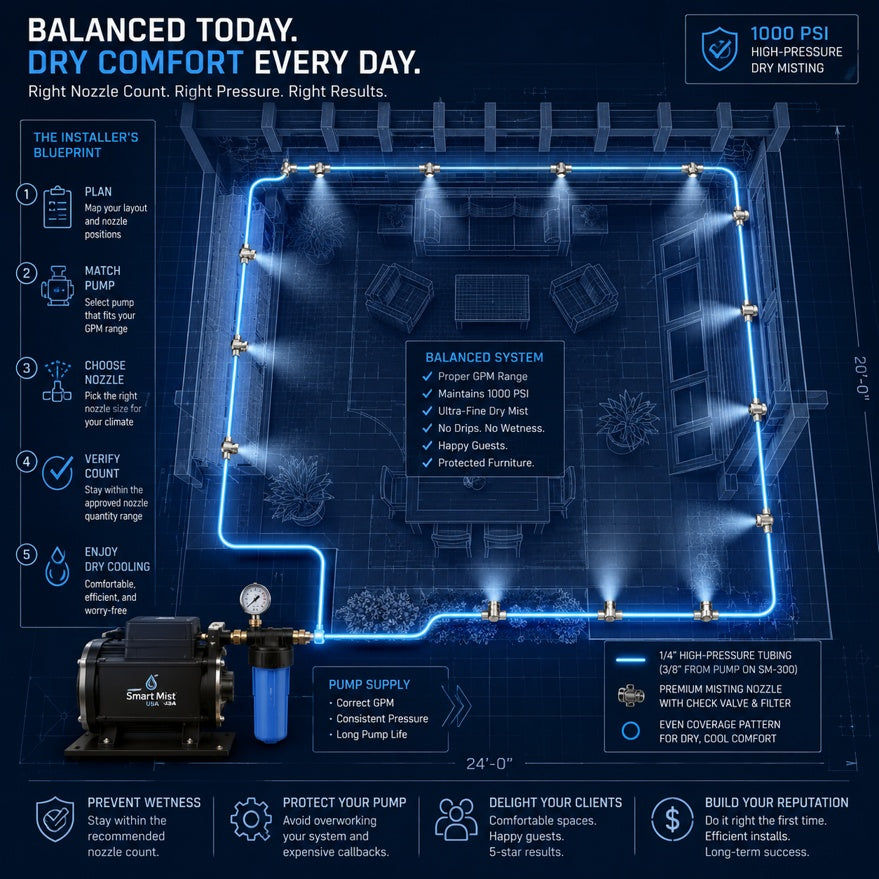
Do not attempt to 'fix' performance issues by merely tweaking pump controls. Flow is set by nozzle size and nozzle count. Poor specs cause wetting and poor evaporation. Wetness troubleshooting must include nozzle sizing and total nozzle count—not just filter checks.
Frequently Asked Questions
Is there any such thing as a "maintenance-free" misting pump?
No—not in the way clients mean it. High-pressure pumps contain moving parts, seals, and oil that all require periodic attention. Any pump pushing water at 1,000+ PSI through orifices measured in thousandths of an inch needs maintenance. Even OEM pump manuals describe routine seal and valve service as standard maintenance. The warranty itself assumes maintenance is performed—neglecting oil changes or seal replacement voids coverage.
A more honest promise is "maintenance-light": easy filtration access, a serviceable layout, and a repeatable checklist.
How often should you change pump oil?
Follow the manual for the specific pump. The 300-hour indicator built into Smart Mist USA pumps provides the most reliable guidance, accounting for actual operating time rather than calendar months.
What's the fastest way to prevent clogged nozzles?
Address water quality at the source. Install appropriate filtration—sediment filters for particles, phosphate treatment for hard water. Scale deposits indicate hard water, and hard water contains dissolved minerals that pass right through standard filters. For existing calcium deposits on nozzles, CLR solution works better than vinegar. Prevention beats cleaning, and treating nozzles as consumables (clean or replace) is the practical approach.
What happens if a misting pump runs without water?
Immediate risk of burnout. The water provides cooling and lubrication for internal components. Even a brief test run without water connected can cause permanent damage.
The myth of maintenance-free equipment persists because it sells. Reality persists because physics doesn't negotiate.
Your clients don't need a system that never requires attention—that system doesn't exist. They need a system installed by someone who understands what attention it actually requires. That's the difference between a professional tool and a disposable toy, between an installer who protects their reputation and one who waits for the Saturday night callback.
Review the high pressure misting system installation guide for complete safety and setup procedures. Browse high pressure misting pumps and filtration components to build systems designed for serviceability from the start. For system-level guidance on hard-water locations or tight equipment areas, contact Smart Mist USA.
Disclaimer: This content is for informational purposes and should not replace professional advice. Always follow manufacturer guidelines and safety data sheets when handling chemical descalers.
Our expert team uses AI tools to help organize and structure our initial drafts. Every piece is then extensively rewritten, fact-checked, and enriched with first-hand insights and experiences by expert humans on our Insights Team to ensure accuracy and clarity.
About the Smart Mist USA Insights Team
The Smart Mist USA Insights Team is our dedicated engine for synthesizing complex topics into clear, helpful guides. While our content is thoroughly reviewed for clarity and accuracy, it is for informational purposes and should not replace professional advice.