(916) 308-3856


📌Key Takeaways
VPD-based humidity control prevents disease by removing heat without wetting leaves, protecting greenhouse crops from the foliar pathogens that thrive on moisture.
-
VPD Trumps Relative Humidity: Vapor pressure deficit measures transpiration potential directly, making it more reliable than RH for managing plant stress across temperature swings.
-
1000+ PSI Prevents Wetting:High-pressure systems create micro-droplets that flash-evaporate before reaching plants, eliminating the leaf wetness that fungi like Botrytis require to infect.
-
Phosphate Filtration Is Mandatory:Hard water deposits calcium inside pumps and nozzles over time, causing expensive failures that phosphate treatment prevents completely.
-
Climate Determines Nozzle Size:Drier climates allow larger nozzles for maximum cooling, while humid regions require finer droplets to evaporate within limited atmospheric capacity.
-
Interval Misting Adapts to Humidity: Short on/off cycles prevent moisture accumulation when ambient humidity approaches saturation, maintaining cooling without creating wet conditions.
Proper system sizing beats pressure adjustments—match pump capacity to nozzle configuration once, then control through timing.
Commercial greenhouse operators managing disease-prone crops will gain implementation clarity here, preparing them for the sensor-to-actuator framework that follows.
Heat builds fast under glass.
Picture a midsummer afternoon in your greenhouse. Temperatures climb past 95°F, your tomato plants start to wilt, and you reach for the misting system. But within hours, you notice something troubling: water droplets clinging to leaves, and the first signs of fungal spots appearing on your crops. The cooling worked, but at what cost?
Greenhouse climate control isn't about adding more moisture; it's about precise removal of heat while keeping leaves dry. This framework shows how to set humidity targets with VPD, then choose equipment, especially high-pressure flash-evaporating systems, that hit those targets without feeding disease. Whether you manage a small nursery operation or oversee a mid-sized commercial greenhouse, understanding this balance can mean the difference between a thriving crop and devastating losses.
By the end of this guide, you'll have a clear decision-making framework for sensors, controls, and hardware that removes heat efficiently while protecting your plants from the moisture-related diseases that plague so many greenhouse operations.
Quick start: Consider printing the "Dry Cooling Configuration Cheat-Sheet" below for your control room, and sign up for greenhouse cooling tips to stay current on best practices.
Humidity Control vs. Plant Health: The Balancing Act

The relationship between humidity and plant health is more nuanced than most growers initially realize. Relative humidity (RH) tells you what percentage of moisture saturation exists in the air at a given temperature, but it doesn't tell you how that moisture affects your plants. This is where vapor pressure deficit, or VPD, becomes essential.
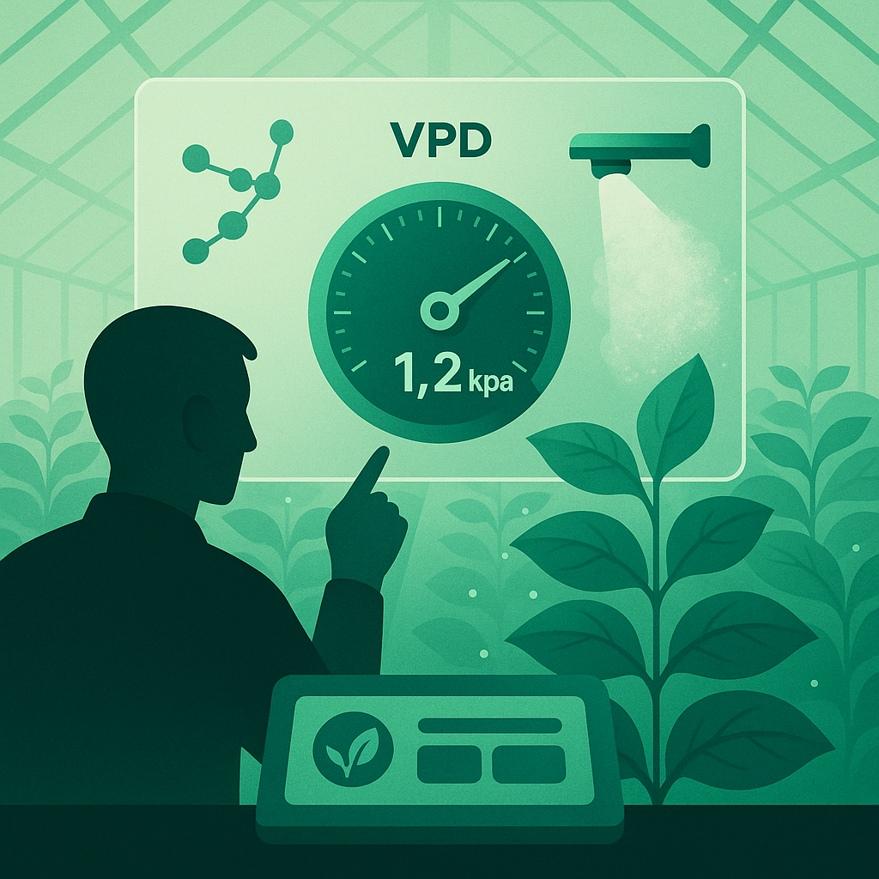
VPD measures the difference between how much moisture the air currently holds and how much it could hold at saturation. More importantly, it directly correlates with how quickly water moves from your plants' leaves into the surrounding air through transpiration. A high VPD (greater than 1.0 kPa) means that the air can still hold a large amount of water, creating a fairly large gradient between plants and the air, enabling plants to transpire and, over time, dry out. A low VPD indicates the air is near saturation, and a VPD of zero means the air is 100 percent saturated, preventing plants from transpiring effectively.
Extension work on greenhouse crops suggests that many warm-season crops perform well within a VPD band of roughly 0.5-1.1 kPa, as long as light, nutrition, and airflow are also in range. For common greenhouse vegetables like tomatoes, peppers, and cucumbers during active vegetative growth, research indicates an ideal range for VPD is from 0.45 kPa to 1.25 kPa, with optimal performance often sitting around 0.85 kPa. Many of these crops grow well at VPDs between 0.8 and 0.95 kPa during their productive stages. However, these ranges vary significantly by crop species and growth stage—propagation and sensitive young plants typically require substantially lower VPD (0.3-0.6 kPa) to minimize stress, while mature fruiting crops may tolerate or even benefit from higher ranges (0.9-1.2 kPa). Always consult crop-specific guidelines for your particular varieties and growth phases.
When VPD strays outside appropriate ranges for a given crop and stage, problems emerge on both ends of the spectrum. Too low, and plants can't transpire properly, leading to nutrient uptake issues and creating the wet leaf conditions that pathogens love. Too high, and plants lose water faster than roots can replace it, causing stomata to close and photosynthesis to stall.
The critical insight here involves leaf surface wetness. Moisture is the critical factor in disease development, and the amount of disease depends on the number and length of wet periods. The majority of fungi, aerial nematodes and bacteria that cause plant diseases require liquid "free" water on plant surfaces before they can infect the plant. Fungi like Botrytis can infect aggressively when leaves remain wet or surrounded by near-saturated humidity for extended periods—often in the range of 8-12 hours under typical greenhouse temperatures, though this duration varies considerably with ambient temperature, light levels, and pathogen spore load present. Warmer temperatures and high inoculum pressure can shorten the required wetness period significantly, while cooler conditions may extend it. This means your humidity control strategy must accomplish two seemingly contradictory goals: maintain adequate moisture in the air for healthy transpiration while ensuring that moisture never condenses on leaf surfaces.
The Framework Components: Sensors, Controls, and Actuators
Effective greenhouse humidity control requires three coordinated elements working together. Think of it as a continuous feedback loop: sensors gather data, controls make decisions, and actuators execute those decisions. When properly integrated, this system maintains optimal conditions with minimal manual intervention.

Sensors: The Foundation of Precision
Accurate measurement forms the foundation of any control system. At minimum, your sensor array should include relative humidity sensors, ambient temperature sensors, and ideally, leaf temperature sensors for calculating true VPD at the plant level.
Standard RH and temperature sensors provide the data needed for basic VPD calculations. However, the air temperature measured by a sensor mounted on the greenhouse wall may differ significantly from conditions at the plant canopy. For greater precision, some operations add infrared leaf temperature sensors that measure actual leaf surface temperatures, enabling calculation of leaf VPD rather than just air VPD. This distinction matters because plants only experience the air with which they come into immediate contact, and when a boundary layer of humid air remains hovering around the plant, it will experience a lower VPD than is measured in the rest of the space.
Sensor placement deserves careful consideration. Position sensors at canopy height in representative locations throughout the greenhouse, avoiding placement near vents, heaters, or exterior walls where readings may not reflect typical conditions.
Control Logic: Making Smart Decisions
Control systems range from simple timer-based intervals to sophisticated computer-controlled automation. The key principles remain consistent regardless of complexity.
Threshold-based controls activate cooling or humidification when readings exceed preset limits. For flash-evaporative cooling, this typically means engaging the system when temperature rises above a target while VPD remains in an acceptable range. More advanced systems incorporate interval strategies, cycling misting on and off in patterns that allow droplets to evaporate completely before the next burst. This prevents the moisture accumulation that leads to wet foliage.
System performance is determined during initial setup by selecting the appropriate pump size and nozzle configuration for your specific conditions. Flow rate is established by nozzle size and quantity, matched to your climate and mounting height, rather than through adjustable settings during operation. This ensures consistent, reliable cooling performance without the need for ongoing manual adjustments.
Safety shutoffs represent a critical control layer. The system should automatically disable misting when humidity climbs too high, when temperatures drop too low for effective evaporation, or when wind conditions might carry droplets onto plants before they can evaporate. These guardrails prevent the very problems the system is designed to avoid.
Actuators: Why 1000+ PSI Matters
The actuator component, the hardware that actually modifies conditions, is where equipment selection makes or breaks your humidity control strategy. For flash-evaporative cooling, this means high-pressure misting systems operating at 1000+ PSI.
The physics here are straightforward. Higher pressure forces water through smaller nozzle orifices, creating finer droplets. These micro-fine droplets have a dramatically higher surface-area-to-volume ratio than larger droplets from lower-pressure systems. The result is rapid evaporation, often within seconds of leaving the nozzle. This flash evaporation absorbs heat from the surrounding air while the water transitions from liquid to vapor, cooling the greenhouse without ever wetting plant surfaces.
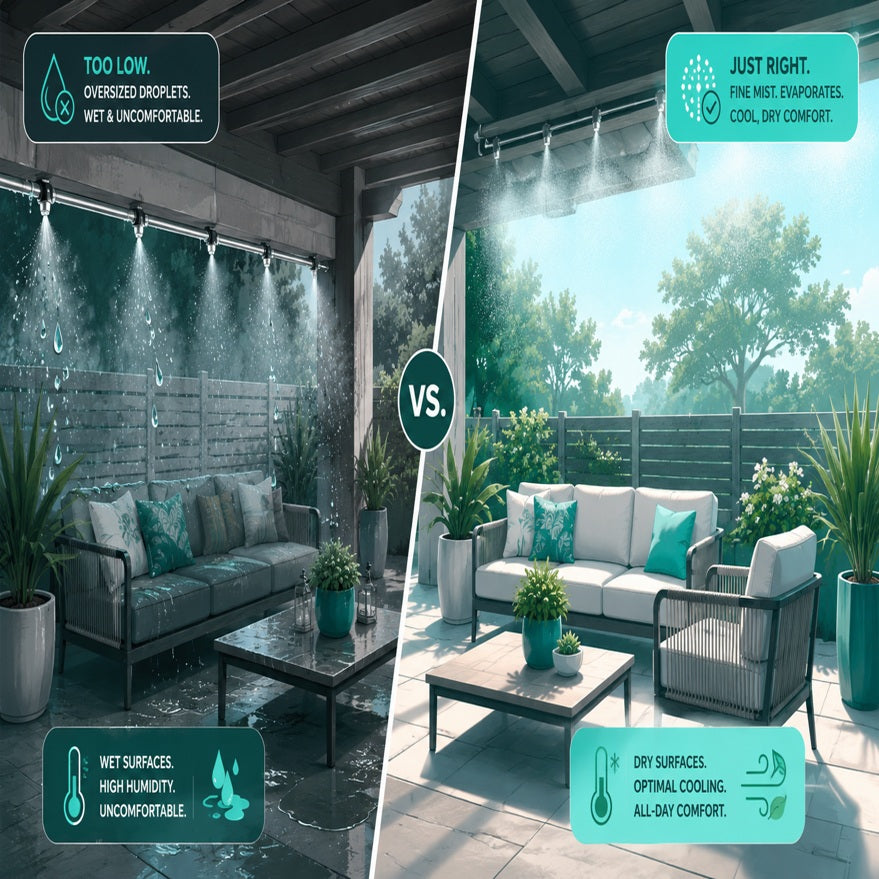
Lower-pressure systems produce larger droplets that take longer to evaporate. In the time required for evaporation, gravity pulls these droplets downward onto plants and surfaces below. The cooling still occurs, but at the cost of wet foliage and all the disease pressure that accompanies it.
Coupling misting with directed airflow accelerates evaporation further. Greenhouse-rated misting fans push air in the same direction as the mist discharge, keeping droplets suspended longer and ensuring complete evaporation before any moisture can settle on crops.
Specifying a High-Pressure Flash-Evap Stage for Greenhouses
Designing an effective flash-evaporative cooling system requires attention to several interconnected decisions. The components must work together as an integrated system, and choices made in one area affect requirements in others.
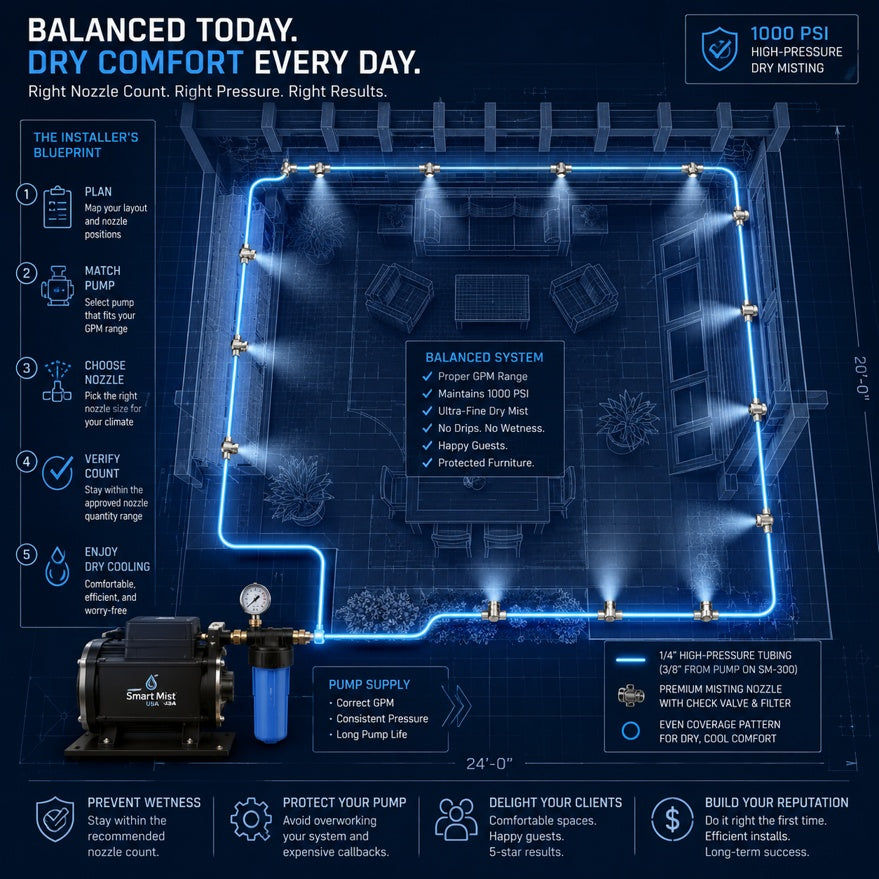
A properly configured system includes three separate components: the misting delivery mechanism (nozzle lines or fan-mounted rings), an external high-pressure pump located remotely from the growing area, and high-pressure tubing connecting the pump to the nozzles. This separation matters because pumps generate heat and noise that don't belong in the growing environment. Locating the pump in a utility area or protected outdoor location, with high-pressure lines running to the greenhouse, keeps the growing space quiet and prevents pump heat from adding to cooling loads.
Filtration sits between the water supply and the pump. Every system needs sediment filtration to remove particles that would clog the fine nozzle orifices. In regions with hard water, which includes much of the United States, a phosphate filter becomes equally essential. Hard water contains dissolved calcium and other minerals that don't get caught by sediment filters. Over time, these minerals deposit inside pumps and nozzles, degrading performance and eventually causing failures. Phosphate treatment prevents scale buildup, protecting your investment and maintaining consistent droplet quality.
Nozzle selection depends on your climate and mounting height. Drier climates with lower humidity allow for slightly larger nozzles that produce more cooling capacity. Humid environments require smaller nozzles producing finer droplets that can evaporate in the limited "headroom" between actual humidity and saturation. Mounting height matters because droplets need sufficient fall distance to evaporate completely. These two parameters—climate (humidity) and mounting height—determine proper nozzle sizing. Once nozzle size and the total number of nozzles are established, the appropriate pump size from our line of commercial pumps can be selected to deliver the required flow rate.
Coverage patterns should account for airflow direction within your greenhouse. Position nozzle lines or misting fans so that prevailing air currents carry the mist cloud through the growing space before droplets can fall onto plants. Avoid placing nozzles directly above high-value crops where any incomplete evaporation would deposit moisture on leaves.
For conditions where humidity already runs high, interval misting provides the solution. Rather than continuous operation, the system cycles through brief misting periods followed by pauses. A pattern of three seconds on, five seconds off, for example, allows each burst of mist to evaporate completely before the next arrives. This maintains cooling effect while preventing moisture accumulation even when ambient humidity limits evaporation speed.
Operating Rules That Prevent Wetting and Disease
Equipment alone doesn't prevent disease. Operational discipline determines whether your investment protects crops or creates new problems. The following guidelines establish the environmental guardrails that keep leaves dry.
Temperature thresholds set the boundaries for safe operation. Flash evaporation works best when temperatures are high enough to drive rapid moisture absorption into the air. As temperatures drop, evaporation slows, and the risk of wetting increases. Most operations disable misting below 75-80°F unless humidity is unusually low. Conversely, extremely high temperatures may call for more aggressive misting intervals to keep cooling pace with heat buildup.
Humidity bands provide the other key constraint. When relative humidity climbs above 80-85%, the air simply cannot absorb moisture quickly enough for complete flash evaporation. Continuing to mist under these conditions guarantees wet foliage. The control system should automatically suspend operation when humidity exceeds safe thresholds, even if temperature would otherwise call for cooling.
Wind-stop rules address air movement that can carry droplets onto plants before evaporation completes. In greenhouse applications with exhaust fans or open vents, strong cross-currents may push mist into growing areas too quickly. Monitoring airflow and suspending misting during high-wind events prevents this problem.
Operator Check: "Leaves Dry in 10-15 Minutes"
A practical rule of thumb for on-the-ground staff: after a misting event, leaves should look and feel dry again within about 10-15 minutes.
If they remain wet:
-
Reduce mist duration
-
Increase interval (more off-time)
-
Inspect fan direction and speed
The underlying principle in all these rules is simple: never allow liquid water to contact leaf surfaces. You can control many plant diseases by controlling the number of free moisture periods and how long those periods last. Every operational decision should reinforce this objective.
Hard-Water and Maintenance Discipline
Water quality and maintenance practices determine whether your system delivers years of reliable service or becomes a constant source of problems. The calcium and mineral content in hard water, common throughout much of the United States, poses the most significant threat to equipment longevity.
Calcium doesn't behave like ordinary sediment. It flows freely through standard filters in dissolved form, then deposits inside pumps, tubing, and nozzles as water evaporates. These deposits accumulate gradually, restricting flow and degrading performance long before complete blockage occurs. By the time symptoms become obvious, significant damage may have already occurred to both nozzles and internal pump components.
Phosphate filtration provides the primary defense. Slow-dissolving phosphate crystals treat incoming water, preventing calcium from depositing on internal surfaces. This treatment approach differs fundamentally from sediment filtration, which physically traps particles. Both filtration types should be present in any system operating on municipal or well water with moderate to high mineral content.
When calcium buildup does occur despite preventive measures, CLR (calcium, lime, rust remover) solutions effectively dissolve deposits without damaging equipment. Soaking affected nozzles in CLR solution restores proper flow patterns. For pump components, follow manufacturer guidance on cleaning procedures to avoid damaging seals or other sensitive parts.
Dry Cooling Configuration Cheat-Sheet
VPD Target Bands
Note: VPD targets are crop-specific and vary by growth stage. The ranges below represent common greenhouse vegetables (tomatoes, peppers, cucumbers) during typical production phases. Always verify appropriate targets for your specific crops and consult extension resources for specialized varieties.
|
Crop Stage / Goal |
Typical VPD Band (kPa) |
Notes |
|---|---|---|
|
Propagation / young transplants |
0.3-0.6 |
Lower VPD minimizes water stress on developing root systems and sensitive young tissue |
|
Vegetative growth (established plants) |
0.7-1.0 |
Balanced transpiration supports nutrient uptake and steady growth without excessive stress |
|
Flowering / early fruiting |
0.8-1.1 |
Moderate VPD maintains active transpiration while reducing condensation risk on flowers and developing fruit |
|
Heavy fruiting / late season |
0.9-1.2 |
Slightly higher VPD keeps mature canopies drier and supports maximum nutrient transport to fruit |
|
Stress threshold (upper limit) |
1.5+ |
Above this level, most crops experience stomatal closure and growth inhibition regardless of other conditions |
These values represent starting points for optimization. Actual optimal ranges depend on crop species, cultivar characteristics, light intensity, air movement, and irrigation strategy. Monitor plant response and adjust targets accordingly.
Interval Misting Rules
-
High heat, low humidity: Continuous or minimal intervals
-
Moderate conditions: 5 seconds on, 5 seconds off
-
Marginal conditions (humidity 70-80%): 3 seconds on, 8 seconds off
-
High humidity (>80%): Suspend misting; use ventilation only
-
Always verify: No visible moisture on leaves 60 seconds after misting stops
Filter Maintenance Cadence
-
Sediment filter: Inspect weekly; clean or replace monthly (more frequently with well water)
-
Phosphate cartridge:Check crystal level monthly; replace when depleted (typically 3-6 months)
-
Hard-water regions: Phosphate treatment is mandatory, not optional
-
Nozzle inspection:Weekly during heavy use; clean with CLR solution if flow pattern degrades
Winterization Trigger Checklist
-
[ ] Disconnect tubing from pump
-
[ ] Insert drain fitting; allow complete line drainage
-
[ ] Open filter drain valve; drain filter housing
-
[ ] Remove and store blue canister filters if freezing possible
-
[ ] Bring pump indoors to protected location
-
[ ] Remove nozzles to prevent damage from residual water expansion
-
[ ] Inspect phosphate level; order replacement cartridges for spring
Seasonal Protection: Winterization
Freeze damage represents an excluded warranty condition for good reason: ice formation inside pumps, lines, and nozzles causes catastrophic and entirely preventable failures. Proper winterization takes less than an hour and protects equipment worth thousands of dollars.
The process begins with disconnecting tubing from the pump. Remove the last nozzle in your system to create a drainage point. Using the drain fitting included with most systems, attach to the high-pressure line fitting and allow gravity to empty water from all tubing. Any water remaining in lines will expand when frozen, cracking tubing and fittings.
Filter housings require separate attention. Open the drain valve on sediment filter housings and allow complete drainage. If you have canister-style phosphate or advanced filtration, remove the canisters entirely and store them where temperatures remain above freezing. This is also an ideal time to inspect phosphate levels and sediment filter condition, ordering replacements for spring startup.
The pump itself must come indoors or to another freeze-protected location. Never leave pumps exposed to freezing temperatures, even in covered outdoor areas. The consequences of freeze damage include cracked pump housings, damaged seals, and destroyed internal components that transform an inconvenience into an expensive replacement.
Nozzles deserve removal and indoor storage as well. The tiny orifices that create fine mist droplets are precisely machined, and residual water expanding during freezing can distort these openings, ruining spray patterns and cooling performance.
ROI and Risk Reduction for Greenhouse Owners
Agricultural production worldwide faces significant challenges from environmental stress and pest pressure. Global analyses drawing on FAO data indicate approximately 20-40% of world crop production is lost to pests each year across all crop types and growing systems. While this figure encompasses field crops, post-harvest losses, and the full spectrum of pest and disease issues globally, it underscores the economic importance of environmental control strategies. Within protected agriculture specifically, many of these pest and disease pressures are amplified by stress and poor climate management—challenges that effective humidity control directly addresses.
Investment in properly designed humidity control delivers returns across multiple dimensions. The most visible benefit involves reduced crop losses from heat stress and disease, but the financial impact extends further.
Heat stress during peak summer months can devastate greenhouse crops. Wilting, blossom drop, and reduced fruit set translate directly to lost revenue. Effective evaporative cooling can achieve temperature reductions ranging from 10-20 degrees in typical greenhouse conditions, with reductions approaching 25 degrees possible in hot, arid climates where the difference between dry-bulb and wet-bulb temperature is maximized. The cooling effect is particularly impressive in drier climates, where lower ambient humidity allows water droplets to evaporate more rapidly, absorbing more heat from the surrounding air. In more humid environments common to many agricultural regions, the physics of evaporation still work effectively, though temperature drops typically range from 8-15 degrees as the air approaches saturation. Regardless of climate, these reductions keep crops in productive temperature ranges throughout the season.
Disease reduction may provide even greater value. Fungal and bacterial pathogens responsible for common greenhouse diseases require leaf wetness to infect plants. Plant pathogenic bacteria require the presence of free moisture for several hours in order to cause infection, and prolonged periods of high humidity and leaf wetness are highly conducive to disease development. By maintaining cooling without wetting, flash-evap systems eliminate a primary disease vector. Fewer disease outbreaks mean reduced losses, lower fungicide costs, and better crop quality.
Automation reduces labor costs while improving consistency. Timer and sensor-controlled systems maintain optimal conditions around the clock without constant manual adjustment. Staff time shifts from reactive crisis management to proactive crop care.
Equipment longevity depends heavily on water quality management and maintenance discipline. Systems operated with proper filtration and regular maintenance routinely deliver many years of service. Those operated without phosphate treatment in hard-water areas may require pump rebuilds or replacement within just a few seasons. The modest ongoing cost of filter maintenance pays substantial dividends in avoided repairs and replacements.
What Real Users Are Saying
Feedback from greenhouse operators using high-pressure misting systems reveals consistent themes worth noting for anyone evaluating this technology.
Cooling performance without wetting emerges as the most frequently praised characteristic. Users regularly report the ability to maintain comfortable working conditions and optimal growing temperatures even during extreme heat events, with furniture, equipment, and plants remaining completely dry. The contrast with previous experiences using lower-pressure systems, where cooling came at the cost of wet surfaces, represents a significant operational improvement.
Filtration guidance consistently appears in user feedback as well. Those operating in hard-water regions emphasize the importance of phosphate treatment, with several noting that they wish they had implemented proper filtration from the start rather than learning through equipment problems. The advice to invest in complete filtration upfront reflects hard-won operational experience.
Customer support and technical guidance receive frequent positive mention. Users describe receiving help with nozzle selection for their specific climate conditions, troubleshooting assistance when issues arise, and responsive service when replacement parts are needed. For equipment requiring some technical knowledge to optimize, access to knowledgeable support makes a meaningful difference in outcomes.
Installation accessibility surprises many users. Despite the sophisticated performance, systems designed for DIY installation typically require only basic tools and a few hours of work. The confidence that comes from understanding your own system also facilitates easier troubleshooting and maintenance going forward.
Frequently Asked Questions
What's the difference between RH and VPD for greenhouse targets?
Relative humidity expresses current moisture as a percentage of the maximum the air could hold at that temperature. The problem is that this maximum changes with temperature, so 60% RH at 70°F represents different conditions for plants than 60% RH at 90°F. VPD measures the actual pressure difference driving moisture from leaves into air, independent of temperature. This makes VPD a more reliable indicator of transpiration conditions and plant stress than RH alone.
Why do high-pressure (1000+ PSI) droplets reduce disease risk vs. low/mid pressure?
Higher pressure creates smaller droplets with more surface area relative to their volume. These tiny droplets evaporate rapidly, often before falling more than a few feet. Lower-pressure systems produce larger droplets that remain liquid long enough to land on plants and surfaces. Since most fungal and bacterial pathogens require liquid water on leaf surfaces to cause infection, the rapid evaporation from high-pressure systems eliminates this infection pathway.
How do I prevent wetting when humidity is already high?
Interval misting is the primary strategy. By cycling the system through brief on periods followed by longer pauses, each mist burst can evaporate before the next arrives, even when ambient humidity slows evaporation rates. In extreme humidity, suspending misting entirely and relying on ventilation may be necessary. The control system should include humidity thresholds that automatically disable misting when conditions preclude effective flash evaporation.
Do I need a phosphate filter if I'm on city water?
In most cases, yes. Municipal water treatment removes pathogens and adjusts some chemical parameters, but typically does not remove the dissolved calcium and minerals that cause scale buildup in misting systems. Water hardness varies by region and even by specific municipal source. If you're uncertain about your water quality, testing is inexpensive and provides clear guidance. In hard-water regions, phosphate treatment is essential regardless of water source.
What winterization steps protect the pump and lines?
Complete drainage prevents freeze damage. Disconnect lines from the pump and use a drain fitting to empty all tubing. Drain filter housings and remove canister filters for indoor storage. Bring the pump itself to a freeze-protected location. Remove nozzles to prevent damage from any residual water that might expand when frozen. This process takes well under an hour and prevents the expensive damage that occurs when water freezes inside precision equipment.
Next Steps
Your path forward depends on where you are in the planning process.
For those still researching options: Explore greenhouse humidity systems to understand the range of configurations available. Review the nozzle sizing guide to understand how climate and mounting height influence equipment selection. Sign up for greenhouse cooling tips to receive ongoing guidance as you develop your approach.
For those ready to configure a system: Browse our line of commercial pumps and, where applicable, our app controlled pumps to find equipment sized for your nozzle plan. Consider directed airflow options if your application would benefit from combined misting and air movement. Get your free installation planning guide to ensure your system design addresses your specific greenhouse configuration.
For those with immediate cooling needs:Shop our line of commercial pumps to find equipment that matches your requirements. Schedule a phone consultation to discuss your specific situation with specialists who can help optimize your configuration for maximum cooling without the wetting that feeds disease.
The balance between moisture and growth doesn't happen by accident. It results from understanding the principles, selecting appropriate equipment, and operating within the guardrails that keep leaves dry while removing heat. With this framework in hand, you're equipped to make those decisions with confidence.
Disclaimer: This article provides educational information about greenhouse humidity control principles and equipment. Specific VPD targets and operational parameters may vary based on crop type, growth stage, regional conditions, and individual greenhouse characteristics. Consult with horticultural advisors familiar with your specific crops and conditions for customized recommendations.
Our Editorial Process:Content developed by the Smart Mist USA Insights Team, combining engineering expertise with horticultural advisory knowledge. For warranty information and terms, visit our Warranty page.
About the Smart Mist USA Insights Team
The Smart Mist USA Insights Team is our dedicated engine for synthesizing complex topics into clear, helpful guides. While our content is thoroughly reviewed for clarity and accuracy, it is for informational purposes and should not replace professional advice.
References
[1] Michigan State University Extension. "Why should greenhouse growers pay attention to vapor-pressure deficit and not relative humidity?" https://www.canr.msu.edu/news/why_should_greenhouse_growers_pay_attention_to_vapor_pressure_deficit_and_n
[2] Wikipedia. "Vapour-pressure deficit." https://en.wikipedia.org/wiki/Vapour-pressure_deficit
[3] Mississippi State University Extension Service. "The Plant Doctor: Watering and Plant Disease." https://extension.msstate.edu/publications/the-plant-doctor-watering-and-plant-disease
[4] UC Agriculture and Natural Resources. "Leaf and Flower Wetness Promotes Disease." https://ucanr.edu/blog/nursery-and-flower-grower/article/leaf-and-flower-wetness-promotes-disease
[5] DryGair. "What is Vapor Pressure Deficit | VPD Meaning." https://drygair.com/blog/vpd-vapor-pressure-deficit/
[6] UMass Amherst Center for Agriculture, Food, and the Environment. "Bacterial Diseases of Vegetable Crops: Leaf Spots & Blights." https://www.umass.edu/agriculture-food-environment/vegetable/fact-sheets/bacterial-diseases-of-vegetable-crops-leaf-spots-blights
[7] CABI. Extension and research guidance on greenhouse VPD ranges and environmental control. https://www.cabi.org/projects/global-burden-of-crop-loss/
[8] E-Gro. University and extension resources describing relationships between leaf wetness duration, high humidity, and foliar disease risk in greenhouse crops. https://e-gro.org/pdf/2018_724.pdf
[9] CEPAL. Global analyses drawing on FAO data indicating that approximately 20-40% of world crop production is lost to pests each year. https://www.cepal.org/sites/default/files/events/files/aszyniszewska_english_session_1.pdf