(916) 308-3856


📌Key Takeaways
High-pressure misting fans eliminate greenhouse disease risk by cooling air without wetting foliage when properly designed and maintained.
-
Flash Evaporation Prevents Disease:Systems operating at 1000+ PSI atomize water into micro-droplets that evaporate mid-air, delivering up to 25 degrees of cooling without leaving moisture on leaves.
-
Four Failures Cause Wetting:Low temperatures, high humidity, insufficient mounting height, or oversized nozzles for pump capacity all prevent proper evaporation and create disease conditions.
-
Three Components Work Together:Every installation requires a fan unit, external high-pressure pump, and properly routed lines—the pump matches total nozzle count, not adjustable settings.
-
Interval Control Manages Humidity: Short misting bursts followed by pause periods keep droplets airborne during marginal conditions, maintaining dry foliage when continuous operation would cause wetting.
-
Winterization Prevents Catastrophic Loss: Draining lines, removing nozzles, and storing pumps indoors before freezing temperatures protects the entire investment—freeze damage voids warranty coverage.
Proper design once, confident operation forever.
Greenhouse managers and nursery operators protecting high-value crops will gain the technical clarity needed here, preparing them for system selection and maintenance decisions that follow.
Wet leaves kill crops.
Picture your greenhouse at 3 PM on a July afternoon. Outside, the thermometer pushes past 95°F. Inside, your tomatoes need relief, but every cooling attempt you've tried leaves moisture clinging to leaves, stems, and fruit. Within hours, that moisture becomes a breeding ground for botrytis, powdery mildew, and a dozen other fungal nightmares that can devastate an entire growing season.
You've invested too much in your operation to watch it succumb to the very system meant to protect it. The frustration is real: you need aggressive cooling to keep plants healthy, but conventional misting just trades heat stress for disease pressure.
This framework changes that equation entirely. By the time you finish reading, you'll understand exactly how high-pressure misting fans deliver dramatic temperature drops without wetting foliage, how to configure a system that matches your specific climate and facility, and how to maintain it for years of reliable, disease-free cooling. The goal isn't just cooler air. It's confident control over your growing environment.
The Real Problem With "Wet" Cooling in Greenhouses
Wet foliage fuels fungal disease. This isn't speculation; it's basic plant pathology. When water sits on leaf surfaces, it creates the exact conditions pathogens need to germinate, penetrate plant tissue, and spread. Research has linked the duration of leaf wetness with the risk and severity of many foliar diseases. The longer leaves stay wet, the greater the infection risk. For greenhouse managers, this creates an impossible tension: plants need cooling during heat spikes, but traditional misting methods deliver that cooling by getting everything wet.
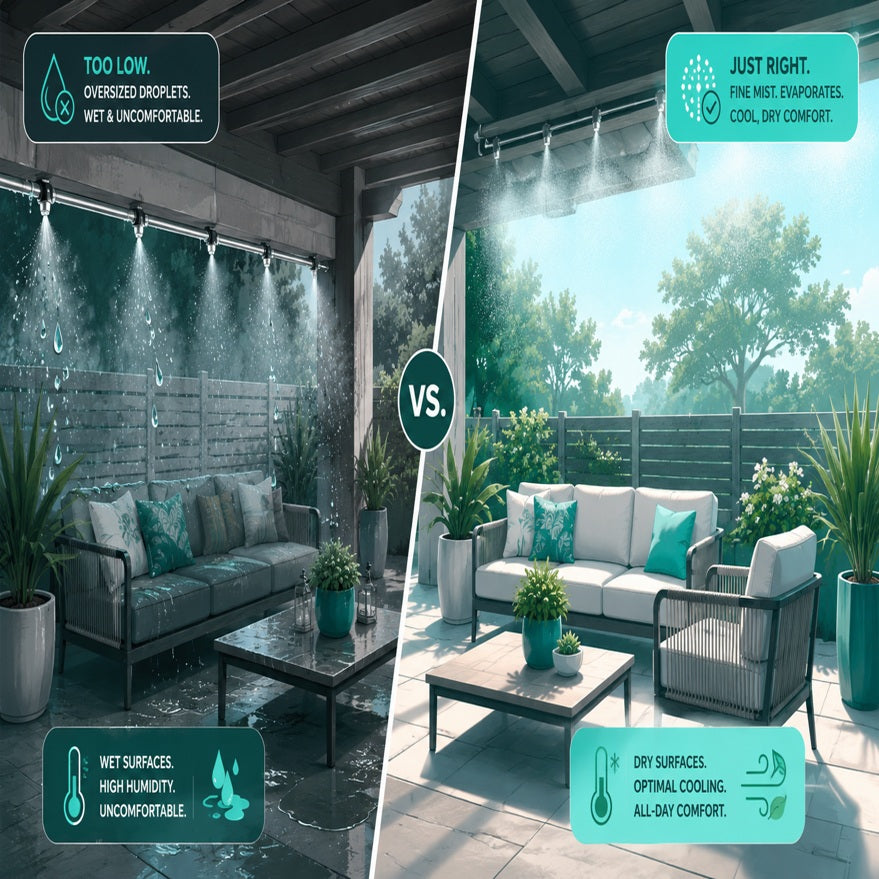
The problem isn't misting itself. The problem is droplet size. Standard misting systems operating at residential water pressure (50-70 PSI) or even mid-range pumps (200-300 PSI) produce droplets large enough to land on surfaces before they evaporate. These droplets accumulate on foliage, drip onto benches, create slip hazards on floors, and establish the humid microclimate where fungal spores thrive.
When greenhouse operators experience unwanted wetting from a misting system, the cause typically traces back to one of four factors. First, ambient temperature may be too low or relative humidity too high for efficient evaporation. Second, the fan may be mounted too low, not allowing sufficient hang time for droplets to evaporate before reaching plant canopy. Third, the nozzle orifice size may be too large for conditions, producing droplets that can't flash-evaporate quickly enough. Fourth, the nozzle size and quantity may exceed the pump's capacity, causing pressure to drop and droplet size to increase.
Understanding these four failure modes is essential because each has a specific solution. The technology exists to cool aggressively while keeping foliage completely dry. The key lies in pressure, physics, and proper system design.
How High-Pressure Flash Evaporation Keeps Plants Dry

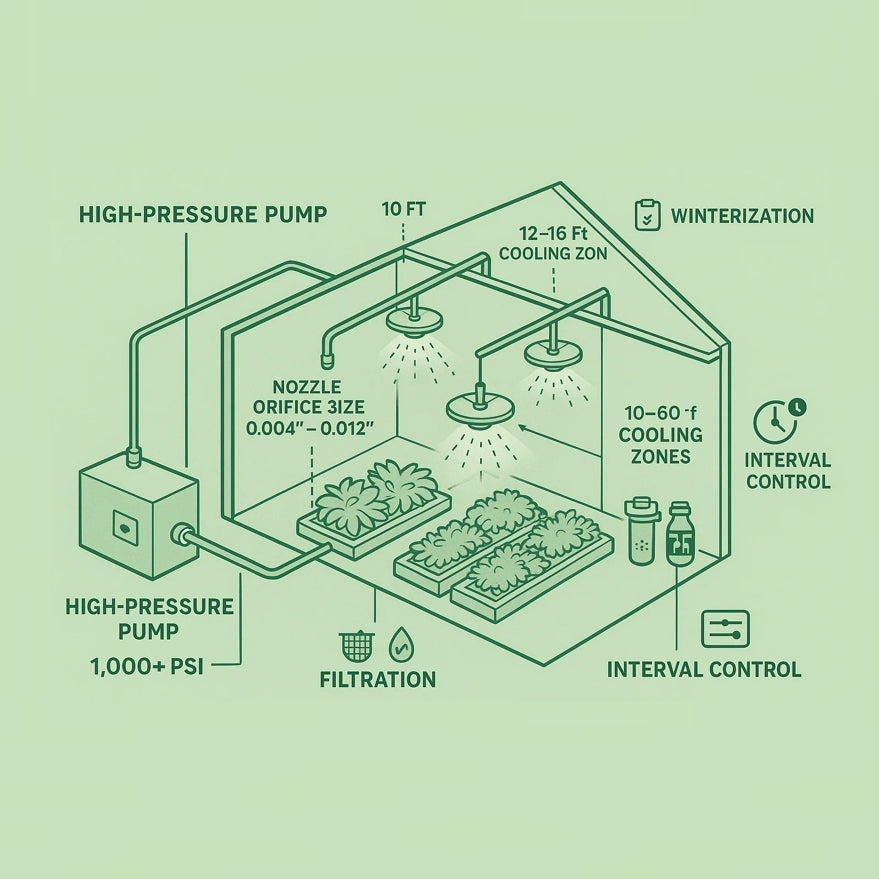
High-pressure misting fans operating at 1000+ PSI create micro-fine mist that evaporates mid-air before droplets can land on any surface. This process, known as flash evaporation, works because extremely high pressure forces water through tiny nozzle orifices, atomizing it into particles so small they absorb heat from surrounding air and transition to vapor almost instantly.
Think of it as an air conditioner for your greenhouse that runs on water physics. When water evaporates, it absorbs energy from its surroundings. This is the evaporative cooling effect. The smaller the droplet, the faster it evaporates and the more efficiently it pulls heat from the air. At 1000 PSI, droplets become fine enough to evaporate within the airflow created by the fan, cooling the air column that then descends to plant level. The result: up to 25 degrees of cooling depending on temperature and humidity conditions, with particularly impressive results in drier climates. These evaporative cooling principles are well-documented in controlled-environment agriculture research.
The physics here matter because they explain why pressure isn't negotiable. Systems operating at lower pressures simply cannot produce droplets small enough for true flash evaporation. They may provide some cooling, but they achieve it by wetting you, your plants, and your facility. High-pressure systems achieve cooling through phase change in the air itself, delivering a cool, buoyant breeze with no damp leaves and no slip hazards.
Nozzle selection plays a critical role in matching the system to your specific conditions. Smaller orifice sizes (0.004" to 0.006") work well in humid environments or lower mounting heights, producing extremely fine mist that evaporates quickly even when conditions don't favor evaporation. Larger orifices (0.008" to 0.012") suit dry climates with high temperatures and adequate mounting height, producing slightly larger droplets that still flash-evaporate while delivering more cooling capacity. The selection depends on your climate's typical humidity levels and your available mounting height, generally around 10 feet for optimal performance.
System Architecture: Fan + External Pump + High-Pressure Lines
Every high-pressure misting fan installation requires three distinct components working together: the fan unit itself, an external high-pressure pump located remotely, and high-pressure lines connecting pump to fan. This architecture differs fundamentally from consumer-grade misting products that connect directly to a garden hose or integrate small pumps into the fan housing.
The fan unit houses the motor, blades, and a misting ring fitted with precision nozzles. The misting ring connects to the high-pressure line, receiving water at 1000 PSI and distributing it through the nozzles positioned around the fan's circumference. As the fan moves air, it carries the atomized mist outward and downward, creating a cooling zone that extends 12 to 16 feet in diameter from the fan's center.
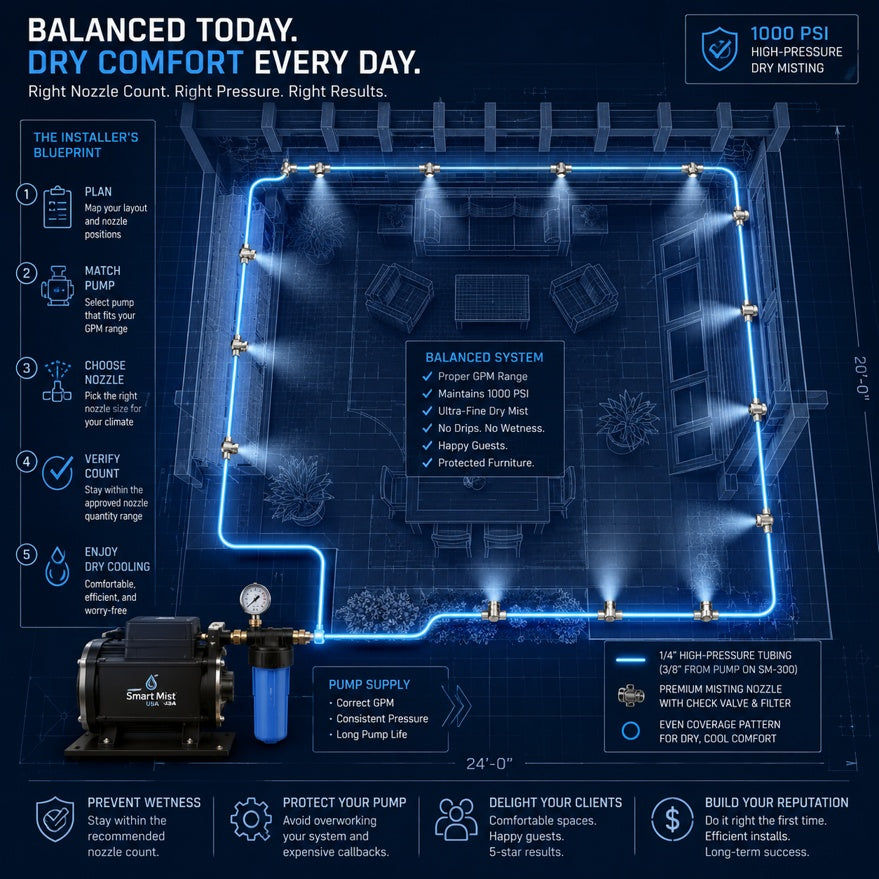
The external pump is the heart of the system. These are typically three-piston pumps designed specifically to generate and maintain 1000 PSI water pressure. Unlike diaphragm pumps used in lower-pressure systems, piston pumps require careful matching between pump capacity (measured in gallons per minute) and the total flow demand of your nozzles. Using too few nozzles overworks the pump, causing it to run hot and wear prematurely. Using too many nozzles exceeds the pump's capacity, dropping pressure and increasing droplet size. Proper balance ensures quiet operation, optimal mist quality, and long pump life.
High-pressure lines route water from pump to fan. Options include stainless steel tubing for a clean, professional appearance on exposed runs, or nylon tubing for flexibility and concealed routing. For installations where lines run behind ceiling surfaces, always use a sleeve such as PEX or PVC to protect the high-pressure line and simplify future maintenance access. This sleeve is essential for any concealed ceiling installation.
Pump Placement and Protection Checklist
Proper pump placement protects your investment and ensures reliable operation. The pump location must provide GFI-protected 110V power, access to clean water supply, protection from direct sun and rain, adequate ventilation to prevent overheating, and proximity to your misting installation (generally within 50 feet of the first nozzle).
Suitable locations include a nearby shed, garage, utility room, under a counter or sink, or within a purpose-built pump enclosure. The enclosure option works well when no existing protected space is available, providing weather protection while maintaining the ventilation pumps need. Never mount the pump inside your home or in any location where noise would be problematic, and never leave the pump exposed to freezing temperatures.
One often-overlooked consideration: if you plan to use app control features available on our app-controlled pumps, verify Bluetooth range between your pump location and the areas where you'll operate the system. A quick range check during installation saves frustration later.
Fan Type Selection: Matching Equipment to Application
Different greenhouse configurations call for different fan types. Understanding the strengths of each helps you design an effective cooling layout.
Ceiling misting fans in 18" to 24" sizes excel at creating focused cooling zones. Mounted at approximately 10 feet, each fan covers a circular area roughly 12 to 16 feet in diameter. This makes them ideal for cooling specific bays, aisles, or work areas within larger structures. Multiple ceiling fans can run from a single pump, with the pump size determined by total nozzle count and size rather than fan quantity. For deep greenhouse spaces where perimeter misting cannot reach the center, ceiling misting fans provide targeted relief exactly where needed.
Wall-mount and pedestal misting fans offer directional spot cooling for edge zones, work stations, or areas requiring portable cooling. These fans can be repositioned as needs change, making them versatile additions to fixed installations.
Non-misting fans deserve mention because they play a valuable complementary role. On days when humidity runs high and flash evaporation becomes marginal, traditional fans provide air movement without adding any moisture. They also improve air circulation at structure edges, help maintain optimal vapor pressure deficit ranges for plant health, and support the overall airflow pattern that makes misting systems effective. Positioning non-misting fans strategically alongside your misting installation gives you flexibility to adapt cooling strategy to daily conditions.
Filtration and Water Quality: Prevent Clogs, Protect ROI

Proper filtration protects both your nozzles and your pump from the two threats that cause most system failures: sediment and hard water minerals.
Every high-pressure misting system should include a stainless steel mesh filter as the first line of defense. This filter catches particulates that would otherwise clog the tiny nozzle orifices or damage pump valves. The mesh filter requires periodic cleaning but lasts indefinitely with proper care.
Hard water presents a more insidious challenge. Calcium and other dissolved minerals pass right through sediment filters, then gradually deposit inside pump components and nozzle orifices. By the time you notice reduced performance or clogged nozzles, significant buildup has already occurred. The solution is a phosphate filter, which treats water with slow-dissolving sodium hexametaphosphate crystals that prevent mineral scale formation. For operations in areas with hard water, phosphate filtration isn't optional; it's essential for protecting your investment. Hard water deposits will clog your nozzles and damage pump valves, and issues caused by hard water are not covered by the warranty.
An optional 5-micron canister filter provides additional protection for facilities with particularly challenging water quality, catching even finer particles than the standard mesh filter.
When calcium buildup does occur despite filtration, CLR (Calcium, Lime, and Rust remover) provides effective cleaning for nozzles and accessible components. Vinegar is not recommended for this purpose as it's less effective on the mineral deposits typical in misting systems.
For facilities unsure about their water quality, water testing services can identify specific filtration needs before problems develop. Prevention costs far less than pump repairs or premature component replacement.
Sizing for Climate Without "Adjusting Pressure"
A common misconception holds that operators can adjust pressure or flow to match changing conditions. In reality, high-pressure misting systems don't work that way. The pump maintains consistent pressure, and flow rate is determined entirely by nozzle orifice size and quantity. There are no user-adjustable pressure knobs or flow controls.
This design is intentional. Piston pumps perform optimally when matched to a specific flow demand. Varying that demand through adjustments would cause the pump to overwork or underperform, shortening its life and degrading mist quality.
So how do you match a system to your climate? Two parameters drive the design: nozzle size selection (based on your typical humidity levels and mounting height) and nozzle quantity (based on the area you need to cool). Together, these determine the pump capacity required. Drier climates with high ceilings can use larger nozzles that deliver more cooling. Humid climates or lower mounting heights call for smaller nozzles that produce finer mist with faster evaporation.
When your needs change significantly, perhaps expanding to cover additional greenhouse bays, the solution isn't adjusting your existing pump. It's upgrading to a larger pump that matches your new total nozzle demand. Our line of commercial pumps ranges from small app-controlled units suitable for focused applications to industrial variable-frequency-drive systems capable of running dozens of fans across multiple zones.
Placement Fundamentals for Ceiling Misting Fans
Effective ceiling misting fan placement starts with understanding the cooling zone geometry. Each 18" to 24" fan mounted at approximately 10 feet creates a cooling effect extending 12 to 16 feet in diameter from center. This cooling zone isn't a sharp boundary; effectiveness tapers gradually at the edges.
For even coverage across a greenhouse bay, plan your layout so cooling zones overlap slightly. This prevents hot spots between fans and ensures consistent conditions throughout the growing area. Measure your space, map the fan positions, and verify that your pump capacity matches the total nozzle count before ordering equipment.
Mounting height matters for two reasons. First, adequate height gives droplets time to evaporate before reaching plant canopy. Second, it allows the cooled air column to develop properly before descending. Mounting too low compresses this process, increasing the risk of foliage wetting even with properly sized nozzles.
For structures with ceilings higher than 10 feet, custom-length down rods can position fans at optimal height regardless of actual ceiling height. The goal is consistent 10-foot mounting from the floor or plant canopy level, not from the ceiling itself.
Interval Control: Staying Dry When Humidity Spikes
Even perfectly designed systems encounter conditions where continuous misting would overwhelm evaporation capacity. Late afternoon humidity spikes, cooling evening temperatures, or unexpected weather changes can shift conditions past the evaporation threshold. When mist can't evaporate fast enough, it travels downward and wets surfaces below.
Interval spraying solves this challenge elegantly. Rather than choosing between full misting and no cooling at all, interval control cycles the system on and off in patterns you define. Three seconds on, five seconds off. Six seconds on, three seconds off. Any combination that keeps mist airborne rather than settling.
Our app-controlled pumps make interval management remarkably simple. The Smart Mist app, for example, provides a scroll wheel interface for dialing in exactly the right on/off cadence. When temperatures cool or humidity rises, adjust the interval to maintain comfortable, dry conditions. When heat peaks, switch to continuous operation for maximum cooling.
Beyond interval spraying, scheduling features allow programming automatic on/off times throughout the day. This proves especially valuable for greenhouse applications where consistent environmental control directly affects crop quality. Set the system to activate before peak afternoon heat, reduce intensity as evening approaches, and shut down overnight.
For operations without our app-controlled pumps, manual switching or timer controls provide basic interval capability, though with less precision and convenience than app-based systems.
Seasonal Reliability: Winterization and Off-Season Care
Freeze damage represents one of the few threats capable of destroying a high-pressure misting system overnight. Water expands when it freezes, and the pressures generated can crack pump housings, split tubing, and implode nozzles. Damage from freezing is not covered under warranty because it's entirely preventable through proper winterization.
The winterization procedure:
-
Unplug the pump and disconnect it from power
-
Remove the last three nozzles in your system to create drainage points
-
Disconnect the high-pressure line from the pump and attach the drain fitting; water should flow from the line
-
If you have an air compressor, blow out remaining water using an air gun with rubber tip
-
Open the valve on your filter housing to drain the filter bulb
-
If you have canister filters, unscrew and bring them indoors
-
Bring the pump inside to a protected location for the winter
-
Check phosphate levels and sediment filter condition; order replacements as needed
Spring startup reverses the process:
-
Clean or replace filters as needed
-
Reconnect both tubes to your pump (blue input on right, black high-pressure on left)
-
With the last nozzle removed, turn water on to approximately one-third flow
-
Let water run freely for 3-4 minutes to flush lines and purge air
-
Turn off water, install the last nozzle, then open water to one-third flow
-
Verify operation and check for leaks
If you notice excessive shaking in the high-pressure line during startup, air remains in the pump. Disconnect the line, let water flow through the pump to purge the air, then reconnect and restart.
Setting a calendar reminder for winterization each fall prevents the kind of oversight that leads to expensive repairs. The cost benefits of proper seasonal care, both in equipment longevity and reduced crop loss from system failures, far outweigh the modest time investment required.
When Plain Fans Still Make Sense
High-pressure misting fans excel at aggressive cooling, but they're not the only tool worth having. Traditional non-misting fans serve valuable purposes that complement misting installations.
On days when relative humidity runs high and evaporation slows, non-misting fans provide air movement without adding moisture. This matters because the cooling sensation from moving air (the wind-chill effect) doesn't depend on evaporation. Even modest air velocity across skin or leaf surfaces accelerates natural transpiration and provides meaningful comfort.
Non-misting fans also improve overall air circulation patterns within enclosed structures. Stagnant air pockets, common in greenhouse corners and along walls, can harbor humidity and disease pressure. Strategic fan placement keeps air moving throughout the structure, supporting healthy vapor pressure deficit management and reducing microclimates where problems develop.
For commercial applications like open-air bars and restaurants, non-misting fans extend the comfortable zone beyond the misted area, providing a transition space where guests experience moving air without mist. This prevents the abrupt boundary between cooled and uncooled areas that some patrons find uncomfortable.
The practical approach treats misting and non-misting fans as complementary rather than competing technologies. Stock both, deploy each where it makes sense, and adjust your strategy daily based on conditions.
Buyer's Quick-Scan Checklist
Before purchasing or installing a high-pressure misting fan system for greenhouse cooling, verify you've addressed each of these critical elements:
Design Inputs
-
Measured area requiring cooling coverage
-
Typical humidity range during peak cooling season
-
Available mounting height (target approximately 10 feet)
-
Local water quality assessment (hard water requires phosphate filtration)
System Architecture
-
Fan unit(s) appropriately sized for your coverage needs
-
External high-pressure pump matched to total nozzle flow demand
-
High-pressure lines with appropriate routing (stainless steel for exposed runs, nylon for flexibility)
-
Sleeves for any concealed line runs
Filtration Plan
-
Stainless steel mesh filter (included with most systems)
-
Phosphate filter if hard water is present
-
Optional 5-micron canister for challenging water quality
-
CLR solution for maintenance cleaning
Control Strategy
-
App control for interval spraying (strongly recommended)
-
Scheduling capability for automated operation
-
Manual backup option
Installation Requirements
-
GFI-protected power source near pump location
-
Protected pump placement (shade, ventilation, weather protection)
-
Water supply access
-
Mounting hardware appropriate for your structure
Seasonal Planning
-
Winterization procedure documented and scheduled
-
Drain fitting and air gun for line purging
-
Indoor storage location for off-season pump protection
-
Calendar reminder for pre-freeze shutdown
Frequently Asked Questions
Do high-pressure misting fans include a pump?
No. High-pressure misting fans require an external pump and high-pressure lines purchased separately or as part of a complete misting system kit. The fan unit contains the motor, blades, and misting ring with nozzles, but the pump that generates 1000 PSI pressure is a separate component installed in a remote, protected location.
How do I keep foliage dry while cooling?
Three factors work together: use 1000+ PSI pressure to create micro-fine droplets capable of flash evaporation, select nozzle sizes appropriate for your humidity and mounting height, and utilize interval control during marginal conditions. When humidity spikes or temperatures cool, reducing mist duration with interval spraying prevents accumulation before evaporation completes.
What filtration do I need for hard water?
Hard water requires both a stainless steel mesh filter (for sediment) and a phosphate filter (for dissolved minerals). The mesh filter catches particles that would clog nozzles; the phosphate filter prevents calcium scale buildup inside the pump and nozzle orifices. An optional 5-micron canister filter provides additional protection for particularly challenging water sources.
Where should I place the pump?
Place the pump in a shaded, ventilated, GFI-protected location such as a shed, garage, utility room, or purpose-built pump enclosure. The site must be protected from sun, rain, and freezing temperatures. Maintain proximity to your misting installation (within 50 feet recommended) and verify Bluetooth range if using app control. Always bring the pump indoors at the end of each season.
How do I winterize the system?
Before any risk of freezing: remove the last three nozzles, disconnect the high-pressure line and attach the drain fitting, drain the filter housing, and bring the pump indoors. If available, use an air compressor to blow remaining water from lines. Freeze damage is not covered under warranty because proper winterization prevents it entirely.
Your Path to Confident Climate Control
Remember that 3 PM scenario, watching moisture accumulate on leaves and knowing disease would follow? That reality doesn't have to be yours.
With high-pressure flash evaporation, you gain the ability to cool aggressively during the most brutal heat without creating the wet conditions that invite crop loss. The technology is proven. The physics are sound. The components, from our app-controlled pumps to ceiling misting fans to complete system kits, are available and well-documented.
What remains is matching the right configuration to your specific facility. Consider your climate, measure your space, assess your water quality, and plan for seasonal maintenance. The framework outlined here gives you the knowledge to make informed decisions and ask the right questions.
For operations ready to move forward, Smart Mist USA offers free phone consultations with Jeff to help design systems matched to your specific needs. Whether you choose professional installation or prefer a DIY approach, we provide the guidance and support to ensure your system performs optimally. For those still in research mode, the Installation Guide provides detailed setup information, and signing up for seasonal cooling tips keeps you informed as best practices evolve.
Your greenhouse deserves cooling that protects rather than threatens your crop investment. Flash evaporation technology delivers exactly that: dry foliage, comfortable temperatures, and the confidence that comes from genuine environmental control.
About the Smart Mist USA Insights Team
The Smart Mist USA Insights Team is our dedicated engine for synthesizing complex topics into clear, helpful guides. While our content is thoroughly reviewed for clarity and accuracy, it is for informational purposes and should not replace professional advice.
Disclaimer:This guide is intended as a comprehensive starting point. For decisions specific to your unique situation, we always recommend consulting a qualified professional.
Warranty | Return Policy | Refund Policy | Terms of Service | Contact