(916) 308-3856


📌Key Takeaways
Dry air forces plants to close stomata and halt photosynthesis, but tracking VPD and using high-pressure misting systems prevents this invisible growth limiter.
-
VPD Trumps Simple Humidity: Vapor pressure deficit quantifies actual transpiration demand, while relative humidity alone misleads because temperature changes atmospheric water capacity.
-
Spot Stress Early: Leaf margin browning, inward curl, and propagation failures signal high VPD before growth permanently stalls.
-
Flash Evaporation Requires Physics: High-pressure systems at 1000 PSI create 10-15 micron droplets that evaporate mid-air when VPD conditions permit complete moisture absorption.
-
Young Plants Need Gentle Conditions: Cuttings and seedlings lack established roots, making them particularly vulnerable to atmospheric moisture deficits during propagation.
-
Hard Water Damages Equipment: Calcium buildup degrades both pump components and nozzle performance, requiring phosphate filters for most operations or reverse osmosis for sensitive species.
Control VPD = control photosynthesis = control growth.
Greenhouse growers managing propagation benches and commercial nurseries will gain immediate diagnostic tools here, preparing them for the detailed system design and maintenance protocols that follow.
Leaves curl. Growth stalls.
It's a heated January morning in your greenhouse. The thermostat reads a comfortable 72°F, yet your tomato seedlings look like they're struggling through a drought. The growing media is moist, the irrigation schedule hasn't changed, and the heating system is working perfectly. So what's going wrong?
The answer often lies not in what you can see, but in what you can't: the moisture content of the air itself. When relative humidity drops too low, your plants experience dry-air stress, a condition that quietly undermines photosynthesis and growth even when every other environmental factor appears ideal. Understanding how to diagnose and prevent this invisible threat is essential for any grower managing a controlled environment, whether you're running a commercial nursery or a research greenhouse.
This guide walks you through the science behind dry-air stress, shows you how to spot it early, and explains how greenhouse humidity control systems can restore optimal growing conditions without the disease risks that come from wet foliage.
What Is Dry-Air Stress?

Dry-air stress occurs when vapor pressure deficit climbs too high and relative humidity drops low enough that plants close their stomata to conserve water. At its core, this is a problem of physics: when the air is too dry, the vapor pressure deficit between the leaf interior and the surrounding atmosphere becomes excessive, forcing plants to close their stomata to prevent dehydration.
Stomata are the microscopic pores on leaf surfaces that regulate gas exchange. When open, they allow carbon dioxide to enter for photosynthesis and release oxygen and water vapor. When VPD climbs too high, plants interpret this as a drought signal and shut these pores to prevent dehydration. The immediate consequence is reduced CO₂ uptake, which directly slows photosynthesis and, by extension, growth.
Think of it like trying to breathe through a straw in desert air. Your plants can technically survive, but they certainly can't thrive.
A practical example illustrates this well: seedlings germinating under heat mats in a greenhouse with inadequate humidity often display edge necrosis and leaf curl within days. The root zone stays adequately moist, but the aerial environment is simply too demanding. Restoring humidity to appropriate levels typically allows these seedlings to recover turgidity and resume normal development.
The Role of VPD and Why Relative Humidity Alone Can Mislead
Many growers rely on relative humidity readings as their primary humidity metric, but this approach has a significant limitation. Relative humidity is temperature-dependent, meaning the same RH percentage can represent vastly different conditions for plant transpiration depending on air temperature.
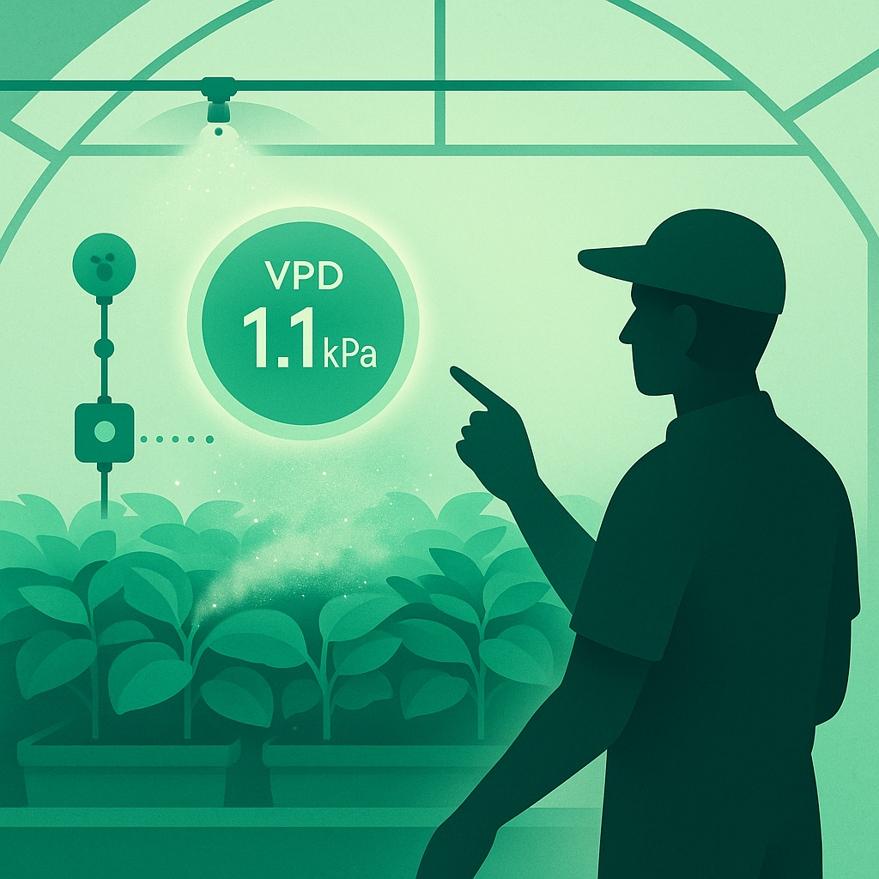
VPD provides a more actionable control metric because it directly quantifies the atmospheric demand for water vapor. At 24°C (75°F), a relative humidity of 55% might keep your plants comfortable. But raise the temperature to 30°C (86°F) while maintaining that same 55% RH, and your plants now face a substantially higher VPD, one that may trigger stomatal closure and stress symptoms.
This is why experienced greenhouse managers increasingly track VPD rather than relying solely on humidity readings. The relationship between temperature, humidity, and plant water demand is dynamic, and your control strategy needs to account for this. When heating systems activate on cold mornings, for instance, air temperature rises but absolute moisture content remains unchanged, causing RH to plummet and VPD to spike. Anticipating these fluctuations allows you to intervene proactively rather than reactively.
"A dry plant is a stalled plant; humidity is the fuel for photosynthesis."
Spot Dry-Air Stress Fast: A Symptoms Checklist
Early detection prevents minor humidity issues from becoming major crop losses. The following signs indicate your plants may be experiencing dry-air stress:
-
Leaf edge browning (necrosis): Margins turn brown and crispy, often appearing first on younger, more actively transpiring leaves
-
Inward curling: Leaves curl upward or inward as tissues lose turgor pressure
-
Brittle texture: Foliage becomes papery and fragile to the touch
-
Stalled new growth:Terminal buds and new leaves fail to develop at expected rates
-
Chronic wilting despite moist media:Plants appear water-stressed even when root zone moisture is adequate
-
Propagation losses spike: Cuttings and young transplants show elevated failure rates
These symptoms often appear first at the leaf margins because that's where transpiration rates are highest relative to the vascular supply. A helpful visual reference is to compare healthy leaves with fully open stomata and uniform green coloration against stressed specimens showing the characteristic marginal browning and inward curl indicative of high VPD conditions. Consider creating a simple diagnostic poster for your propagation bench showing side-by-side comparisons of healthy versus stressed leaves alongside a diagram illustrating open versus closed stomata.

When propagation success rates decline unexpectedly, humidity should be among the first variables you investigate. Young tissue with underdeveloped root systems is particularly vulnerable to atmospheric moisture deficits.
Adding Moisture Without Wet Foliage
Here's where many humidity management strategies fail: they solve the dry-air problem by creating a wet-leaf problem. For most greenhouse production, foliage that remains wet for extended periods becomes vulnerable to fungal diseases, bacterial infections, and a host of other pathogen pressures. The goal is to raise ambient humidity while keeping plant surfaces dry.
High-pressure misting systems accomplish this through flash evaporation when environmental conditions allow. Operating at approximately 1000 PSI, these systems force water through precision nozzles that atomize droplets into particles fine enough to evaporate mid-air before reaching plant surfaces. The physics are straightforward: smaller droplets have higher surface-area-to-volume ratios, which accelerates evaporation. When properly configured and operated within appropriate VPD ranges, the mist adds moisture to the air column without contacting leaves.
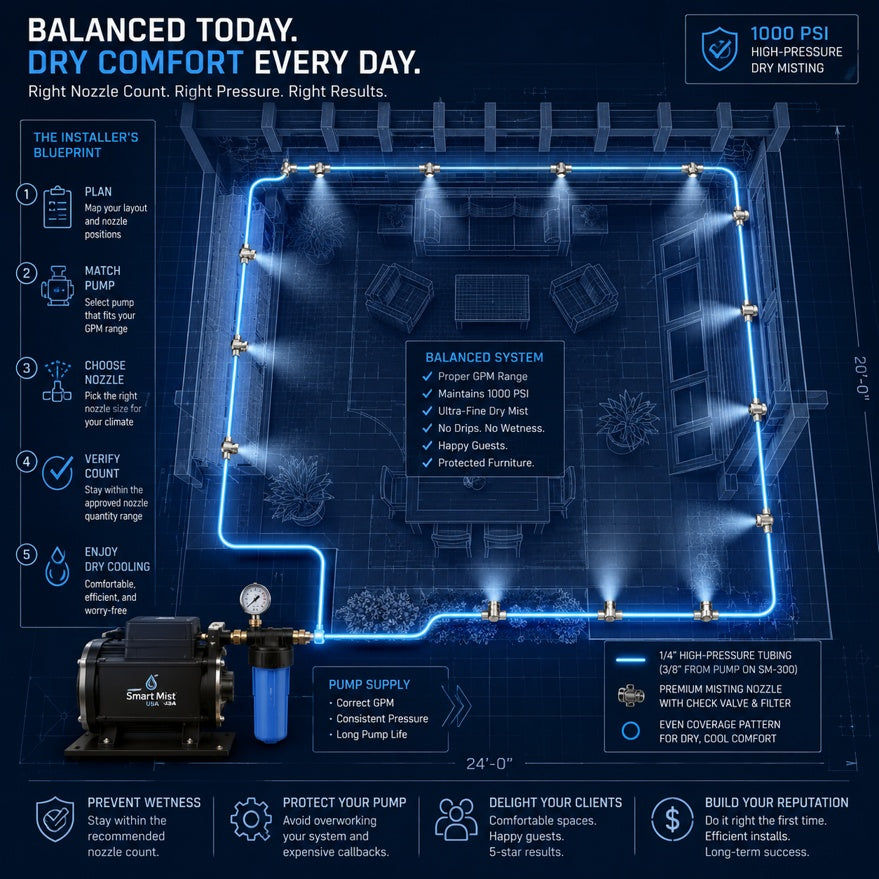
This approach requires understanding the three-component architecture of a proper high-pressure system: the fan unit for air circulation, an external high-pressure pump to generate the necessary pressure, and high-pressure lines connecting the pump to the nozzle array. These components work together but remain separate, each sized appropriately for your specific application.
Flow rate in these systems is determined by nozzle size and nozzle count rather than pump adjustments. Different pump sizes accommodate different total nozzle loads. Pairing our app-controlled pumps with non-misting fans for airflow creates a system where you can schedule intermittent mist cycles that maintain target humidity while ensuring adequate air movement to keep vapor suspended and evenly distributed.
Propagation and Seedlings: Higher Target Humidity Windows
Young plants require gentler VPD conditions than established specimens. Cuttings lack functional root systems to replace transpired water, while seedlings have limited root mass relative to their leaf area. Both situations demand higher ambient humidity to reduce transpiration pressure during these vulnerable growth stages.
Propagation strategies vary depending on your approach. Traditional mist propagation intentionally wets foliage to prevent transpiration entirely until roots develop. The dry-fog approach described here represents an alternative strategy: maintaining high ambient humidity around cuttings without saturating leaf surfaces, which can reduce disease pressure while still supporting rooting. A typical dry-fog propagation bench workflow integrates several elements: warm air temperatures to promote root initiation, shielded airflow to prevent excessive leaf drying, and scheduled high-pressure micro-mist bursts timed to evaporate before contacting foliage.
Humidity requirements typically decrease as root systems develop. A cutting that needs 80-85% RH during initial rooting may transition to 70-75% once roots establish, and eventually to standard greenhouse conditions as it matures into a transplant-ready specimen. Tracking VPD throughout this progression provides more nuanced control than fixed RH setpoints, since temperature conditions on your propagation bench may differ significantly from the rest of your greenhouse.
Monitoring and Controls: Building a Responsive System
Effective humidity management requires accurate data and responsive controls. The foundation is properly calibrated sensors positioned at plant canopy height rather than on greenhouse walls or at ceiling level. Humidity and temperature can vary substantially across vertical gradients, and readings from the wrong location will mislead your control decisions.
Beyond basic sensing, consider implementing humidistat logic that triggers misting cycles based on actual VPD calculations rather than simple humidity thresholds. This approach accounts for the temperature-humidity interaction and provides more consistent conditions across varying ambient temperatures.
A morning ramp protocol illustrates responsive humidity control in practice. As supplemental lighting and heating systems activate at dawn, air temperature rises rapidly. Sensors detect the temperature climbing and calculate VPD trending upward. The controller preemptively triggers short micro-mist bursts coordinated with fan operation, adding moisture to the warming air column before VPD spikes high enough to stress plants. Non-misting fans mix the air so humidity distributes evenly, avoiding pockets of dry air. Rather than reacting to stress symptoms after they appear, you're preventing them entirely. VPD stays inside the target band throughout the morning transition.
Logging VPD data over time reveals patterns that can inform scheduling refinements. You may discover, for example, that conditions become most challenging during specific afternoon hours when heating and ventilation systems interact in particular ways, allowing you to program additional humidity support during those windows.
Water Quality and Maintenance: Protecting Your Investment
Water quality directly impacts both mist quality and equipment longevity. Two filtration concerns deserve attention: sediment and dissolved minerals.
Sediment filtration removes particulates that would otherwise clog precision nozzles. Most high-pressure systems include stainless steel mesh filters as standard equipment, but water sources with elevated particulate loads may benefit from supplementary canister filtration with 5-micron cartridges.
Hard water presents a different challenge. Calcium and other dissolved minerals pass through sediment filters but precipitate inside equipment as scale deposits. Phosphate filters offer one approach to managing hard water by treating it to prevent mineral buildup in pumps, lines, and nozzles. Unlike sediment filters that physically trap particles, phosphate systems use slow-dissolving crystal beads that condition water chemistry. Calcium buildup damages both pump components and nozzle performance, making proper filtration essential for system longevity.
For operations growing sensitive species or those requiring low total dissolved solids—such as orchids, carnivorous plants, or certain tropical specimens—reverse osmosis filtration may be necessary despite higher equipment and operating costs. RO removes dissolved minerals entirely rather than stabilizing them, producing water suitable for species intolerant of residual mineral content. Consult your supplier or extension specialist when selecting filtration for specialty crop applications.
Establish a maintenance calendar that includes quarterly filter inspections and replacements as conditions warrant. Nozzles should be checked regularly for consistent spray patterns and cleaned or replaced when performance degrades. For calcium deposits that do accumulate, CLR solution effectively dissolves mineral buildup without damaging components.
For more detailed guidance on system setup and ongoing care, the installation guides and frequently asked questions resources provide comprehensive reference material.
If You See Wetness: A Troubleshooting Checklist
Wet leaves are a red flag indicating system misconfiguration when your goal is dry-fog humidification. When mist fails to evaporate before reaching plant surfaces, work through these four potential causes in sequence:
-
Climate conditions: Is the ambient environment too humid or too cool for efficient evaporation? High background humidity or low temperatures slow evaporation rates, allowing droplets to travel further before dissipating. Remember that no misting system can force evaporation when air is already near saturation—evaporation is governed by the current VPD, not just system pressure.
-
Mounting height: Are nozzles positioned too close to plant canopy? Insufficient vertical distance reduces the time available for mid-air evaporation.
-
Nozzle size:Are orifices too large for current conditions? Larger nozzles produce larger droplets that require more time and distance to evaporate completely.
-
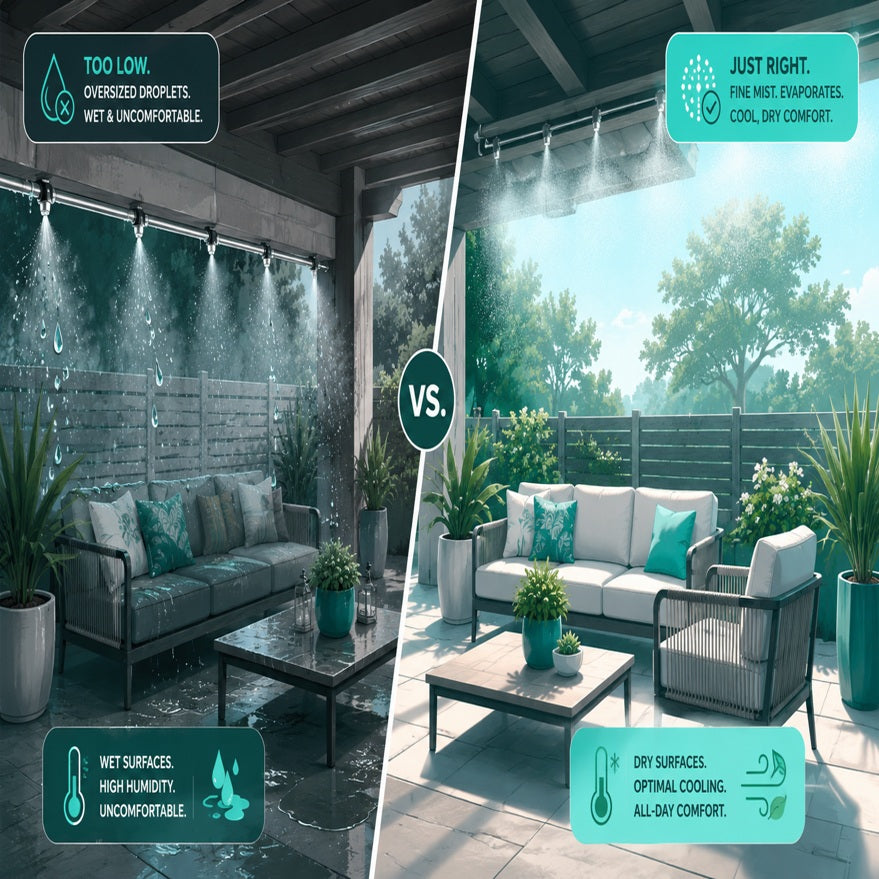
System balance: Is the number or size of nozzles too large for the pump, resulting in low pressure? When the total nozzle load exceeds what the pump can support, operating pressure drops and droplet size increases. The solution involves reducing nozzle count, switching to smaller orifice sizes, or sizing up to an appropriate pump.
Addressing wetness issues systematically ensures you identify the actual cause rather than implementing ineffective fixes. Often, switching to a smaller nozzle orifice or reducing the number of active nozzles resolves the problem without requiring equipment changes.
From Stress to Strength: Your Path Forward
The curled leaves and stalled growth that signaled trouble on that January morning don't have to define your growing season. Understanding the relationship between atmospheric moisture, vapor pressure deficit, and stomatal function transforms humidity from an invisible variable into a manageable one.
Effective greenhouse humidity control systems work by adding moisture while minimizing foliage wetting: high-pressure micro-mist that evaporates mid-air when VPD conditions permit, raising ambient humidity without inviting disease pressure in standard production environments. Combined with accurate monitoring, responsive controls, and proper maintenance, this approach keeps stomata open, gas exchange flowing, and photosynthesis running at full capacity.
Your plants can't tell you when the air is too dry. But now you know how to read the signs, understand the science, and implement solutions that keep growth moving forward through heated winters, arid summers, and everything in between.
Schedule your FREE phone consultation with Jeff to review your layout.
Buy online with same-day processing.
About the Smart Mist USA Insights Team
The Smart Mist USA Insights Team is our dedicated engine for synthesizing complex topics into clear, helpful guides. While our content is thoroughly reviewed for clarity and accuracy, it is for informational purposes and should not replace professional advice.
Disclaimer:This guide is intended as a comprehensive starting point. For decisions specific to your unique situation, we always recommend consulting a qualified professional.