(916) 308-3856



📌Key Takeaways
Automated greenhouse humidity control maintains optimal VPD around the clock, preventing crop stress and disease while freeing staff for strategic work.
-
Sensors Replace Constant Vigilance: Automated systems respond to humidity shifts instantly, catching 2 a.m. spikes that manual monitoring misses.
-
Flash Evaporation Prevents Disease: High-pressure misting at 1000 PSI keeps foliage dry while maintaining target humidity levels throughout the growing space.
-
Precision Cuts Resource Waste: Interval scheduling and smart triggers eliminate overcorrection, reducing water consumption and energy costs by delivering moisture only when needed.
-
Zone Control Scales With Growth: VFD pumps adjust automatically to multi-zone demands, allowing different humidity targets across propagation and finishing areas without equipment strain.
-
Maintenance Beats Monitoring: Weekly sensor calibration and seasonal adjustments replace the unpredictable, labor-intensive demands of manual environmental control.
Automation transforms humidity from a constant worry into a predictable maintenance routine.
Commercial greenhouse growers managing thousands of square feet will gain clarity on implementing reliable environmental control, preparing them for the detailed system specifications and purchasing guidance that follows.
It's 2 a.m. in July.
The temperature outside just spiked unexpectedly, and inside your greenhouse, relative humidity is dropping fast. Your plants are stressed, stomata are closing, and by the time you arrive in the morning, the damage is already done. This scenario plays out in greenhouses across the country every growing season, and it's almost always preventable.
If you've ever walked into your facility to find wilted seedlings, unexpected fungal outbreaks, or crops that just aren't thriving the way they should, you know the frustration. Manual humidity management demands constant vigilance, and even the most dedicated grower can't monitor conditions around the clock.
Automated greenhouse humidity control systems change this equation entirely. By the end of this guide, you'll understand exactly how automation delivers reliable, low-maintenance environmental management that protects your crops while freeing you to focus on what actually grows your business.
What Automated Humidity Control Actually Means
Automated humidity control uses sensors paired with controllers to maintain relative humidity and vapor pressure deficit (VPD) within your target range without constant manual input. Think of it as a thermostat for moisture that never sleeps.
VPD describes how "dry" the air feels to the plant—a combination of temperature and humidity that drives transpiration. When VPD is too low (air is too humid), transpiration and nutrient uptake slow and disease risk rises. When VPD is too high (air is very dry), stomata close and plants can stall or stress. Understanding this relationship explains why precision humidity control matters so much for commercial operations.
These systems continuously monitor environmental conditions and trigger precise responses, whether that means activating misting intervals, adjusting schedules, or shutting down when targets are met. The result is a greenhouse environment that stays within optimal parameters day and night, regardless of external weather shifts or staffing gaps.
For commercial growers managing thousands of square feet, this precision translates directly into healthier crops, reduced losses, and more predictable outcomes.
1) 24/7 Consistency: No Missed Spikes, No Overcorrections
Automation eliminates human error and maintains target humidity levels around the clock.
The reality of manual humidity management is that it depends entirely on someone being present, alert, and making the right call at the right moment. Overnight temperature swings, weekend staffing gaps, and simple human fatigue all create opportunities for conditions to drift outside optimal ranges. By the time the problem becomes visible in your plants, you're already dealing with setbacks that affect yield and quality.
Automated systems with app-controlled pumps solve this by responding to conditions in real time. Features like on/off control, interval spraying, and daily scheduling mean your system adjusts automatically whether you're on-site or not. The advanced timer functionality allows multiple scheduling windows throughout the day, so your greenhouse receives precisely calibrated humidity support during critical periods.
This consistency matters most during transitional seasons when outdoor conditions fluctuate dramatically. A system that catches a 2 a.m. humidity drop and responds with appropriate misting intervals prevents the kind of plant stress that compounds into significant crop losses over time.
2) Drier, Safer Cooling: Control Moisture Without Wetting Foliage

High-pressure micro-mist combined with interval logic delivers flash evaporation that cools air without depositing water on leaves.
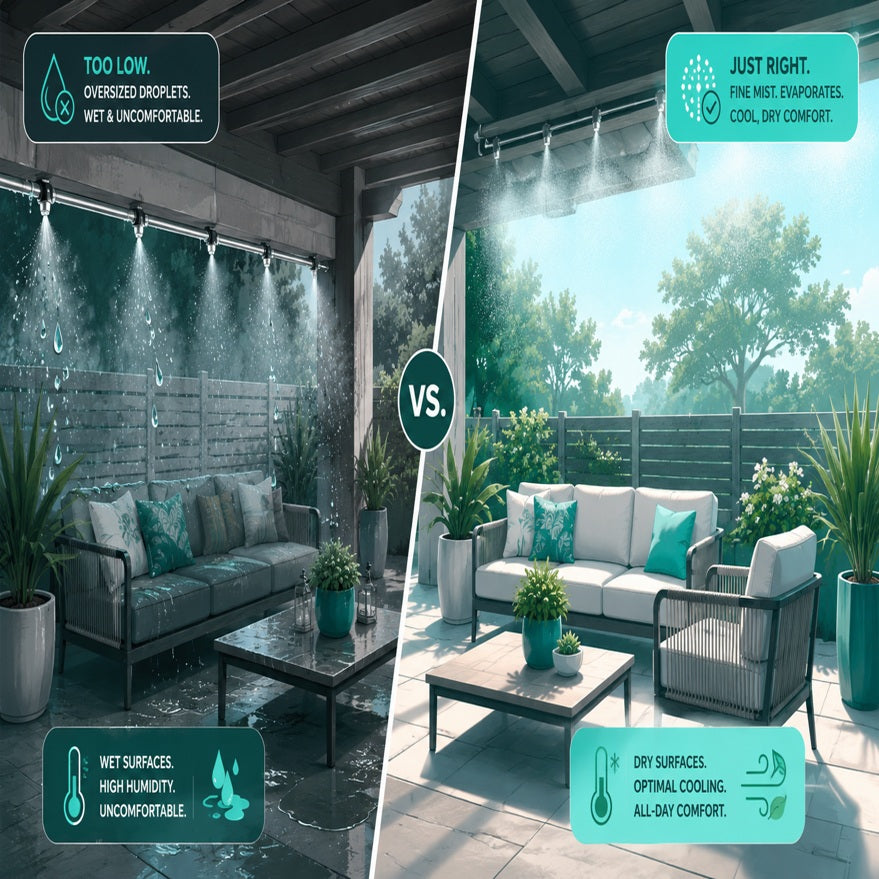
Wet foliage creates conditions that favor fungal disease, and growers managing humidity often face a difficult tradeoff: add moisture to the air and risk promoting pathogen-friendly conditions, or keep plants dry and watch them struggle with transpiration stress. High-pressure misting addresses both concerns simultaneously by controlling ambient humidity levels while keeping leaf surfaces dry.
Systems operating at 1000 PSI generate droplets fine enough to evaporate almost instantly. This evaporative cooling effect can reduce surrounding air temperature by up to 25 degrees under optimal conditions, depending on the difference between dry-bulb and wet-bulb temperature in your local climate. Drier climates with greater "Wet Bulb Depression" will experience the most dramatic cooling, while humid climates may see more modest temperature reduction but still gain crucial humidity regulation benefits. The mist itself never reaches plant surfaces when properly configured.
The science behind flash evaporation explains why pressure matters so much: lower-pressure systems produce larger droplets that will cause wetting on plants and surfaces.
Interval spraying takes this capability further. By setting precise on/off cycles (for example, 3 seconds on and 5-8 seconds off), you can fine-tune moisture delivery based on current conditions. During marginal humidity periods when full continuous misting would cause wetting, interval presets maintain target humidity levels while keeping foliage completely dry.
If leaves ever feel damp, four factors are typically responsible: air temperature is too cool or humidity already too high, circulation fans are mounted too low, nozzle orifices are too large for the conditions, or too many nozzles for the pump capacity are creating pressure drop. Adjusting these factors and tightening intervals brings the system back into true dry cooling mode.
Maintaining proper VPD ranges while keeping foliage dry supports comprehensive disease prevention strategies as part of your integrated pest management approach.
3) Lower Water and Energy Waste: Only the Mist You Need, When You Need It

Precise scheduling and interval control reduce over-spray and unnecessary runtime compared to manual "always on" approaches.
Manual humidity management tends toward overcorrection. When conditions drift out of range, the natural response is to run systems longer or harder than necessary, then compensate in the other direction. This pattern wastes both water and energy while creating the environmental inconsistency that stresses plants.
Automated systems apply humidity in measured doses based on actual conditions rather than operator estimates. For afternoon peaks when humidity demands increase, you can schedule denser interval blocks that deliver more moisture precisely when plants need it most. At night, when transpiration slows and humidity requirements decrease, the system automatically dials back, conserving resources while still maintaining target ranges.
Research supports this efficiency advantage. The USDA's guidance on controlled environment agriculture emphasizes that resource efficiency is becoming increasingly important for commercial growing operations facing rising utility costs and water constraints. Similarly, NYSERDA (New York State Energy Research and Development Authority) research shows that tighter environmental control and energy-focused scheduling can cut unnecessary energy use and improve overall efficiency in greenhouses.
The operational savings compound over time. Reduced water consumption, lower energy bills, and decreased wear on equipment all contribute to better margins, while your plants receive more consistent care than manual management could ever provide.
4) Labor Reallocation: From Monitoring to Managing
Automation frees operators from constant environmental checks so they can focus on crop strategy and high-value tasks.
Every hour your team spends walking rows with a hygrometer or manually adjusting misting schedules is an hour not spent on activities that directly improve crop quality and yield. Propagation, pest scouting, harvest timing, customer relationships: these are the tasks that actually grow a greenhouse business. Environmental monitoring, while essential, is precisely the kind of repetitive, time-sensitive work that machines handle better than humans.
With automated humidity control, your role shifts from reactive monitoring to strategic oversight. Weekly calibration of sensors and filters, seasonal adjustments to scheduling parameters, and occasional system maintenance replace the constant vigilance that manual management demands.
This shift matters especially for smaller operations where owners and managers wear multiple hats. When the humidity system handles itself reliably, you can actually take a day off without worrying about what conditions your plants are experiencing. The maintenance requirements for properly filtered systems are straightforward and predictable, unlike the unpredictable demands of manual environmental control.
For operations in areas with hard water, pairing your system with appropriate phosphate filtration prevents calcium buildup in nozzles and pump components. Distinguishing between basic sediment filtration and hard-water treatment is important here: sediment filters remove particles, while phosphate systems actually treat the water to prevent scale formation. If calcium deposits do occur, CLR solution effectively cleans affected components.
5) Scalable Control: From One Bay to Multi-Zone
Commercial pump options and controls scale with your operation without creating system conflicts or equipment strain.
Growth creates complexity. A humidity solution that works perfectly for a single greenhouse bay can become a bottleneck when you add zones, expand square footage, or diversify crops with different environmental requirements. Systems designed for scalability address this challenge from the start.
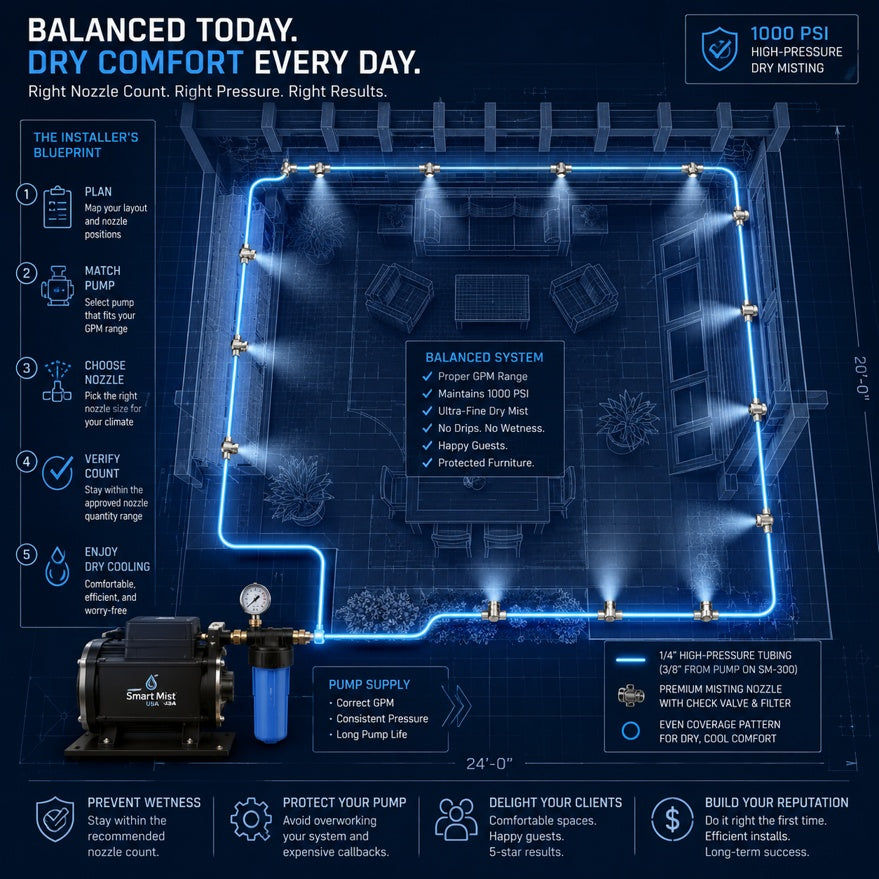
Commercial high-pressure pumps rated for continuous duty handle expanded operations without the overheating concerns that limit residential-grade equipment. These pumps come with 3-year warranties and are built for the demanding cycles commercial growing requires. The right pump size for your operation is determined during initial setup based on two key parameters: nozzle size and total nozzle quantity across all zones.
Our line of commercial pumps includes variable frequency drive (VFD) options that offer particular advantages for multi-zone operations. VFD systems allow you to operate different zones independently or together, shut off sections for maintenance, or accommodate different nozzle configurations across your facility. When zones are activated or deactivated, the VFD automatically adjusts motor speed to match system demand, preventing the motor strain that occurs when fixed-speed pumps work against partially closed systems.
This zone flexibility means you can maintain different humidity targets in propagation areas versus finishing zones, or run some sections while others are shut down for maintenance or crop rotation.
What Automation Looks Like with Smart Mist USA
Implementing automated humidity control involves matching the right equipment to your operation's specific requirements.
App-controlled pumps form the foundation for many commercial greenhouse installations. These systems offer on/off control, adjustable interval spraying, and daily scheduling through a smartphone interface. The Bluetooth control range allows convenient adjustments from anywhere within your facility, while the advanced timer supports multiple scheduling windows for complex environmental programs.
For operations requiring industrial-grade reliability, the commercial pump lineup provides continuous-duty performance with zone flexibility. The three-year warranty on commercial pumps reflects the build quality these systems demand.
The Humidity Control collection includes complete greenhouse misting kits with smart humidity controllers, ranging from entry-level systems to commercial-scale installations. These kits integrate the pump, controller, tubing, fittings, nozzles, and filtration components needed for a complete installation.
Manual vs. Automated Humidity Control
|
Task |
Manual Method |
Automated Method |
Operational Impact |
|---|---|---|---|
|
Overnight monitoring |
Requires staff presence or goes unmonitored |
Continuous sensor-based response |
Prevents overnight humidity drift and plant stress |
|
Responding to weather changes |
Reactive adjustments after conditions shift |
Automatic interval and schedule adaptation |
Maintains target ranges regardless of external conditions |
|
Preventing foliage wetting |
Difficult to calibrate manually; tends toward over/under-misting |
Precision interval control with flash evaporation |
Supports disease prevention by keeping foliage dry while maintaining optimal humidity |
|
Water and energy usage |
Prone to overcorrection and waste |
Measured delivery based on actual demand |
Lower utility costs and resource consumption |
|
Staff time allocation |
Constant monitoring and adjustment |
Periodic calibration and maintenance |
Frees labor for higher-value activities |
|
Scaling to multiple zones |
Requires proportional increase in monitoring effort |
Zone-independent control from central system |
Growth doesn't multiply management complexity |
Frequently Asked Questions
Does automation make plants wetter?
No. High-pressure systems operating at 1000 PSI produce micro-fine droplets that evaporate almost instantly through flash evaporation. Combined with interval spraying that cycles the system on and off, automated humidity control actually keeps foliage drier than manual approaches while still maintaining target humidity levels in the air.
Can I schedule different intervals for day and night?
Yes. App-controlled systems and advanced timers support multiple scheduling windows throughout each 24-hour period. You can program denser misting intervals during peak afternoon demand and lighter cycles overnight when plant transpiration slows, optimizing both humidity levels and resource consumption.
Will automation work with multiple zones as I scale?
Yes. Commercial VFD pump options specifically support multi-zone operations. These systems sense demand based on active nozzle count and adjust automatically, allowing you to operate zones independently, shut down sections for maintenance, or accommodate different humidity targets across your facility without equipment strain.
Your Path to Consistent, Protected Growth
The greenhouse manager who walked in to find stressed plants after that 2 a.m. humidity drop has a different morning now. The system caught the shift, adjusted misting intervals automatically, and maintained conditions within target range until staff arrived. No scrambling, no damage control, no lost crop value.
Automated greenhouse humidity control systems deliver this kind of reliable, low-maintenance environmental management. You gain 24/7 consistency that human monitoring simply cannot match, dry cooling that supports disease prevention as part of comprehensive plant health management, resource efficiency that improves margins, labor freed for strategic work, and scalability that supports growth without proportional complexity.
The technology isn't complicated. It's precision and reliability, applied consistently.
Ready to take the next step?
Ready to discuss your specific operation? Schedule a FREE phone consultation with Jeff to design the right system for your greenhouse.
About the Smart Mist USA Insights Team
The Smart Mist USA Insights Team is our dedicated engine for synthesizing complex topics into clear, helpful guides. While our content is thoroughly reviewed for clarity and accuracy, it is for informational purposes and should not replace professional advice.
Disclaimer:This guide is intended as a comprehensive starting point. For decisions specific to your unique situation, we always recommend consulting a qualified professional.